Benjamin Franklin:
(Boston, 17 January [O.S. 6 January] 1705/6[1] – Philadelphia, 17 April 1790).
One of the Founding Fathers of the United States. He was also an American politician, scientist and moralist. He is the epitome of industriousness and honesty.
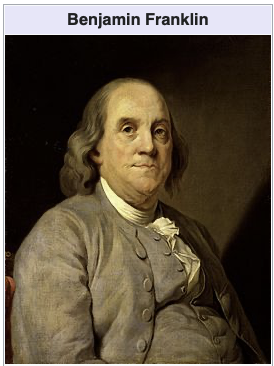
Those willing to give up essential freedom to buy a bit of temporary security deserve neither freedom nor security.
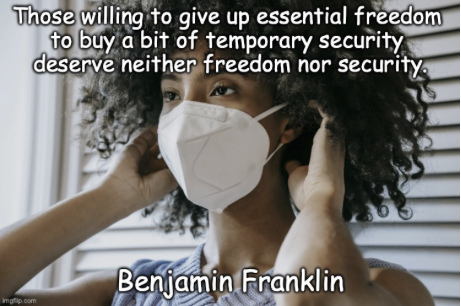
Make yourself sheep and the wolves will eat you.
Without freedom of thought, there can be no such thing as wisdom – and no such thing as public liberty without freedom of speech.

He who sacrifices freedom for security deserves neither.
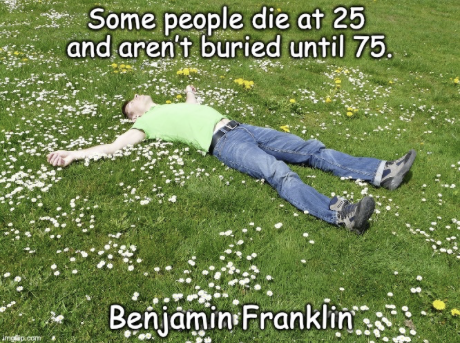
Some people die at 25 and aren’t buried until 75.
Well done is better than well said.
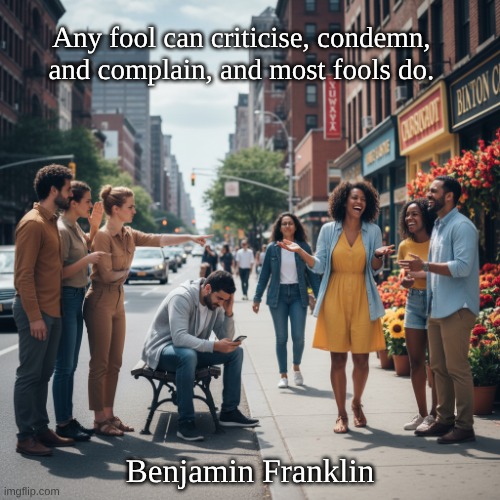
Any fool can criticise, condemn, and complain, and most fools do.
Sloth, like rust, consumes faster than labor wears, while the used key is always bright.
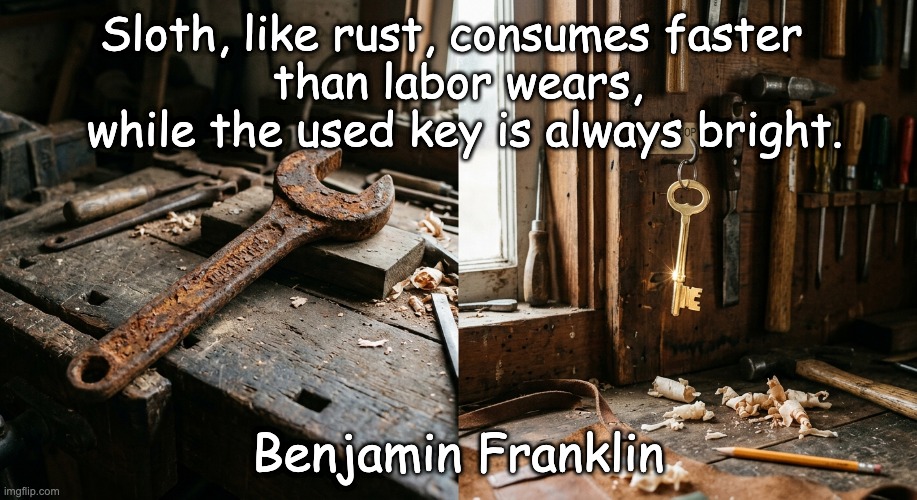
This quote beautifully contrasts the destructive nature of laziness (sloth) with the beneficial effects of activity and hard work.
– ‘Sloth (laziness) is compared to rust.’ Rust, a product of neglect and inaction, eats away at metal, slowly but surely destroying it. Similarly, laziness erodes our skills, potential, and even our character through disuse and decay.
– “Consumes faster than labor wears” suggests that the negative consequences of doing nothing are more rapid and damaging than the gradual “wear and tear” that comes from active, purposeful work. While work might tire us out physically, it keeps us sharp, capable, and productive. Inactivity, on the other hand, leads to stagnation, decay, and a faster decline in our abilities.
– “While the used key is always bright”
This part highlights the positive side of activity. A key that is used frequently is constantly being polished by friction and interaction, keeping it shiny and functional.
In the same way, our skills, talents, and minds are kept sharp and bright through regular use and exercise. Active engagement in work, learning, and life keeps us vibrant, capable, and ready for use.
‘In essence, the quote warns us that inactivity (sloth) is far more damaging in the long run than the effort and exertion of work (labor). It encourages us to stay active, keep our skills sharp, and embrace diligent effort as the path to brightness and success.’
🖋️ Origin and Author:
This quote is widely attributed to Benjamin Franklin.
Where it appeared:
It is most famously found in his annual publication, ‘Poor Richard’s Almanack’, specifically in the 1734 edition. Franklin, writing under the pseudonym “Poor Richard Saunders,” often included aphorisms, proverbs, and witty observations on life, success, and morality.
Context: Franklin was a strong advocate for hard work, frugality, and self-improvement. This particular saying perfectly encapsulates his philosophy on diligence and the dangers of idleness. It reflects the Protestant work ethic that was prevalent in his time and continues to resonate with many today.
While the ‘exact’ wording might vary slightly in different sources, the core message and attribution to Franklin are well-established. It’s a classic example of his ability to convey profound wisdom in a concise and memorable way.
Big ships may venture more, but little boats must keep near shore.
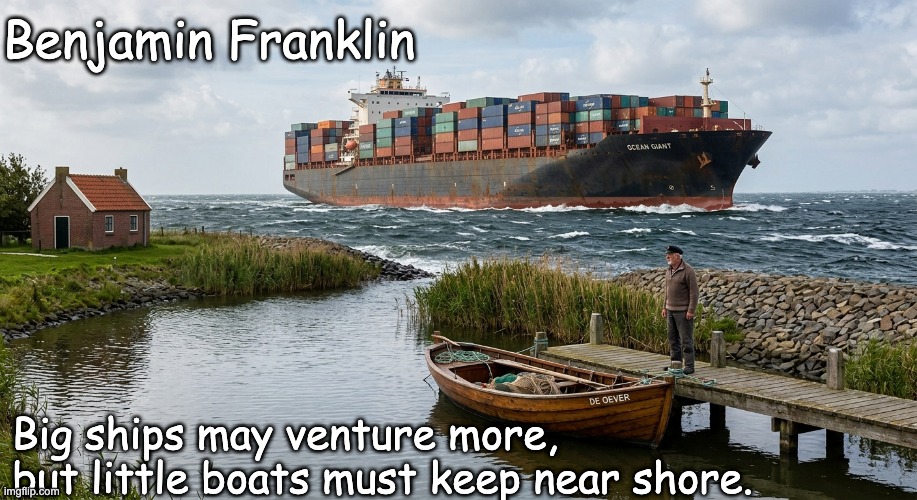
– People or organizations with ‘greater strength, wealth, experience, or resources’ can afford to take bigger risks.
– Those with ‘limited resources or less security’ should be more cautious.
– In simple terms:
don’t take risks beyond your capacity to handle the consequences.
✅ Example:
A large company may invest millions in a risky new project, but a small business should be careful and avoid risking everything.
🌊 Origin:
This saying comes from a traditional nautical metaphor:
– ‘Big ships’ can survive rough seas and long voyages.
– ‘Little boats’ are more vulnerable and safer near the shore.
The best-known earlier form is:
> “Great estates may venture more, but little boats should keep near shore.”
✍️ Author:
The saying is commonly attributed to Benjamin Franklin, who included a version of it in “Poor Richard’s Almanack”, written under the pen name Richard Saunders.
🧠 Core Lesson:
‘Take risks according to your ability to withstand loss.’
The bigger your resources, the more you may safely venture; the smaller your resources, the more careful you should be.
