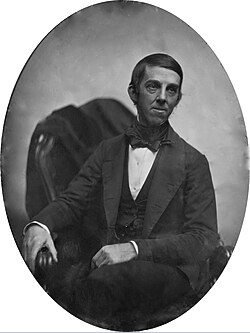
Oliver Wendell Holmes Sr.:
(Cambridge, August 29, 1809 – Cambridge, October 7, 1894)
American physician, poet, professor, lecturer, and author. He was the father of jurist Oliver Wendell Holmes Jr.
October, the extravagant sister.
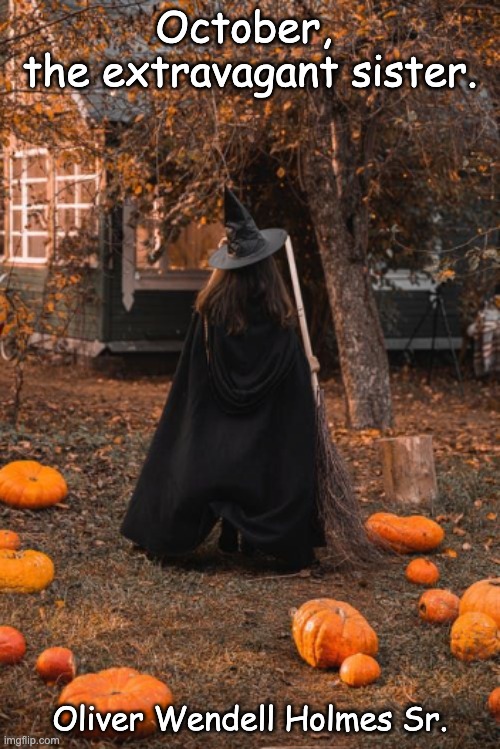
This phrase ‘personifies October as a lavish, showy “sister” among the months’.
– “Extravagant” means rich, luxurious, lavish, or excessive.
– October is called extravagant because in many places it brings:
– brilliant autumn leaves 🍁
– rich harvest colors 🌾
– dramatic seasonal beauty
– a sense of abundance before winter
So the phrase means: ‘October is a beautifully lavish, colorful, and richly decorated month.’
It is ‘not really a common idiom’ in everyday English; it is more of a ‘literary metaphor/personification’.
✍️ Author: Oliver Wendell Holmes Sr. 1809–1894
He was an American:
– physician
– poet
– essayist
– professor
⚠️ He should not be confused with Oliver Wendell Holmes Jr., his son, who was a famous U.S. Supreme Court Justice.
📖 Origin / fuller quotation:
> “October, the extravagant sister, has ordered an immense amount of the most gorgeous forest tapestry for her grand reception.”
The line comes from Holmes’s 19th-century literary prose and is usually cited as one of his descriptions of autumn.
✅ In simple words:
“October, the extravagant sister” means:
> ‘October is like a rich, flamboyant sister who decorates the world with beautiful autumn colors.’
September is dressing herself in showy dahlias and splendid marigolds and starry zinnias.
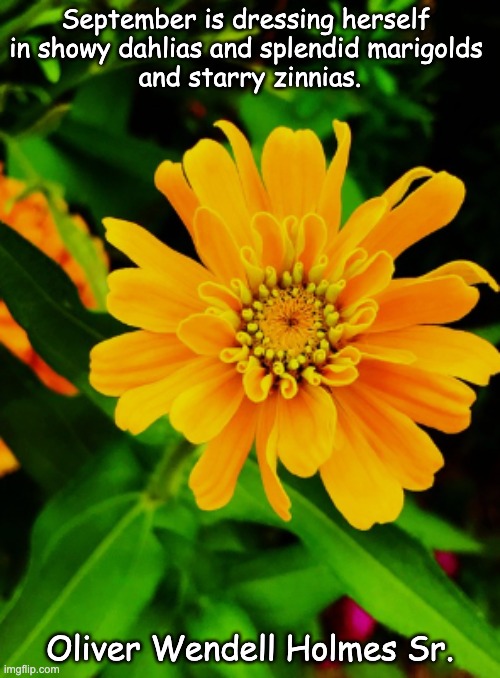
This is ‘not really an idiom’; it is a ‘poetic/literary personification’.
– “September” is imagined as a woman “dressing herself.”
– Her “clothes” are the bright flowers that bloom in late summer and early autumn:
– “dahlias”
– “marigolds”
– “zinnias”
– The sentence means that ‘September is filled with vivid, colorful autumn flowers’, as if the month is adorning itself beautifully.
In simpler words:
> ‘September arrives wearing the bright flowers of late summer and early fall.’
🍂 Literary Effect:
The phrase uses:
– ‘Personification’ — September is treated like a person.
– ‘Imagery’ — the flowers create a colorful visual picture.
– ‘Seasonal symbolism’ — it suggests the transition from summer into autumn.
✍️ Author: Oliver Wendell Holmes Sr.
> American physician, poet, essayist, and lecturer
> 1809–1894
This is ‘not’ Oliver Wendell Holmes Jr., the U.S. Supreme Court Justice.
📚 Origin:
The line appears in quotation collections and seasonal/literary quote lists as attributed to Oliver Wendell Holmes Sr. However, it is best described as a ‘iterary quotation’, not a traditional idiom.
A precise original source—such as a specific poem, essay, or book—is not always clearly cited in modern quote references, so if you need it for academic work, it would be safest to write:
> “Commonly attributed to Oliver Wendell Holmes Sr.”
The foliage has been losing its freshness through the month of August, and here and there, a yellow leaf shows itself like the first gray hair amidst the locks of a beauty who has seen one season too many.
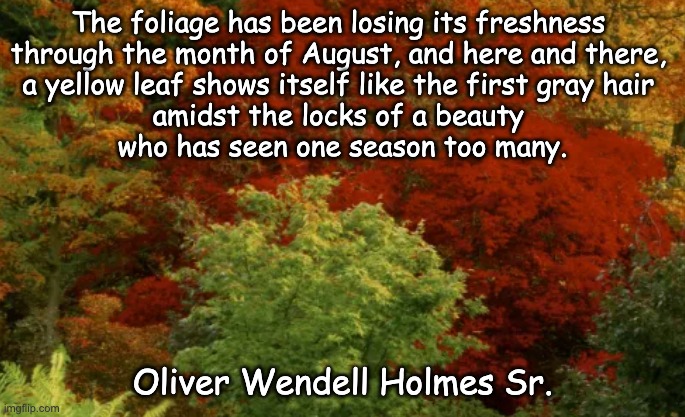
– 🍃 ‘By August, the leaves are no longer as fresh and green as they were earlier in summer.’
– 🍂 ‘A few yellow leaves begin to appear’, signaling the first approach of autumn.
– 👩🦳 The yellow leaf is compared to ’the first gray hair’ in the hair of a still-beautiful woman.
– ⏳ The phrase “who has seen one season too many” means someone or something is ‘beginning to show age’, slightly past its peak freshness or youthful beauty.
So the whole image suggests:
> ‘Nature is still beautiful, but the first signs of aging and decline are beginning to appear.’
📌 Is It an Idiom? Not exactly. It is better described as:
– a ‘literary simile’
– an ‘extended metaphor’
– a poetic way of describing the transition from ‘summer to autumn’.
However, the idea of the “yellow leaf” as a symbol of aging or decline has a long literary history.
✍️ Author and Origin:
The passage is by Oliver Wendell Holmes Sr.
It appears in:
> “The Autocrat of the Breakfast-Table”
> Published in book form in 1858
> First serialized in “The Atlantic Monthly” in 1857–1858
Oliver Wendell Holmes Sr. was an American physician, poet, essayist, and humorist — not to be confused with his son, Oliver Wendell Holmes Jr., the U.S. Supreme Court justice.
🍂 Literary Background: “Yellow Leaf”:
The image of the “yellow leaf” often symbolizes:
– aging
– fading beauty
– autumn
– decline
– approaching death or ending
A famous earlier example appears in Shakespeare’s “Macbeth”, Act 5, Scene 3:
> “My way of life
> Is fall’n into the sere, the yellow leaf…”
Here, Macbeth uses the “yellow leaf” to describe the late stage of life.
Holmes’s passage likely draws on this older literary association, though he gives it a lighter, more elegant seasonal image.
🧠 In Simple Terms:
> ‘Late summer is beginning to look old, just as a beautiful woman might first show age when a gray hair appears.’
It is a poetic observation about ’the first visible signs of decline after a period of beauty and fullness’.
Too young for love? Ah, say not so while daisies bloom and tulips glow! June soon will come with lengthened day to practice all love learned in May.

Core: you are not “too young” to feel love.
Figuration: love belongs to the season and nature (daisies/tulips bloom).
Time metaphor: May = learning/maturing love, June = practicing/developing love through “more daylight/time”.
🕰️ Origin:
The poem is included in: “The Poetical Works of Oliver Wendell Holmes”
Volume 11: “Poems from the Teacups Series”
Online source: Project Gutenberg
👤 Author:
Oliver Wendell Holmes Sr. (so: the father; not Oliver Wendell Holmes Jr., the famous Chief Justice)
June comes in with roses in her hand, but very often, with a thick shawl on her shoulders, and a bad cold in her head.
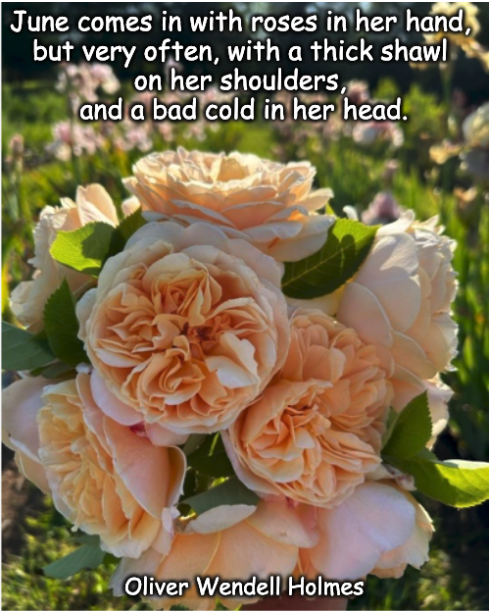
The line means that ‘June may look like summer—full of flowers, roses, and beauty—but it often still feels cold, damp, or changeable’.
– “Roses in her hand” = June brings blossoms, beauty, and the promise of summer.
– “A thick shawl on her shoulders” = the weather may still be chilly.
– “A bad cold in her head” = June can be damp, raw, or unhealthy enough to make people catch colds.
So the idea is: ‘June is outwardly lovely but not always warm or pleasant.’
It is more a ‘literary quotation/personification’ than a true idiom.
Author ✍️: The quotation is generally attributed to Oliver Wendell Holmes Sr.
He was an American physician, poet, essayist, and humorist, not to be confused with his son, Oliver Wendell Holmes Jr., the U.S. Supreme Court justice.
Origin / Source 📚:
The line comes from Holmes’s prose writings, commonly cited from “The Autocrat of the Breakfast-Table” or related “Breakfast-Table” essays, where he often comments humorously on New England life, weather, health, and seasons.
The wording is usually given as:
> “June comes in with roses in her hand, but very often with a thick shawl on her shoulders, and a bad cold in her head.”
Some versions use “hands” instead of “hand.”
In Plain English ✅:
Holmes is joking that ‘June arrives looking beautiful and summery, but it can still be cold and miserable enough to make you sick’ —especially in climates like New England.
Love is the master key that opens the gates of happiness.
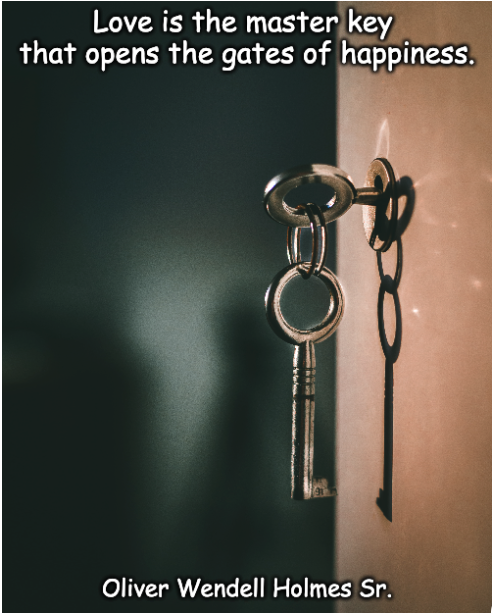
This saying means that ‘love is the essential force that leads to true happiness’.
– A “master key” is a key that can open many locks.
– The “gates of happiness” symbolize access to joy, peace, and fulfillment.
– The message is that ‘loving others and being loved can unlock the deepest forms of happiness in life’.
In simple words:
‘Love makes life happier and more meaningful.’
👤 Author: The quote is most commonly attributed to:
Oliver Wendell Holmes Sr.
– Born: 1809
– Died: 1894
– Nationality: American
– Known as: Physician, poet, essayist, and humorist
⚠️ He should not be confused with Oliver Wendell Holmes Jr., his son, who was a famous U.S. Supreme Court Justice.
📚 Origin:
The saying is generally credited to Oliver Wendell Holmes Sr., though the exact original publication or work in which it appeared is not always clearly cited in modern quote collections.
A common variant is:
> “Love is the master key which opens the gates of happiness.”
So, it is best described as a quote ’traditionally attributed to Oliver Wendell Holmes Sr.
