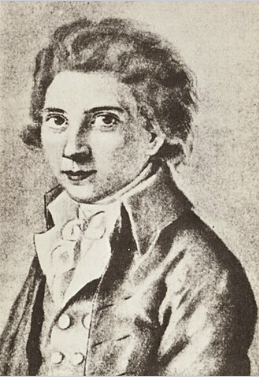
Karl Wilhelm Friedrich (von) Schlegel:
(Hannover, March 10, 1772 – Dresden, January 12, 1829).
German literary figure, literary theorist, art critic, poet, philosopher, and translator. He is considered one of the pioneers of comparative linguistics. By writing and publishing fragments, Schlegel attempted to build a philosophical encyclopedia.[1] Schlegel gave German Romanticism, a term that only came into use around 1810, a political foundation in response to the growing influence of France and Napoleon Bonaparte. Towards the end of his life, he was a defender of the Catholic heritage of the Middle Ages.
A historian is a prophet turned backwards.
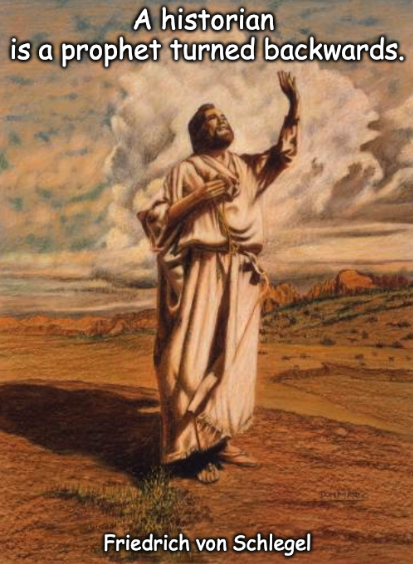
– A ‘prophet’ predicts the future.
– A ‘historian,’ on the other hand, “looks” into the past.
– Both attempt to “interpret” events, recognize connections, and give them meaning.
– The historian is thus a kind of ‘prophet looking backward’:
He explains in retrospect why something happened and what its significance was.
In short:
➡️ ‘The historian interprets the past the way a prophet interprets the future.’
🧠 Origin and author:
The sentence comes from:
Friedrich Schlegel
1772–1829, German writer, philosopher, and literary theorist of the early Romantic period.
The formulation can be found in his “Athenäum Fragments,” which were published in 1798 in the Romantic journal “Athenäum.”
The well-known version reads:
> *”The historian is a prophet looking backward.”
📚 Classification:
The saying is less a folk proverb than an ‘aphorism’ or ‘witty maxim’.
It fits well with the Romantic view of history:
History is not only understood as a collection of facts, but as something that must be interpreted, understood, and placed in a broader context.
The Life and power of poetry consist in its ability to step out of itself, tear off a fragment of religion, and the return into itself and absorb it. So too with philosophy.