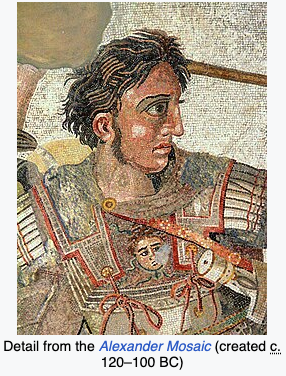
Alexander III of Macedon:
(Pella, 20 July 356 BC — Babylon, 11 June 323 BC)
Better known as Alexander the Great, King of Macedon. He conquered the Persian Empire as far as the Indus, thereby creating one of the greatest empires of antiquity.
I am not afraid of an army of lions led by a sheep; I am afraid of an army of sheep led by a lion.
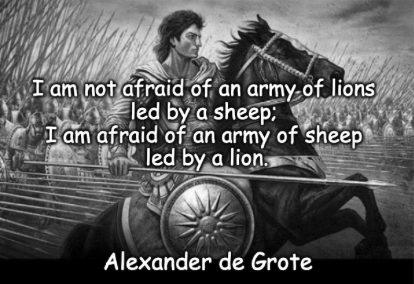
The quote argues that leadership quality matters more than the quality of those being led. A poor leader (“a sheep”) will waste even the most capable people (“lions”), while a strong leader (“a lion”) can turn ordinary people (“sheep”) into an effective force. It’s typically used to make a point about leadership in military, business, or organizational contexts.
Origin:
There’s no solid trail connecting this quote to antiquity in the form it’s usually quoted today:
– The earliest confirmed written version appears as a “proverb” quoted by Agostino Nifo in his 1523 work ‘De Regnandi Peritia’ — nearly two millennia after Alexander’s death — phrased as “An army composed of sheep but led by a lion is more powerful than an army of lions led by a sheep.”
– A similar idea is attributed to Chabrias, an Athenian general (420–357 BC), in the form “an army of deer led by a lion is more to be feared than an army of lions led by a deer.” Since Chabrias died around when Alexander was born, he’s the earliest historical figure to whom any version has been linked — but this attribution also lacks a primary source.
– Some sources claim Polybius reported the saying (attributing it to either Alexander or Chabrias), but the line doesn’t actually appear in Polybius’s surviving works.
– Later variants were claimed to be Arabian in origin, and the “sheep” phrasing has also been attributed to sources in Ghana.
– One researcher tracing the exact modern wording concluded its first clearly documented use may actually belong to Talleyrand (“I am more afraid of one hundred sheep led by a lion than one hundred lions led by a sheep”).
Wikiquote itself flags the Alexander attribution as disputed, with no citation to an original ancient document.
Author:
Most likely ‘not’ Alexander the Great, despite near-universal internet attribution to him. It functions more like a folk proverb that accumulated various forms over centuries and was later — probably apocryphally — pinned on Alexander (as inspiring quotes about leadership and conquest often are), alongside competing attributions to Chabrias, Talleyrand, and Napoleon. If you need a name for citation purposes, “attributed to Alexander the Great” (with the caveat “disputed/unverified”) is the honest framing.
