Edmund Burke:
(Dublin, 12 January 1729 – Beaconsfield, 9 July 1797).
British-Irish philosopher and politician considered the founder of modern conservatism. For the liberal Whigs, he sat in the House of Commons for more than 30 years. Burke is best known for his vigorous opposition to the French Revolution, which he saw as a consequence of the Enlightenment. Above reason, he valued organically grown and divinely sanctioned tradition.
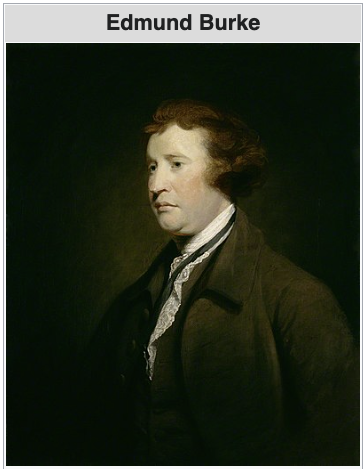
But what is liberty without wisdom and without virtue? It is the greatest of all possible evils; for it is folly, vice, and madness, without tuition or restraint.
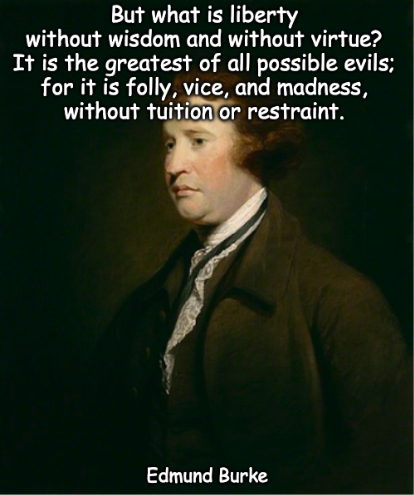
studio of Joshua Reynolds ( 1723 – 1792 ).
Freedom without wisdom is debauchery.

Liberty must be limited in order to be possessed.
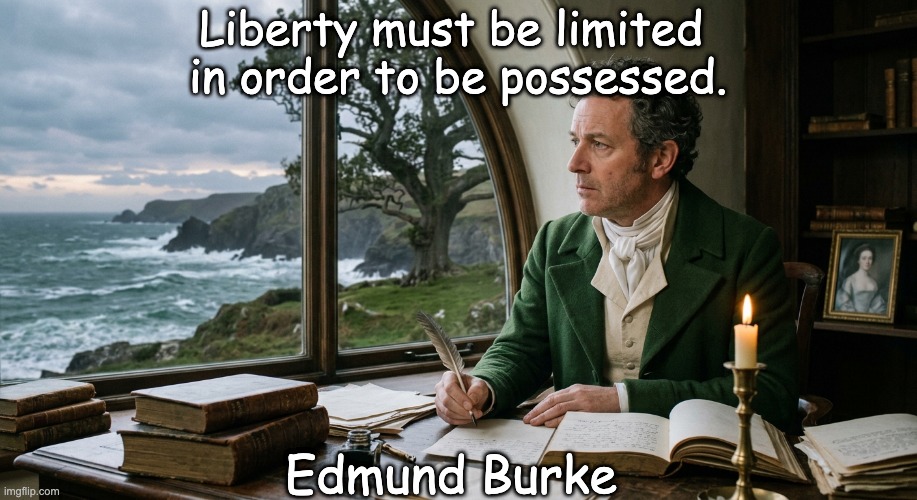
Burke’s argument is that for liberty to be meaningful and possessed (i.e., enjoyed safely and consistently by all citizens), it must be constrained by laws, social order, and moral responsibility.
The Paradox of Absolute Freedom:
If every individual has total, unlimited freedom, their freedoms will inevitably clash. The “liberty” of the strong to oppress the weak would destroy the liberty of the weak.
Ordered Liberty:
Burke advocates for “ordered liberty.” This means that we voluntarily accept certain restrictions (like laws against theft or violence) because these limits are precisely what protect our own rights and property.
A Balance:
The phrase emphasizes that true freedom is not the absence of restraint, but rather the existence of just restraints that prevent chaos and ensure mutual respect.
The core meaning explores the fundamental paradox of freedom. It suggests that absolute, unrestrained liberty is unsustainable in a functioning society.
🏛️ Origin and Context:
The exact quote, or a very close variation, appears in Burke’s seminal work, “Reflections on the Revolution in France” (1790).
The French Revolution:
Burke was writing as a critic of the unfolding French Revolution. He argued that the revolutionaries, in their pursuit of abstract, absolute “rights of man” and “liberty,” were tearing down the necessary social and political institutions (the monarchy, the church, established law) that actually made liberty possible.
Abstract vs. Practical Liberty:
He believed the French approach was reckless and would lead to anarchy and tyranny (a prediction that proved prescient). Burke contrasted this with the British model of gradual, evolutionary reform, which he argued preserved liberty by anchoring it in established traditions and institutions.
Author:
This famous quote is attributed to Edmund Burke, an Anglo-Irish statesman, author, and philosopher widely regarded as the founder of modern conservatism.
