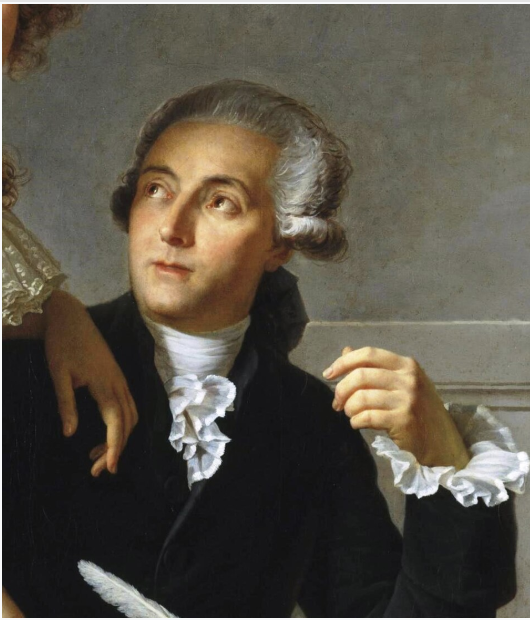
Antoine Laurent Lavoisier:
(Paris, August 26, 1743 – ibid., May 8, 1794).
A French chemist who also made significant contributions to other branches of science. In the field of chemistry, he formulated the law of conservation of mass and discovered that oxygen plays an essential role in combustion. He brought about a revolution in chemical nomenclature and is often regarded as the father of modern chemistry.
Nothing is created, nothing is lost.
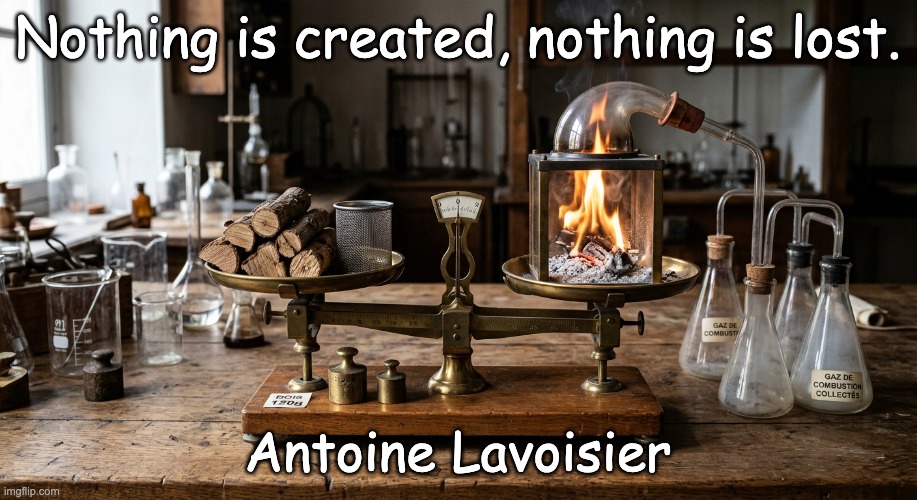
– Conservation of mass:
Nothing is created, nothing is lost; everything is transformed. This means that matter cannot be created or destroyed, but only transformed from one form into another.
– Example:
When you burn wood, the total mass of the wood and the oxygen before combustion is equal to the total mass of the ash, carbon dioxide, and water vapor produced after combustion.
Origin:
– Law of conservation of mass:
The statement is a paraphrase of the law of conservation of mass, formulated by the French chemist Antoine Lavoisier in the 18th century. This law stipulates that the total mass of the reactants in a chemical reaction is equal to the total mass of the products.
Author: Antoine Lavoisier.
Although the phrase itself is not a direct quote from Lavoisier, he is credited with discovering and formulating the underlying principle.
