Harold “Hal” Glen Borland:
Hal Borland (1900–1978)
Celebrated American author, journalist, and naturalist best known for his nature writing and, specifically, his “outdoor editorial” columns in The New York Times. For over 37 years, he wrote weekly, nature-focused,, and observational essays for the Sunday edition, providing, in his words, “a weekly report on what’s going on up country”
There are two seasonal diversions that can ease the bite of any winter. One is the January thaw. The other is the seed catalogs.
No winter lasts forever; no spring skips its turn.
Year’s end is neither an end nor a beginning, but a going on—with all the wisdom that experience can instill in us.
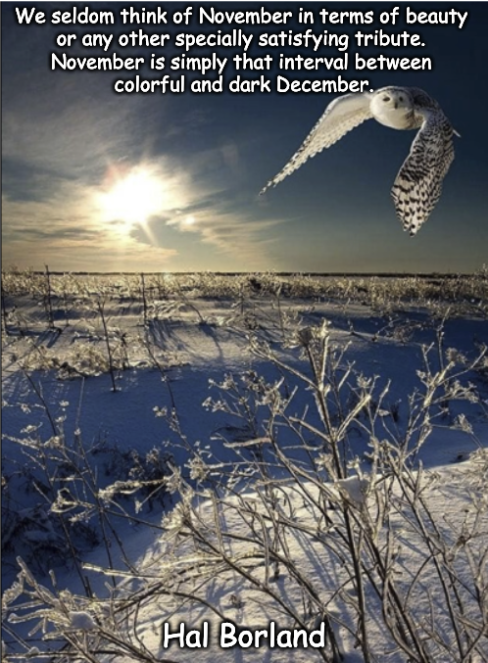
We seldom think of November in terms of beauty or any other specially satisfying tribute. November is simply that interval between colorful and dark December.
There is the touch of November in the air, chill enough to have a slight tang, like properly aged cider. Not air that caresses, nor yet air that nips. Air that makes one breathe deeply and think of spring water and walk briskly.
October is a fallen leaf, but it is also the wider horizon more clearly seen. It is the distant hill once more in sight, and the enduring constellations above that hill once again.

🍁 The Core Metaphor:
– ‘The fallen leaf’ symbolizes loss and transience — the end of summer’s abundance
– ‘The broader horizon’ represents a new perspective that arises precisely because of this loss
– ‘The distant hills’ represent permanence — something that was always there, but temporarily obscured by the dense summer foliage
– ‘The constellations’ reinforce the cosmic, eternal element — which persists despite seasonal changes
🧠 The Philosophical Layer:
In the full context of the chapter “Autumn Is for Understanding”, this appears not to be an isolated image of nature, but the final piece of a broader argument:
– 🌾 Autumn is a moment of ‘rest after the harvest’
— the pressure drops
– 👁️ Space is created to “look at the distant hills”
— space for longer, deeper thoughts
– 🔄 The great ‘rhythms of seasons and years’ penetrate the soul, instead of the short-breathed rhythms of busy days
– 🎯 Key message:
Just as nature “defoliates” to its essence in the fall, the human mind can strip away superficial concerns to see the larger, lasting patterns of life
In summary:
Loss and reduction paradoxically reveal a greater, timeless truth that was always there.
📚 Origin:
📖 Book: “Sundial of the Seasons”
📄 Chapter: “Autumn Is for Understanding”
📅 Section: October
📍 Position: Closing sentence of the chapter
🔍 Verification process:
1. 🌐 Quote first found on ‘quoteambition.com’ (with slight deviation: “hill” instead of “hills”)
2. 📘 Confirmed via the original book
— a photo of the source text showed the authentic, complete passage
3. ✅ This confirms that it is an ‘authentic Borland quote’, although slightly different versions are circulating online
✍️ Author: Hal Borland (1900–1978)
👤 Who Was He?
– 🇺🇸 American writer, journalist and natural thinker
– 📰 For decades he wrote ‘weekly nature essays’ for ‘The New York Times’
– 📚 Known for books such as “Sundial of the Seasons” and “Twelve Moons of the Year”
✒️His Style:
– Short, lyrical reflections on seasonal changes
– Accurate nature observations (bird migration, leaf fall, constellations) linked to ‘greater philosophical insights’.
– Repeated themes: transience versus continuity, humans as part of natural cycles.
✅ Conclusion:
This quote is a “fully authenticated, authentic Hal Borland quote,” taken from his book “Sundial of the Seasons.” The meaning goes further than a beautiful autumn image:
It is a philosophical invitation, like nature in October, to let go of the noise of everyday life and see the enduring, larger patterns of existence. 🌟
Some of the rarest days of the year come in September, days when it is comfortably cool but pulsing with life.
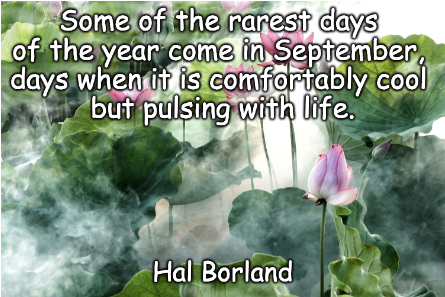
The saying celebrates the special character of certain September days:
– The oppressive heat of summer has passed, so the weather is pleasantly cool.
– Nature is still active—birds, insects, plants, and autumn colors create a sense of energy.
– “Rarest” means unusually precious or exceptional, not literally uncommon calendar days.
– It captures September as a brief balance between summer’s vitality and autumn’s coolness.
✍️ Author:
The quotation is generally attributed to Hal Borland (1900–1978), an American writer, journalist, and naturalist known for his reflections on the seasons.
📚 Origin:
It is commonly traced to Borland’s seasonal nature writing, particularly “Sundial of the Seasons” (1964),
a collection of his outdoor editorials, many originally published in “The New York Times”.
The line is therefore not an old proverb but a literary observation about early autumn. Exact wording may vary slightly across quotation collections.
September is more than a month, really; it is a season, an achievement in itself. It begins with August’s leftovers and it ends with October’s preparations.
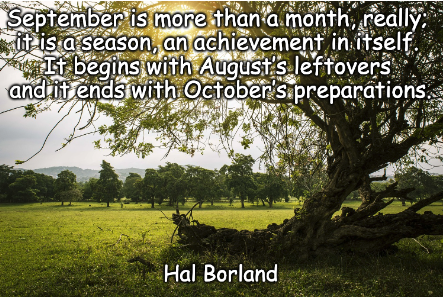
Borland presents ‘September as a transitional season rather than merely one calendar month’:
– “August’s leftovers” refers to lingering summer warmth, vegetation, harvests, and habits.
– “October’s preparations” suggests falling leaves, cooler weather, shortening days, and nature preparing for late autumn and winter.
– Calling September “an achievement in itself” emphasizes its distinct character: it is the culmination of summer’s growth and the beginning of autumnal maturity.
The observation reflects the seasonal cycle of the ‘Northern Hemisphere’, particularly the rural New England landscape Borland frequently described.
✍️ Author and origin:
The quotation is correctly attributed to Hal Borland (1900–1978), an American nature writer and longtime editorial writer for “The New York Times”.
It appears in:
> “Hal Borland, ‘Sundial of the Seasons’ (1964), September 1 entry”.
The book is a collection of Borland’s short nature editorials, many originally written for “The New York Times”. Thus, the 1964 collection is a reliable printed source, although the passage may have appeared earlier as one of his newspaper editorials.
September is here, and summer thins away.
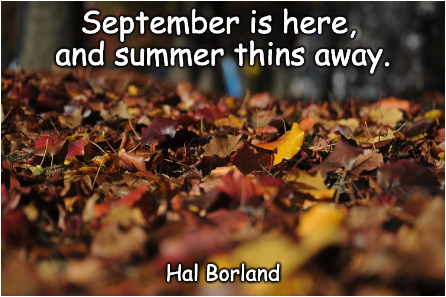
The line describes summer ‘gradually fading rather than ending abruptly’. In September—especially in the Northern Hemisphere—the days shorten, temperatures soften, vegetation begins to change, and the signs of autumn become more noticeable.
The verb “thins” is metaphorical: summer seems to lose its fullness and intensity, becoming less substantial day by day.
✍️ Author and origin:
The quotation is ‘widely attributed to Hal Borland’ (1900–1978), an American nature writer and longtime writer of outdoor editorials for “The New York Times”.
It is likely drawn from one of his brief seasonal essays or editorials. Many such pieces were later collected in books including:
– ‘Sundial of the Seasons’ (1964)
– ‘An American Year’
– ‘This Hill, This Valley’
However, online quotation collections generally give the sentence ‘without an essay title, publication date, or page number’, so its precise first appearance is difficult to establish. Thus:
– Attribution to Hal Borland:
very likely and generally accepted
– Exact original source:
not securely documented in common references
– Not an old proverb:
it appears to be a literary observation by Borland
A cautious citation would therefore be:
> “September is here, and summer thins away.” — Hal Borland, attributed.
July is a picnic and a red canoe and a sunburned neck and a softball game and ice tinkling in a tall glass.
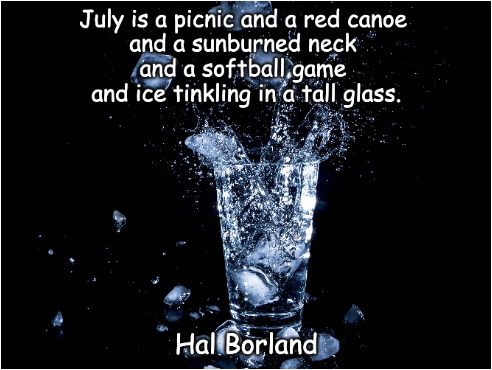
The quote means that ‘July’ is evoked as a series of typical summer experiences and images:
– 🧺 ‘a picnic’ — eating outdoors, relaxation, socializing
– 🛶 ‘a red canoe’ — vacation, water, adventure
– ☀️ ‘a sunburned neck’ — bright summer sun, spending a lot of time outdoors
– 🥎 ‘a softball game’ — summer sports and village life, especially American
– 🧊 ‘clinking ice in a tall glass’ — cooling, quenching thirst, summer drinks
In short: it is a ‘poetic description of July as a warm, lively summer month full of outdoor life and nostalgia’.
Origin 📚:
The quote is often found in collections of seasonal quotes and observations on nature. It belongs to the American tradition of ‘nature writing’: short, evocative texts about nature, the weather, and the seasons.
Author ✍️:
The quote is generally attributed to Hal Borland.
Hal Borland was an American writer, journalist, and nature columnist:
– Full name: Harold Glen Borland
– Born: 1900
– Died: 1978
– Known for his nature and seasonal columns, including for “The New York Times”.
A small side note: although the quote is frequently attributed to Hal Borland, the exact original publication is not always easy to verify in online sources.
July is the high noon of the northern year, firefly nights, and corn growing so fast out in Iowa that you can hear its joints pop in the moonlight.
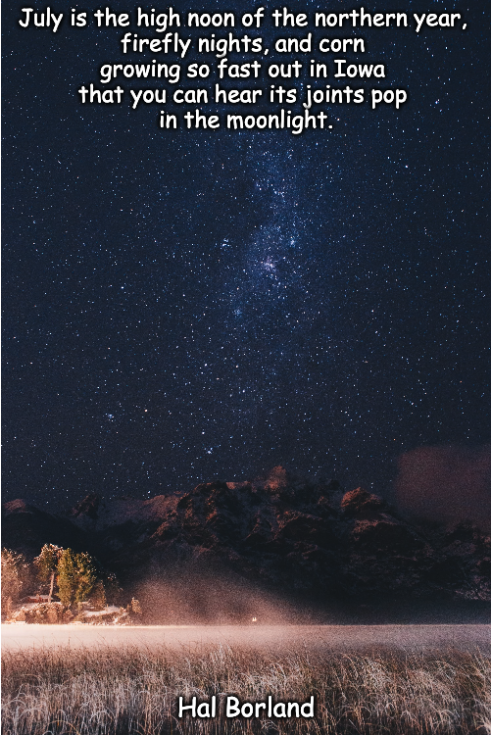
Borland casts July as the peak of the year — “high noon” evokes both the sun at its highest point and the year at its midpoint of vitality and energy. “Firefly nights” captures the defining sensory image of a Midwestern summer evening. The closing image — Iowa corn growing so fast you can “hear its joints pop” — draws on old Midwestern farmer’s folklore about audible corn growth, using it as a vivid symbol of the season’s overflowing fertility and abundance. Interestingly, this bit of folklore has some real basis: researchers have recorded actual crackling sounds from corn stalks, caused by tiny fractures as the plant rapidly stretches and grows.
Origin:
The line almost certainly comes from one of Borland’s original nature editorials for “The New York Times”, where he wrote a long-running Sunday column on the natural world for decades. The telltale sign is the word “Ioway” (an old, folksy spelling of “Iowa”) preserved in careful quotation sources — this archaic spelling suggests it’s an exact quote from his original writing rather than a modern paraphrase. Much of his best material, including this line, was later collected in anthologies such as “Sundial of the Seasons” and, posthumously, “Twelve Moons of the Year” (1979), a selection of 365 short pieces chosen by Borland and his wife, Barbara Dodge Borland. I wasn’t able to pin down the exact column and publication year it first appeared in.
Author: Hal Borland (1900–1978)
American writer, journalist, and naturalist. He was a longtime staff writer and editorialist for “The New York Times”, known for his nature essays, and also wrote novels (including the bestseller “When the Legends Die”), memoirs, and young-adult books. He considered himself a “natural philosopher,” exploring how human life is bound to the natural world.
July is a blind date with summer.

An Unpredictable and exciting Encounter.
This charming idiom perfectly captures the essence of July, blending anticipation with the unpredictable nature of the season.
This idiom beautifully compares the month of July to a blind date with the season of summer itself. Here’s a breakdown of the imagery:
The Blind Date:
A blind date is filled with anticipation, excitement, and a touch of nervousness. You don’t know exactly what to expect from your companion – will they be charming, adventurous, or perhaps a little intense?
Summer’s Personality:
July represents the peak of summer, a time when the season truly reveals its full character. It’s often associated with long, sunny days, heatwaves, unexpected thunderstorms, and a vibrant energy.
The Metaphor:
Just as you approach a blind date with an open mind, ready for whatever the encounter brings, we approach July with a sense of wonder and readiness for summer’s unpredictable nature. Will it be a month of endless beach days, cozy evenings, or perhaps some dramatic weather events? We embrace the excitement of the unknown.
🕰️ Origin:
While the exact origin of this specific idiom is difficult to pinpoint with absolute certainty, its roots are often traced back to the writings of Hal Borland.
Hal Borland (1900-1978) was an American author and naturalist known for his evocative nature writing, particularly his “outdoor editorials” for “The New York Times”. His work celebrated the changing seasons and the beauty of the natural world, often using poetic language and insightful observations.
✍️ Autor: Hal Borland: The Master of Seasonal Descriptions.
Although the exact phrase “July is a blind date with summer” might not be found verbatim in one of his published works, it aligns perfectly with Borland’s style and themes. He frequently used metaphors and personification to bring the seasons to life, and the idea of summer as an unpredictable, almost personified entity resonates strongly with his writing.
It’s highly likely that the idiom evolved from Borland’s wider body of work, perhaps as a paraphrase or a summation of his descriptions of July. His writing often captured the essence of each month, highlighting its unique character and the feelings it evokes.
Summer is a promissory note signed in June, its long days spent and gone before you know it and due to be repaid next January.
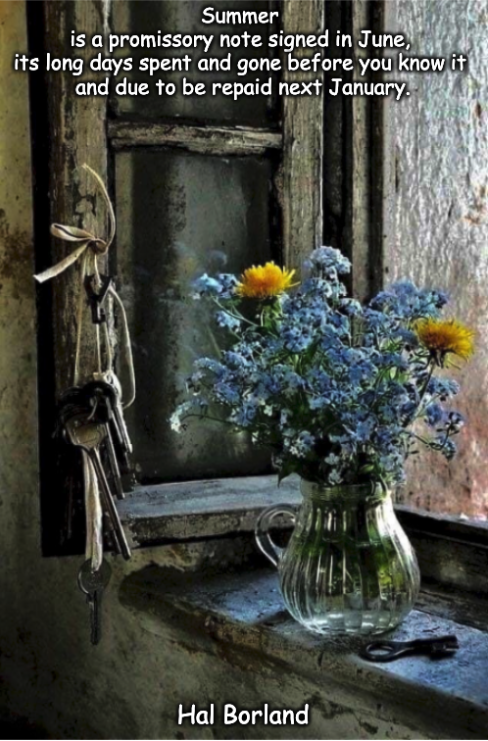
The image revolves around a “promissory note” / confession of debt:
– In “June”, you “sign” a promise, as it were:
– long days
– warmth
– holiday feeling
– abundance of light
– But that abundance is ’temporary’:
– summer flies by
– before you know it, the days are getting shorter again
– In “January”, the “bill” arrives:
– cold
– darkness
– austerity
– the loss of summer
💡 Free interpretation
The saying actually says:
> Summer feels like a delightful advance on happiness, but nature later reclaims its balance.
It is therefore a “poetic metaphor” for:
– the transience of beautiful periods
– the seasonal cycle
– the idea that abundance is often followed by scarcity
✍️ Author: Hal Borland 🌿
– American writer and journalist
– lived off 1900 to 1978
– primarily known for:
– nature descriptions
– seasons
– rural life
– contemplative, aphoristic statements
The style of this quote also suits him very well:
– nature-related
– melancholic
– vivid
– seasonal-philosophical
📚 Origin:
– The quote is ‘originally English’
– The well-known form is:
> “Summer is a promissory note signed in June…”
– It is usually attributed to Hal Borland in anthologies, quote collections, and online sources. What is less certain:
– The “exact first source” — for example:
– a specific book
– a newspaper column
– an essay
– This is often ‘not consistently included’ with the quote.
April is a promise that May is bound to keep.
March is a tomboy with tousled hair, a mischievous smile, mud on her shoes and a laugh in her voice.
Language: Originally, the quote was written in English: “March is a tomboy with tousled hair, a mischievous smile, mud on her shoes and a laugh in her voice.”
The “dog days” are over, and here comes September. Not autumn yet; simply September, which can be as sweltering as mid-July and as chill as late October, and usually manages to be both.
Borland is describing September as a ’transitional and unpredictable month’:
– The most oppressive period of summer—the “dog days”—has supposedly ended.
– Yet September is not fully autumn.
– It can still produce July-like heat, followed by October-like cold, sometimes within a short period.
Author and source:
The quotation is attributed to Hal Borland (1900–1978), an American nature writer and longtime editorial writer for “The New York Times”.
It is associated with Borland’s short seasonal or “outdoor” editorials for the newspaper and is also commonly linked to collections of that writing, particularly:
> “Sundial of the Seasons: A Selection of Outdoor Editorials from The New York Times”.
> by Hal Borland, published in 1964.
Thus, it is ‘not an old anonymous saying’ but a passage by Borland, apparently originating in or preserved from his “New York Times” nature writing. Online quotation sites often reproduce it without the exact original newspaper date.
Origin of “dog days” 🐕⭐:
The expression “dog days” is much older. It comes from the ancient Greek and Roman association of the hottest part of summer with ‘Sirius’, the “Dog Star,” in the constellation ‘Canis Major’. Its appearance near the Sun was traditionally connected with intense summer heat.
