Tegen de verkeerde boom blaffen.

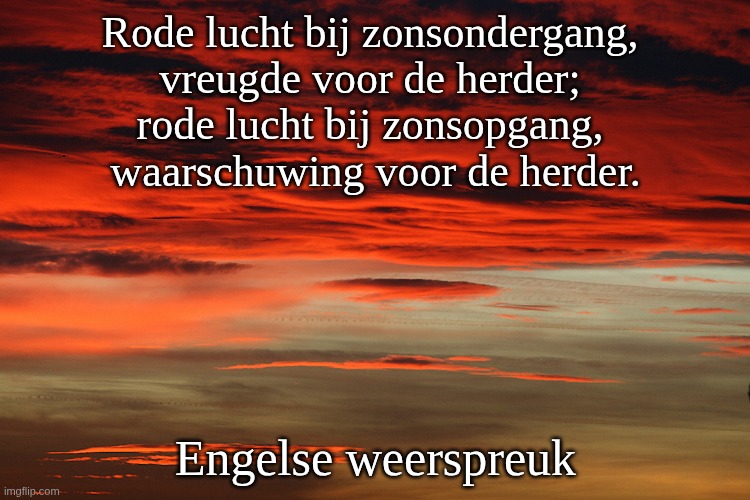
Rode lucht bij zonsondergang, vreugde voor de herder; rode lucht bij zonsopgang, waarschuwing voor de herder.
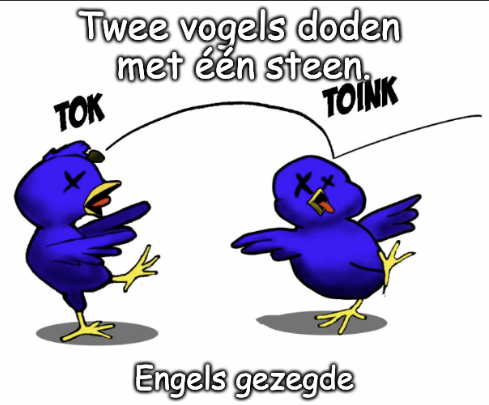
Twee vogels doden met één steen.
Hij die in de vallei blijft, zal nooit over de heuvel heen komen.

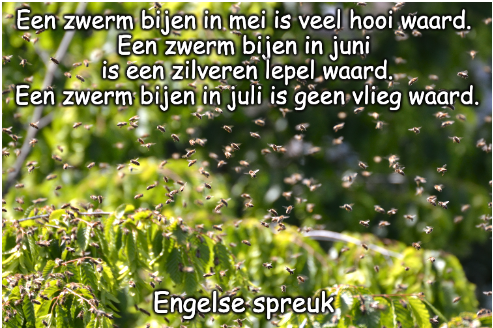
Een zwerm bijen in mei is veel hooi waard. Een zwerm bijen in juni is een zilveren lepel waard. Een zwerm bijen in juli is geen vlieg waard.
– ‘Een bijenzwerm vroeg in het seizoen is veel waard’, omdat de bijen nog genoeg tijd hebben om:
– raten te bouwen,
– voedsel te verzamelen,
– uit te groeien tot een sterke kolonie,
– eventueel nog honing op te leveren vóór de winter.
– “Een zwerm in mei” is daarom “een vracht/hoop hooi waard”: zeer waardevol.
– ‘Een zwerm in juni’ is nog nuttig, maar minder waardevol: “een zilveren lepel waard”.
– ‘Een zwerm in juli’ komt te laat: die heeft vaak te weinig tijd om sterk te worden of wintervoorraad op te bouwen, en is daarom “geen vlieg waard”.
Kort gezegd: ‘hoe vroeger de bijenzwerm, hoe waardevoller voor de imker’.
🇬🇧 Engelse oorsprong:
Dit is vrijwel zeker een vertaling van een oude Engelse bijenhoudersspreuk:
> A swarm of bees in May
> is worth a load of hay;
> A swarm of bees in June
> is worth a silver spoon;
> A swarm of bees in July
> is not worth a fly.
Ook komt de kortere vorm voor:
> A swarm in May is worth a load of hay;
> a swarm in June is worth a silver spoon;
> a swarm in July is not worth a fly.
📜 Oorsprong en auteur:
– De spreuk is ‘anoniem’.
– Het is een ’traditioneel Engels volksgezegde’ uit de bijenteelt.
– Er is dus geen bekende “auteur” in literaire zin.
– De spreuk werd opgenomen in Engelse spreekwoorden- en landbouwverzamelingen, onder meer toegeschreven aan de traditie die ook door verzamelaars zoals John Ray werd vastgelegd in “A Collection of English Proverbs” uit de 17e eeuw.
Belangrijk: ‘John Ray was niet de bedenker’, maar een verzamelaar van bestaande Engelse spreekwoorden.
🌾 Waarom “hooi”, “zilveren lepel” en “vlieg”?
De beelden zijn vooral gekozen om hun ‘rijm en herkenbaarheid’:
– “hay / May”
– “June / spoon”
– “July / fly”
Maar ze drukken ook een waardeschaal uit:
1. “load of hay” – grote praktische waarde in een agrarische samenleving;
2. “silver spoon” – nog steeds waardevol, maar kleiner;
3. “fly” – vrijwel niets waard.
🐝 Moderne kanttekening:
Voor moderne imkers is de spreuk niet altijd letterlijk waar. Met voeren, kastbeheer en kunstzwermen kan een late zwerm soms nog worden gered. Toch blijft de kern juist:
> ‘Een vroege zwerm heeft veel meer kans om uit te groeien tot een sterke, productieve bijenvolk dan een late zwerm.’
Het was in de vrolijke maand mei toen bloemen bloeiden, en lieve William op zijn sterfbed lag voor de liefde van Barbara Allen.

These lines immediately set the tone of the song:
– “the cheerful month of May” and ‘blooming flowers’ evoke an image of:
– spring
– youth
– love
– new life
– In contrast stands:
– William on his deathbed
– dying of heartbreak
– because of Barbara Allen
🎭 Contrast:
The power of the opening lies in the contrast between:
– vibrant nature
– and death / unrequited love
That makes the ballad immediately tragic:
while everything in nature is blooming, William is dying of heartbreak.
🏰 Origin:
“Barbara Allen” is an ‘old English folk ballad’ from the tradition of:
– Scotland
– England
– later also Ireland and North America
📜 Historical background:
– The ballad has been known since the 17th century. – One of the earliest mentions appears in the diary of Samuel Pepys from 1666, where he mentions a “little Scottish song” about Barbara Allen.
– The text later appeared in various ‘broadsides’ and oral variants.
🎶 Folk song tradition:
Because it is a folk ballad:
– there are ‘many different versions’
– rules vary by region
– names, place names, and formulations sometimes change
The English version of the quote often reads approximately:
> “It was in the merry month of May,
When green buds they were swelling,
Sweet William on his death-bed lay,
For love of Barbara Allen.”
✍️ Author: There is ‘no certain, known author’. – “Barbara Allen” is an ‘anonymous traditional ballad’
– originating from ‘oral tradition’
– therefore not written by one clearly identifiable poet or writer
📚 The ballad is known as:
– ‘Child Ballad No. 84’
– named after ‘Francis James Child’, the collector of English and Scottish ballads
❤️ What is the song generally about? Broadly speaking, the ballad tells the story:
– “Sweet William” is sick or dying
– he has “Barbara Allen” summoned
– she responds coolly or dismissively
– William dies
– Barbara later regrets it
– in many versions, she dies too
– the song often ends symbolically with:
– a ‘rose’ growing from his grave
– and a ‘blackberry/thorn bush’ from hers
– intertwining as a sign of eternal love
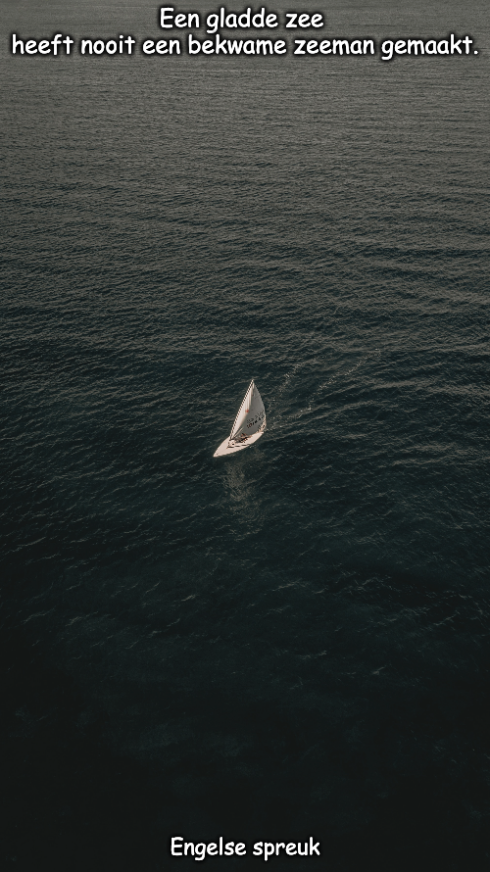
Een gladde zee heeft nooit een bekwame zeeman gemaakt.
Een gladde zee heeft nooit een bekwame zeeman gemaakt.
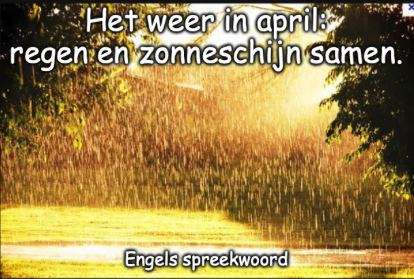
Het weer in april: regen en zonneschijn samen.
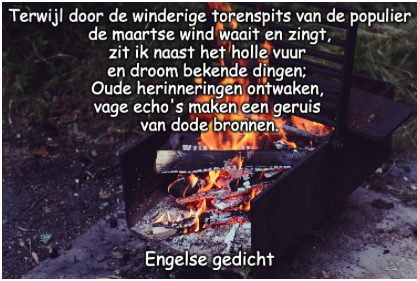
Terwijl door de winderige torenspits van de populier de maartse wind waait en zingt, zit ik naast het holle vuur en droom bekende dingen; Oude herinneringen ontwaken, vage echo’s maken een geruis van dode bronnen. ( Engels gedicht )
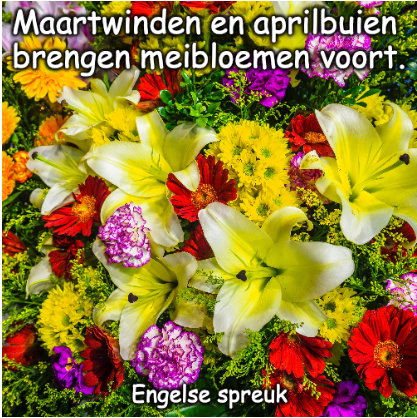
Maartwinden en aprilbuien brengen meibloemen voort.