Moses:
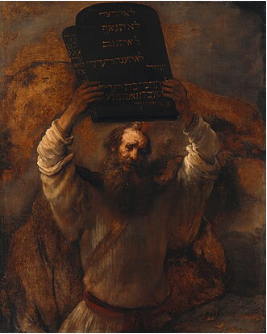
Moses is a central figure in Judaism, Christianity, and Islam. He is considered a prophet and leader of the people of Israel.
Life story (according to the Bible/Torah):
– Birth and childhood:
Moses was born in Egypt, at a time when Pharaoh had ordered that all newborn Hebrew boys be killed. His mother placed him in a reed basket in the Nile to save him. He was found by Pharaoh’s daughter, who raised him as her own son at the Egyptian court.
– Flight to Midian:
As an adult, Moses killed an Egyptian slave driver who was mistreating a Hebrew slave, and subsequently fled to the desert of Midian. There he married Zipporah and became a shepherd.
– The burning bush:
At Mount Horeb, God appeared to Moses in a burning bush that did not burn up, and commanded him to deliver the people of Israel from Egypt. The Exodus:
Moses returned to Egypt and demanded that Pharaoh let the Israelites go. After ten plagues, Pharaoh finally allowed the people to depart. Famous events from this period include:
– The crossing of the Red Sea (often called the “Red Sea”)
– The forty-year journey through the desert
– The receiving of the Ten Commandments on Mount Sinai
– Death:
Moses himself was not allowed to enter the Promised Land; he died on Mount Nebo, from where he was allowed to behold the land.
Significance in the three religions:
– Judaism: Moses (Moshe) is the most important prophet and lawgiver; the Torah is attributed to him.
– Christianity: Moses is seen as a forerunner of Jesus and an important prophet of the Old Testament.
– Islam: Moses (Musa) is mentioned as one of the most important prophets in the Quran, with more mentions than any other prophet. Historical context:
There is no archaeological or extra-Biblical evidence that confirms the existence of Moses as a historical person. Among historians and Biblical scholars, there is debate regarding whether Moses was a historical figure, a composite of multiple individuals, or a largely legendary figure. This is a subject on which there is no scholarly consensus.
And God went on to say: “Let an expanse come to be in between the waters and let a dividing occur between the waters and the waters.”
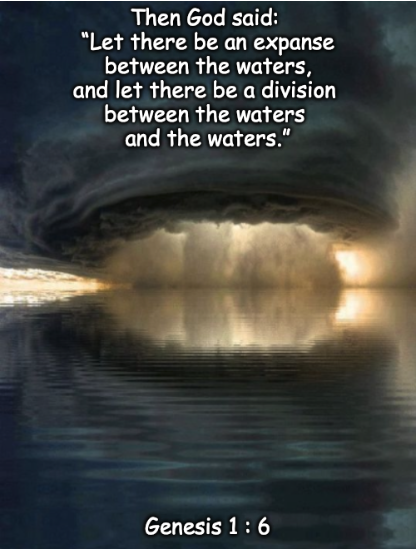
– “Then God said:
‘Let there be a firmament between the waters…’” is a Biblical phrase from Genesis 1:6.
– It means:
– God causes a “firmament”/“sunshine” to arise as a kind of ‘separation or exhalation/vault’ between waters.
– In the imagery of the time, it concerns the creation of an ‘order in the cosmos’: waters are separated, and space/structure emerges in which the world is further formed.
🟦 Note terms:
– In some modern translations, you see words like “vault” or “firmament”.
📚 Origin:
– Bible text from the ‘Jewish and Christian Old Testament’.
– Specifically: Genesis 1:6 (creation story). – Context:
– This is the ‘second part’ of the days of creation (day 2), in which God “separates” what first seemed like one whole.
✍️ Author:
– The creation story (Genesis 1) was not written by one person as a “separate work,” but is traditionally attributed to ‘ancient Israelite traditions’ and ‘editorial compilation’.
– Generally, modern biblical scholarship and many theological textbooks offer one of these approaches:
🔎 Most common academic interpretation:
– Genesis 1 is often linked to the Priestly (P) source material.
– In this case, “Author” is more likely ‘a collection of traditions/editorial staff’ than a known individual writer.
📌 Traditional (faith) interpretation
– In some classical religious traditions, the ‘Pentateuch’ (Genesis–Deuteronomy) is attributed to Moses.
– However, the text itself does not explicitly state: “Moses wrote this specific verse.”
