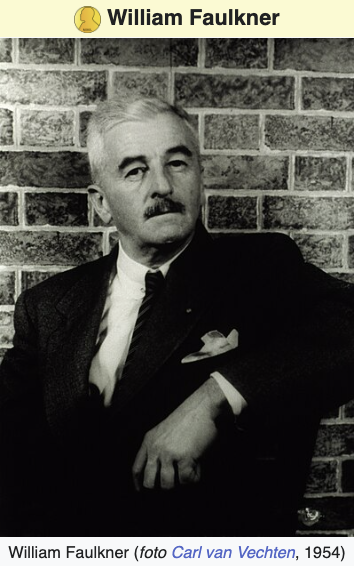
William Cuthbert Faulkner:
(New Albany (Mississippi), 25 September 1897 – Oxford (Mississippi), 6 July 1962).
American writer from Mississippi and winner of the Nobel Prize in Literature in 1949. Although his works are sometimes challenging or even difficult, he is generally considered one of the most important fiction writers in the United States.
Some days in late August at home are like this, the air thin and eager like this, with something in it sad and nostalgic and familiar.

This is a ‘literary description’.
The sentence means that certain days in late August have a special emotional atmosphere:
– 🌬️ “the air thin and eager”
— the weather feels lighter, sharper, almost expectant, as summer begins to turn toward autumn.
– 🍂 “sad and nostalgic”
— it brings a feeling of melancholy, memory, or longing for the past.
– 🏡 “familiar”
— the feeling is connected with “home,” childhood, or old memories.
In simpler words:
> Some late-August days feel like the end of summer is near, and the air itself seems to carry memories, sadness, and a sense of home.
📚 Origin and Author: William Faulkner.
It comes from his novel:
> William Faulkner, “The Sound and the Fury” 1929
The line appears in the “Quentin Compson section”, dated June 2, 1910, where Quentin’s perceptions and memories blend together in Faulkner’s stream-of-consciousness style.
🧠 Why it feels “Faulknerian”:
The sentence is typical of Faulkner because it combines:
– intense memory,
– Southern atmosphere,
– time passing,
– nostalgia,
– emotional ambiguity,
– and a sensory description of weather and place.
Perhaps they were right putting love into books. perhaps it could not live anywhere else.

The line is about the gap between the ideal and the real. A few ways to read it:
– ‘Love as literary invention’: Books can present love as complete, resolved, and meaningful, because a writer can shape it that way. Real relationships are messier, harder to sustain, and often disappointing by comparison.
– “Disillusionment”: The speaker has likely been let down by love in his own life, and is rationalizing that disappointment by concluding that “true” love was never really achievable outside of fiction anyway.
– ‘The power of narrative’: There’s also a subtler point about how storytelling lets us experience emotions like love in their most concentrated, meaningful form, something everyday life, with all its distractions and compromises, usually can’t offer.
Origin:
The line comes from a passage where a character reflects on how the idealized, romantic love found in novels rarely survives contact with real, lived experience. He’s weighing the “book version” of love against the messier version he’s encountered himself, and concluding that maybe fiction is the only place where love can exist in its pure, uncomplicated form.
Author:
The quote is from William Faulkner’s novel “Light in August” (1932). This tension between illusion and reality, and between memory and truth, is a recurring theme in Faulkner’s work: the idea that people often need story and narrative to make sense of experiences, like love, time, or identity, that are otherwise too chaotic or painful to hold onto directly.
Dreams have only one owner at a time. That’s why dreamers are lonely.