Angie Weiland Crosby:
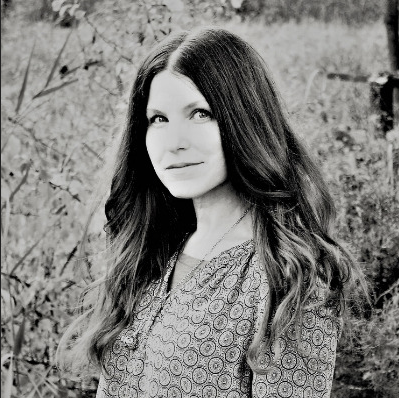
American writer from Southern Maryland. Author of many inspirational sayings.
Nature is the purest portal to inner-peace.

This quote expresses the idea that ‘nature is one of the most direct and pure paths to inner calm and mental balance’.
Core of the meaning:
– ‘Nature’ symbolizes silence, simplicity and authenticity.
– “The purest gate” means: the most natural, unsophisticated and sincere entrance.
– “Inner peace” refers to:
– mental calm,
– emotional balance,
– peace with yourself,
– liberation from stress and anxiety.
Substantive interpretation:
The quote suggests that people in contact with nature:
– easier to ‘come to terms with oneself’;
– distance yourself from crowds, noise and tension;
– experience more space for ‘reflection, silence and recovery’;
– feel a deeper connection with their own inner life.
In summary:
👉 The message is that ‘nature has a healing effect’ and can help people find ‘rest, peace and balance’.
🕰️ Origin:
Modern origin:
It is probably a ‘modern inspiration quote’ or ‘poetic statement’ that is mainly distributed via:
– social media,
– quotes pages,
– blogs,
– writer’s websites,
– inspiring nature and wellness contexts.
The best-known form seems to be the ‘English version’:
> “Nature is the purest portal to inner-peace.”
According to the available information:
– the quote circulates frequently on ‘Instagram’ and ‘Facebook’;
– it is attributed to Angie Weiland-Crosby on various online pages;
– it has also been adopted by other writers and quotes blogs.
Careful conclusion about the origin:
✅ Modern quote
✅ Probably originally in English
✍️ Author: Commonly attributed to Angie Weiland-Crosby.
– American writer,
– novelist,
-blogger,
– and nature lover.
Work and fame:
Her name is associated with:
– blog posts,
– inspirational quotes,
– and her debut novel “Scarlet Oak”.
Important nuance:
‘Attributed’ is slightly more precise than saying that the origin is completely conclusive, unless one can identify a ‘primary source’, such as:
– its official website,
– an original blog post,
– a book publication,
– or an official author profile in which the quote explicitly appears.
Autumn whispered to the wind: ‘I fall, but always rise again’
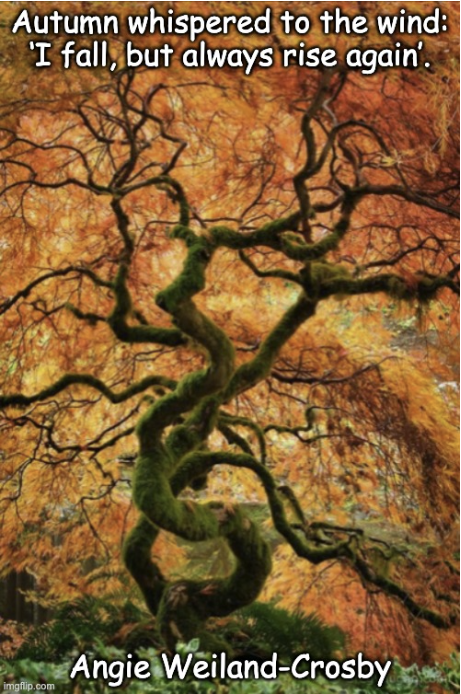
The sentence uses ‘autumn as a metaphor for resilience and renewal’:
> ‘“I fall”’ refers both to the season’s American name, ‘fall’, and to leaves falling—or, figuratively, to experiencing failure or hardship.
> “But always rise again” suggests recovery, rebirth, and the recurring cycle of the seasons.
Its central message is:
‘falling is temporary; renewal will follow’.
✍️ Author and origin:
The quotation is ‘widely attributed to Angie Weiland-Crosby’, a contemporary American writer known for short, nature-inspired poetic reflections:
> “Autumn whispered to the wind, ‘I fall, but always rise again.’”
However, there does not appear to be a clearly documented original book, poem, or traditionally published work associated with it. It circulates mainly through quotation websites, social media, and decorative artwork. Therefore:
– Angie Weiland-Crosby is the generally accepted attribution.
– The exact date and first publication are uncertain.
– It is a modern quotation, not an old proverb or a line by a classical poet.
A polished punctuation version would be:
> “Autumn whispered to the wind, ‘I fall, but I always rise again.” — Angie Weiland-Crosby
The repeated “I” is optional, but it makes the sentence grammatically more complete.
When life grows cold…a dog will warm your soul.