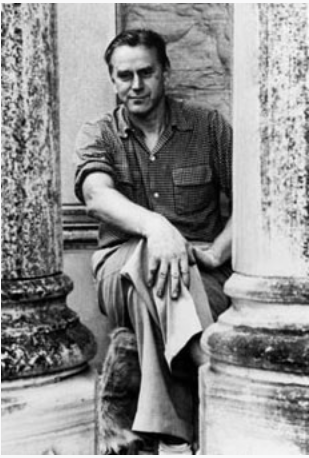
(October 12, 1908 – March 22, 1991).
An American poet, editor, teacher, literary critic, novelist, and playwright. He is remembered as the long-time director of the Iowa Writers’ Workshop and as co-founder of the International Writing Program (IWP), both at the University of Iowa.
Paul Engle. Photo: wikipedia.org
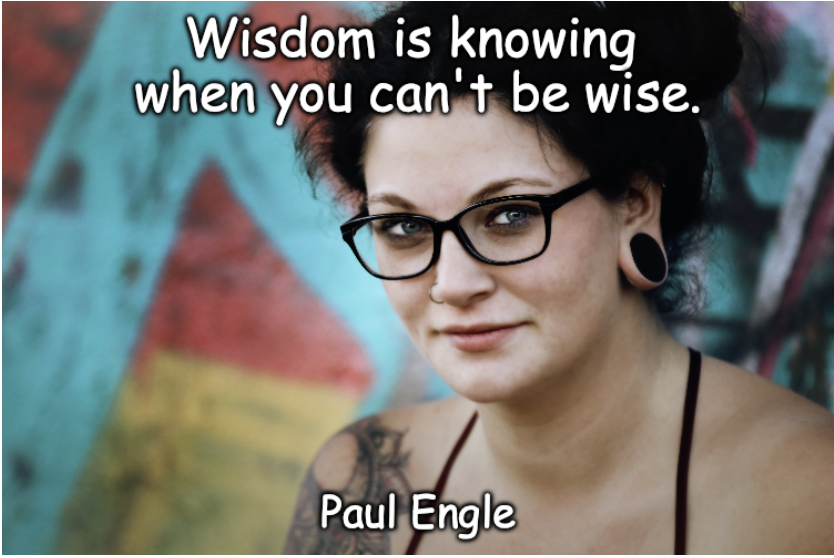
Wisdom is knowing when you can’t be wise.
Photo: Jen Theodore. Meaning 🧠📖: This saying expresses that ’true wisdom does not mean that you always have an answer’. Precisely a wise person realizes when: he ‘knows too little’; a situation is ’too complex’; emotions or circumstances make a clear judgment impossible; silence, hesitation, or restraint is wiser than a definitive statement. Core idea:‘True wisdom begins with acknowledging the limits of your own insight.’ Literary and philosophical layer:The statement is powerful due to its ‘paradox’: you are wise because you know that sometimes you ‘cannot be wise’; wisdom is linked here to: modesty; self-knowledge; doubt; intellectual humility. Related thought: The saying brings to mind:Socrates: “I know that I know nothing.” The idea that ‘self-knowledge’ is the basis of wisdom; literature and philosophy in which man learns that not everything is solvable or fully understandable. Essentially, it says: do not pretend that you always know everything; acknowledge your limitations; not every problem allows for a “wise” answer; Sometimes ‘doubt itself is a form of wisdom’. Free literary paraphrase: ‘Wisdom is not having all the answers, but the realization when life is bigger than your understanding.’🕰️ Origin:Sometimes the variant also appears: “Wisdom is knowing when you cannot be wise.”Regarding the origin: It appears to be an ‘English aphorism’. The saying is often quoted in: collections of quotations; online overview lists; anthologies of aphorisms. Important nuance: The ‘exact primary source’ is not always clearly documented. That means: there is a common attribution; but not always an easily verifiable first occurrence in a book, essay, interview, or lecture. So regarding origin, it is best to phrase it cautiously: The saying presumably originates from English and circulates primarily as an aphorism, without completely certain source attribution. ✍️ Author: The statement is usually attributed to Paul Engle (1908–1991), American poet, writer, and teacher, best known for his role at the ‘Iowa Writers’Workshop.Certainty of attribution: Paul Engle is the most common name associated with this quote, but the attribution is ‘not fully watertight documented’; therefore, the most correct phrasing is: usually attributed to Paul Engle.
Door Pieter
Mensenmens, zoon, echtgenoot, vader, opa.
Spiritueel, echter niet religieus.
Ik hou van golf, wandelen, lezen en de natuur in veel opzichten.
Onderzoeker, nieuwsgierig, geen fan van de mainstream media (MSM).