Joseph Joubert (1754–1824).
French moralist and essayist, best known for his Carnets (diary entries), which were not published until after his death.
He is known for:
Style:
Aphoristic and fragmentary writing — he published virtually nothing during his lifetime, but filled notebooks with random thoughts and observations for decades.
Great brevity and precision: he strove to capture the essence of an idea in as few words as possible.
Musicality and rhythmic prose — he placed great value on the sound and cadence of sentences, and regarded style as inseparable from thinking.
A meditative, introspective tone, without the satirical sharpness of contemporaries such as La Rochefoucauld.
Topics:
Aesthetics and literature: Joubert wrote extensively about what constitutes good style, poetry and writing. He admired classical clarity over baroque excess.
Morality and virtue: in the tradition of the French moralists, he reflected on honesty, friendship, vanity and the good life — but more gently and less cynically than many predecessors.
Religion and metaphysics: he was deeply religious and wrote about the soul, God and the afterlife in a philosophical-poetic way.
Education and training: As a former teacher, he had much to say about the formation of the minds and character of young people.
Memory and time: transience, memory and the workings of the human mind are recurring themes.
Position in literary history:
Joubert is often compared to Pascal (for his fragmentary depth) and later admired by Chateaubriand, Matthew Arnold and André Gide, among others. He is a writer’s writer: not widely read, but highly regarded by those who know him.

He who does not have the weakness of friendship also lacks its strength.

Imagination is the eye of the soul.

The mind conceives with pain, but it brings forth with delight.
This phrase means that ‘intellectual creation is painful when the idea is formed,’ but becomes ‘a source of pleasure when it is realized or expressed.’
– “Conceive”: to form an idea, to imagine, to develop it internally.
– “With pain”: the effort of thinking, clarifying, and composing can be difficult and laborious.
– “Give birth”: to produce the work, to formulate the idea, to bring it forth.
– “With delight”: once the idea is found or expressed, there is joy, relief, and creative pleasure.
👉 The image is based on a ‘metaphor of birth’: the mind is compared to a mother who carries and then gives birth to an idea. But the phrase partially reverses the usual bodily experience: here, it is ‘conception’ that causes suffering, and ‘giving birth’ that provides pleasure.
✍️ Author: Joseph Joubert. This maxim is generally attributed to Joseph Joubert—a French moralist and writer, born in 1754 and died in 1824.
Joubert is famous for his “thoughts, maxims, and aphorisms,” often very short, meditative, and elegant. He published little during his lifetime; many of his texts come from his notebooks and were published posthumously.
📚 Origin: This phrase belongs to the collection of Joseph Joubert’s “Thoughts,” published posthumously, notably in collections such as:
– “Thoughts of Joseph Joubert,” published after his death;
– and later in more complete editions of his “Thoughts, Essays, Maxims, and Correspondence.”
It is therefore not really a ‘popular saying’ in the traditional sense, but rather a ‘literary maxim’ or a ‘moralistic aphorism’.
⚠️ Depending on the edition or the quotes, slight variations may occur, for example “with delight” in the singular or “with delights” in the plural.
Grace is in garments, in movements, in manners; beauty in the nude, and in forms. This is true of bodies; but when we speak of feelings, beauty is in their spirituality, and grace in their moderation.
Joubert distinguishes several notions here: ‘elegance’, ‘beauty’ and ‘grace’.
👗 1. For the body: elegance and beauty:
– ‘Elegance’ relates to what surrounds or accompanies the body:
– clothes,
– gestures,
– manners,
– social attitude.
It therefore depends in part on culture, education, taste, style.
– ‘Beauty’ is more essential:
– it is in the very shape of the body,
– in its proportions,
– in what it is naturally, independently of ornaments.
In other words: ‘one can be elegant through dress and manners; we are beautiful through form and natural harmony.’
💓 2. For feelings: beauty and grace:
Joubert then transposes this distinction to the internal, moral and emotional domain.
✨ The beauty of feelings:
According to him, a feeling is beautiful when it has ‘spirituality’:
– moral elevation,
– purity,
– generosity,
– disinterestedness,
– inner nobility.
For example, love, friendship or compassion are beautiful when they are not just instinctive or possessive, but elevated, sincere and deep.
⚖️ The grace of feelings:
‘Grace’ comes from ‘moderation’:
– not to be excessive,
– not to spread with violence,
– keep a measure,
– express your feelings delicately.
A feeling can be strong, but it becomes graceful when it is contained, harmonious, dignified.
🪶 General interpretation: The sentence therefore opposes:
| Domain | Elegance / grace | Beauty |
| ‘Body’ | clothes, gestures, manners | nudity, natural forms |
| ‘Feelings’ | moderation, measure | spirituality, moral elevation |
Joubert suggests that true beauty is not just external. In the moral life, it resides in the elevation of the soul; and grace comes from the measure with which we express what we feel.
📚 Probable origin:
The quote comes from Joseph Joubert’s “Pensées”, a collection published ‘after his death’. Joubert published very little during his lifetime; his notes, notebooks and maxims were collected posthumously, notably in:
– “Collection of the thoughts of M. Joubert”, published by Chateaubriand in 1838;
– then in various editions of “Thoughts, essays, maxims and correspondence” by Joseph Joubert.
There may be slight variations depending on the edition, as his texts often come from notebooks and handwritten fragments.
✅ Author and nature of the sentence:
This sentence is ‘well attributed to Joseph Joubert’ — Joseph Joubert (1754-1824), French moralist and writer, friend in particular of Chateaubriand.
It is not really a ‘saying’ in the popular and anonymous sense of the term, but rather a ’thought’, a ‘maxim’ or an ‘aphorism’: a brief formula which proposes a moral or aesthetic distinction.
Make what is vice in others a quality in you.

This maxim means that the same disposition can be a ‘flaw’ or a ‘strength’ depending on how it is experienced, controlled, and directed.
The idea is to ’transform within oneself’ what appears as a vice in others:
– ‘stubbornness’ can become ‘perseverance’;
– ‘pride’ can become ‘dignity’;
– ‘mistrust’ can become ‘prudence’;
– ‘ambition’ can become ‘a desire for excellence’;
– ‘severity’ can become ‘moral rigor’.
👉 In other words, it’s not about imitating the flaws of others, but about ensuring that the same tendencies within oneself are ‘disciplined’, ‘measured’, and ‘morally positive’.
📚 Origin:
This isn’t strictly speaking a ‘popular saying,’ but rather a ‘moral maxim’ or ‘aphorism.’
It belongs to the tradition of ‘French moralists,’ who formulated observations on human conduct, virtues, vices, and passions in short sentences.
It is associated with collections of thoughts published after Joseph Joubert’s death, notably under titles such as:
– “Thoughts of Joseph Joubert”
– “Thoughts, Essays, and Maxims”
⚠️ Like many of Joubert’s thoughts, the wording may vary depending on the edition and collection.
👤 Author:
– Full Name: Joseph Joubert
– Dates: 1754-1824
– Nationality: French
– Profile: Writer, moralist, and author of aphorisms
Joseph Joubert published very little during his lifetime. His thoughts were primarily collected and disseminated ‘posthumously’ from his notebooks and manuscripts.
✅ Attribution to Joubert is therefore ‘probable and common’, although it may be useful to verify the exact wording in a critical edition if one is looking for a precise bibliographic reference.
It is easy to understand God as long as you don’t try to explain him.
This maxim rests on a fruitful paradox: ‘intuitive understanding’ and ‘discursive rationalization’ are two opposing approaches. One can ‘feel’ or ‘experience’ God—through faith, contemplation, and piety—without necessarily being able to define, demonstrate, or rationally explain Him. As soon as one attempts to subject Him to logic and language, one encounters the infinite, the ineffable, and understanding collapses under the weight of analysis. In other words, God belongs to the realm of inner experience, not intellectual discourse. This idea aligns with a long mystical and apophatic tradition (negative theology), according to which God, by his very nature, eludes any human definition.
Origin:
The quote—“It is easy to understand God as long as you don’t try to explain him”—is attributed to Joseph Joubert and appears in his collected thoughts. During his lifetime, Joubert never published anything, but he wrote numerous letters as well as notes and journals in which he recorded his reflections on human nature, literature, and other subjects, often in an aphoristic style. After his death, his widow entrusted his notes to Chateaubriand, who published a selection of them under the title “Recueil des pensées de M. Joubert” (Collection of Thoughts of Mr. Joubert) in 1838. More complete editions followed, including that of the “Librairie Vve Le Normant” in 1850.
Author: Joseph Joubert (1754–1824) was a French moralist and essayist. A close friend of Chateaubriand and a discreet figure in the literary world of his time, he is now best known for his “Pensées” (Thoughts), a posthumous collection of exquisitely crafted aphorisms.
Ask the young. They know everything.
It means in substance:
– young people often have great confidence;
– they may believe they have the answer to everything;
– but this certainty sometimes comes from a lack of experience;
– with age, we generally discover the complexity of things.
👉 So this is not a literal compliment, but a mocking remark on the ‘presumption of youth’: ‘when you are young, you think you know everything’.
✍️ Author: The formula is ‘generally attributed to’ Joseph Joubert — French moralist of the 18th-19th century.
– Joseph Joubert: 1754-1824
– Author of thoughts, maxims and aphorisms
– Friend of Chateaubriand
– His writings were mainly published ‘after his death’.
The quote is often given in the form:
> “Talk to young people, they know everything. »
We also find variations like:
> “Ask the young people: they know everything. »
📚 Origin:
The phrase comes from Joubert’s “Pensées” or collections of maxims, published posthumously.
His notes were notably collected in:
– “Collection of the thoughts of M. Joubert”, published in 1838 by Chateaubriand;
– then in expanded editions like “Thoughts, essays and maxims”.
⚠️ Like many of Joubert’s maxims, the exact wording can vary between editions and collections of quotes.
🧠 Summary meaning:
Clearly, Joubert means:
> ‘Young people often have more certainties than experience.’
It is a moral and psychological observation, close to the idea:
> ‘At twenty, you think you know everything; later, we learn how little we knew.’
You will not find poetry anywhere unless you bring some of it with you.
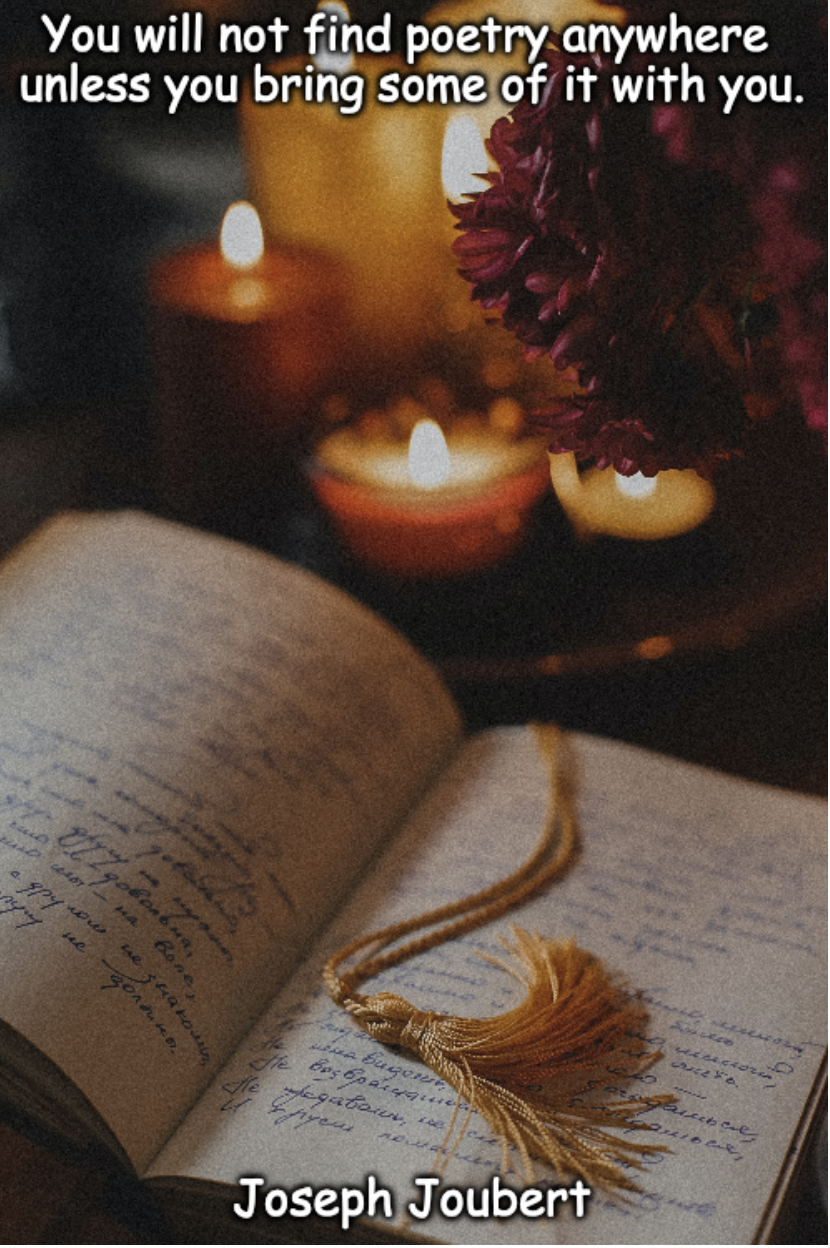
The saying means that ‘poetry, beauty, or wonder resides not only in the external world’, but especially within the one who looks.
In other words:
– Those who lack sensitivity, imagination, or inner receptiveness will quickly find the world dry, ordinary, or empty.
– Those who ‘do’ “carry poetry within” see beauty in things that others overlook: light, silence, nature, people, memories, language.
– It is therefore not just about poems, but about a ‘poetic attitude to life’.
A similar thought is:
‘Beauty lies partly in the eye — or better: in the soul — of the observer.’
👤 Author: Joseph Joubert
A French writer, thinker, and moralist. He published little to nothing in book form during his lifetime, but kept notebooks containing thoughts, aphorisms, and reflections. After his death, his thoughts were published, including by or thanks to his friend François-René de Chateaubriand.
His work appeared posthumously under titles such as:
– “Pensées”
– “Pensées, essais et maximes”
– “Recueil des pensées de M. Joubert”
The statement in question is attributed to Joubert in that tradition.
📝 Original French formulation:
> “One finds no poetry anywhere when one does not carry it within oneself.”
There are minor variations, for example with “guère”:
> “One finds hardly any poetry anywhere when one does not carry it within oneself.”
That means approximately:
> “One finds hardly any poetry anywhere when one does not carry it within oneself.”
Pleasures are always children, pains always have wrinkles.
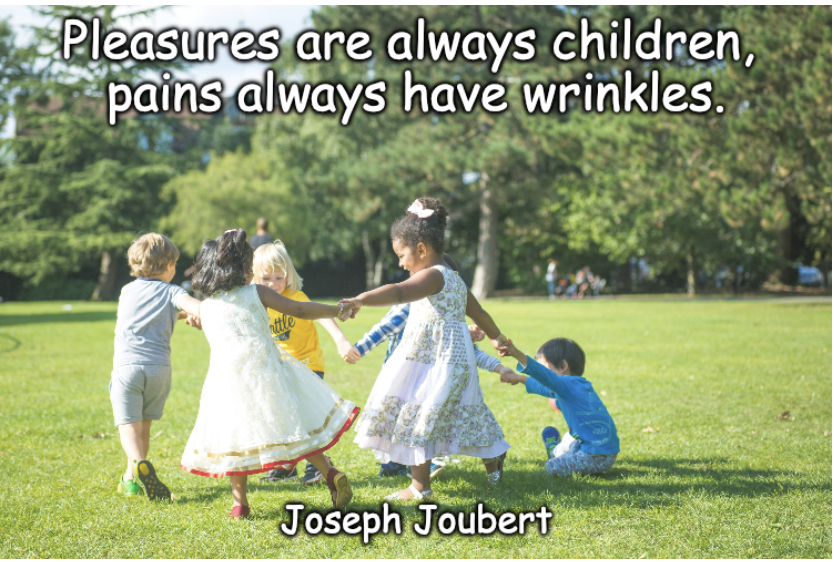
The aphorism contrasts two things:
– “La grâce” = grace, gracefulness, charm, innocent beauty
→ which is presented as ‘young, fresh, childlike, spontaneous’.
– “La douleur” = pain, sorrow, grief
→ which is presented as something that ‘ages’, leaves traces, gives “wrinkles”.
In short:
> ‘Innocence and charm remain young; suffering marks a person.’
So it is not literally about children always being fun, but about the idea that ‘something childlike is often associated with freshness, innocence, and beauty’, whereas ‘pain and sorrow can visibly mark someone.’
⚠️ Regarding the English phrasing:
The sentence “Pleasures are always children” sounds grammatically and semantically strange in English. This suggests that it is likely an automatic or sloppy translation. This is likely what went wrong:
– ‘enfant’ here does not literally mean “children”, but rather “childlike” or “like a child”.
– ‘grâce’ does not mean “pleasure”, but ‘grace, gracefulness, charm’.
– ‘douleur’ can mean “pain”, but in this context also ‘grief, sorrow, suffering’.
👤 Author:
> Joseph Joubert
> French moralist and aphorist
> 1754–1824
Joubert primarily wrote short thoughts, notes, and aphorisms. Many of these were only published ‘after his death’ in collections such as:
– “Recueil des pensées de M. Joubert”
– “Pensées, essais, maximes et correspondance”
Therefore, his sayings often circulate in various forms and translations.
Superstition is the only religion of which base souls are capable of.
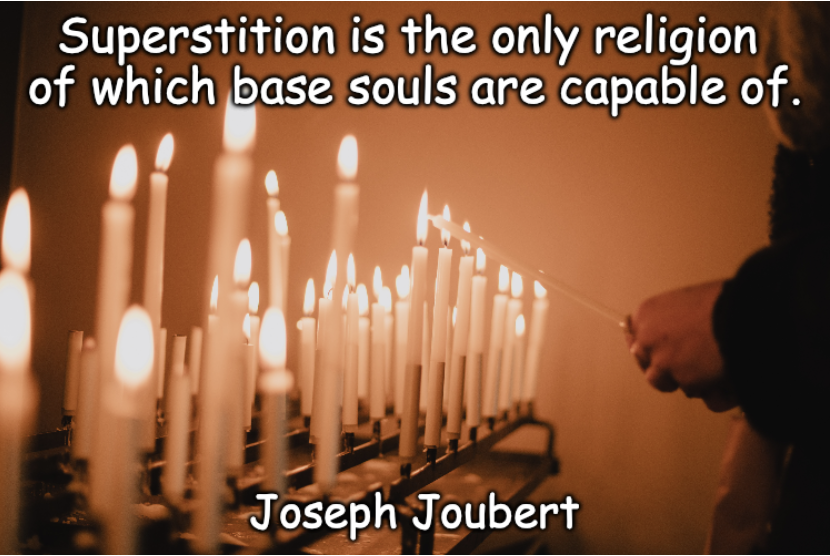
This is a English translation of the French aphorism:
> « La superstition est la seule religion dont les âmes basses soient capables. » The statement distinguishes between “religion” and “superstition”.
– ‘Religion’ is viewed here as something higher: connected with morality, reverence, spiritual elevation, love, or truth.
– ‘Superstition’ is seen as a lower, fearful, or magical form of belief: believing out of fear, laziness, or a need for signs, omens, miracle cures, or rituals without inner conviction.
– By “low souls,” Joubert probably does not literally mean poor or simple people, but rather people with a ‘low mental attitude’: narrow-minded, fearful, selfish, or morally undeveloped.
In short:
> ‘According to Joubert, people who are incapable of a noble, inner religiosity fall into superstition.’
⚖️ Nuance:
The statement is therefore ‘not necessarily anti-religious’. On the contrary: Joubert seems rather to be defending the ’true religion’ against what he sees as its caricature: superstition.
At the same time, the phrasing sounds quite ‘elitist’ or ‘denigrating’ nowadays, especially due to the words “low souls”. In modern language, one might say:
> ‘Superstition is an impoverished or immature form of religious feeling.’
Joubert thus makes a distinction between ‘faith’ and ‘superstition’. It is a matter of perception.
👤 Author:
– The saying is generally attributed to Joseph Joubert,
a French moralist and essayist, born in 1754 and died in 1824.
– He was best known for his short thoughts, maxims, and aphorisms, which were largely published ‘posthumously’. 📚 Origin:
– The statement comes from Joubert’s collected thoughts, often published under titles such as “Pensées”, “Carnets”, or “Pensées, essais et maximes”.
– Joubert published hardly any major works during his lifetime; many of his notes were published after his death, with the help of literary friends such as Chateaubriand, among others.
The precise wording may vary by edition or translation, but the core sentence in French is generally attributed to Joubert.
Everyone is born to observe order, but few are born to establish it.
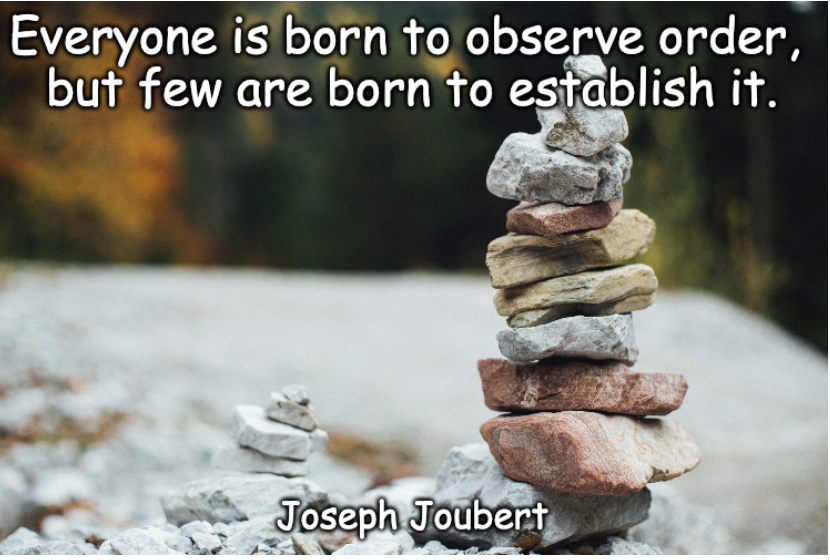
– “Tous sont nés pour observer l’ordre”
→ Everyone is born to ‘observe order’: to follow/maintain rules, habits, and existing structures.
– “mais peu sont nés pour l’établir”
→ But ‘few people’ are born to ‘establish / bring about’ that order: to create new rules, systems, or reforms.
➡️ Core idea: the majority adapts and preserves; a small minority shapes and creates.
Origin 📜:
– French original text:
“Tous sont nés pour observer l’ordre, mais peu sont nés pour l’établir.”
Source:
“Pensées de J. Joubert” — published by M. Paul de Raynal (1862)
– The quote is also mentioned/found via “Today In Science History”.
Author ✍️:
– Joseph Joubert (1754–1824) ✅
The beautiful epic, dramatic, lyrical poems are nothing but the dreams of an awakened sage.
The passions of the young are vices in the old.
– What can still be seen as an understandable ‘passion, drive or zest for life’ in ‘young people’, is more likely to be assessed as a ‘vice, defect or moral weakness’ in ‘old people’.
– The same tendency — for example, vanity, infatuation, ambition, sensuality, rashness — is therefore valued differently according to ‘age’.
– The saying expresses a rather moralistic idea: youthful passion is natural or pardonable; in old age one would expect more control, wisdom and moderation.
In short: ‘what is called passion in youth is called vice in old age.’
✍️ Original wording:
The saying is almost certainly a translation from French. A common French form reads:
> “Les passions des jeunes gens sont des vices dans la vieillesse.”
Or in a slightly different form:
> “Les passions de la jeunesse sont les vices de la vieillesse.”
Literally:
> “The passions of young people are vices in old age.”
👤 Author: Usually attributed to Joseph Joubert 1754–1824, a French moralist, essayist and aphorist.
He is best known for his short, subtle thoughts and maxims, published posthumously as “Pensées” / “Pensées, essais et maximes”.
📚 Origin:
The saying belongs to the tradition of the French ‘moralists’:
writers such as La Rochefoucauld, Vauvenargues, Chamfort and Joubert, who summarize human motivations in short, sharp sentences.
For Joubert the idea circulates in collections of his “Pensées”. Because his notes were largely published posthumously, different formulations exist in quotation books. That is why one finds variants such as:
– “Les passions des jeunes gens sont des vices dans la vieillesse.”
– “Les passions de la jeunesse sont les vices de l’age mûr.”
– “The passions of youth are the vices of old age.”
The core remains the same.
Only choose in marriage a man whom you would choose as a friend if he were a woman.

– Do not choose a marriage partner based solely on infatuation, attraction, status, or romance.
– Choose someone with whom you could also have a deep friendship.
– Your partner’s character, spirit, reliability, and companionship are essential for a good marriage.
In short: ‘marry someone you would also value as a best friend.’
✍️ Author: This saying is usually attributed to:
– Joseph Joubert, 1754–1824, French writer, moralist, and essayist.
He is best known for his short reflections, aphorisms, and moral sayings.
🌍 Origin:
The original saying usually reads in English:
> “Choose in marriage only a woman whom you would choose as a friend if she were a man.”
In French, she is often rendered as:
> “N’épousez qu’une femme que vous choisiriez pour ami si elle était homme.”
That literally means:
> “Marry only a woman you would choose as a friend if she were a man.”
This version:
> “In marriage, choose only a man you would choose as a friend if he were a woman.”
is likely a **modern, reversed, or modified variant** of Joubert’s original statement.
📚 Context:
Joubert lived in a time when men and women often had socially separate worlds. Friendship was then often portrayed as something between men, while marriage was often approached more socially, economically, or familially.
His statement was therefore progressive: he emphasized that a husband or wife should not only be a romantic partner, but also a ‘friend in character, spirit, and company’.
God is the place where I don’t remember the rest.

– God is not an ordinary “place”, but an inner, spiritual space.
– When one focuses entirely on God, ‘everything else fades into the background’: worries, worldly things, the self, time, memories.
– It is a ‘mystical or contemplative thought’: in the experience of God, “the rest” becomes unimportant or forgotten.
– It therefore does not literally say that God is a location, but uses “place” as a metaphor for the ‘ultimate center of attention and presence’. Loosely translated:
> ‘God is the space in which everything else ceases to occupy me.’
✍️ Author: Usually attributed to Joseph Joubert
— French moralist, essayist, and aphorist, 1754–1824.
The French formulation usually reads:
> “Dieu est le lieu où je ne me souviens pas du reste.”
Literally:
> “God is the place where I do not remember the rest.”
📚 Origin:
The statement comes from the realm of Joubert’s ‘posthumously published notes and aphorisms’, often referred to as his:
– “Pensées”— “Thoughts”
– or “Carnets” — “Notebooks”
Joubert hardly published anything himself during his lifetime. His thoughts were collected and published after his death, thanks in part to friends and editors such as Chateaubriand and later Paul de Raynal.
Therefore, the statement often circulates as a standalone aphorism, without always having an exact page number or date.
🧠 Philosophical background:
The phrasing “God is the place…” aligns with an older philosophical-theological tradition. A related thought appears particularly in the work of Nicolas Malebranche:
> “Dieu est le lieu des esprits, comme l’espace est le lieu des corps.”
“God is the place of the spirits, just as space is the place of the bodies.”
Joubert seems to make that tradition poetic and personal: not only is God the “place” of the spirit, but God is the place where everything else disappears from consciousness.
There are opinions that come from the heart, and whoever has no fixed opinion has no constant feelings.

> “Some convictions arise not only from logical reasoning, but from one’s deeper feelings, character, and moral sensitivity. Whoever is inwardly fickle in their feelings will also find it difficult to have steadfast convictions.”
In other words: ‘fixed opinions are linked to fixed feelings or inner conviction’. It is not necessarily about stubbornness, but about the idea that true convictions are rooted in the heart.
✍️ Author: This saying is attributed to Joseph Joubert
1754–1824, a French moralist, essayist, and aphorism writer.
🌍 Origin:
The original French formulation usually reads:
> « Il y a des opinions qui viennent du cœur; et quiconque n’a pas de sentiments fixes n’a pas d’opinions constantes. »
📚 Source context:
Joubert mainly wrote short thoughts and aphorisms in notebooks. Many of these were published ‘posthumously’, including in collections such as “Pensées” / “Pensées de Joseph Joubert”.
Logic works, metaphysics contemplates.

The saying contrasts two ways of thinking:
– Logic works 🧠
– Logic is practical and instrumental.
– It organizes reasoning, tests validity, and draws conclusions according to rules.
– It “does work”: analyzing, deducing, proving.
– Metaphysics considers 🌌
– Metaphysics concerns itself with fundamental questions about reality, being, cause, soul, God, freedom, time, and so on.
– It is more contemplative and speculative.
– It “considers” or “contemplates” what lies behind or above directly observable reality.
In short: ‘logic is methodical and active; metaphysics is contemplative and reflective.’
🏛️ Origin:
The statement goes back to a French formulation:
> “La logique travaille; la métaphysique contemple.”
> “Logic works; metaphysics observes/contemplates.”
✍️ Author:
– Joseph Joubert
– 1754–1824
– French moralist, essayist, and aphorist
– Known for short, philosophical thoughts and maxims
– His notes and thoughts were published mostly posthumously, including in collections such as ‘Pensées’.
⚠️ Nuance:
The saying need not be read as a condemnation of metaphysics. Rather, it indicates that both disciplines have different functions:
– Logic: verifies and constructs reasoning.
– Metaphysics: reflects on the deepest foundations of reality and existence.
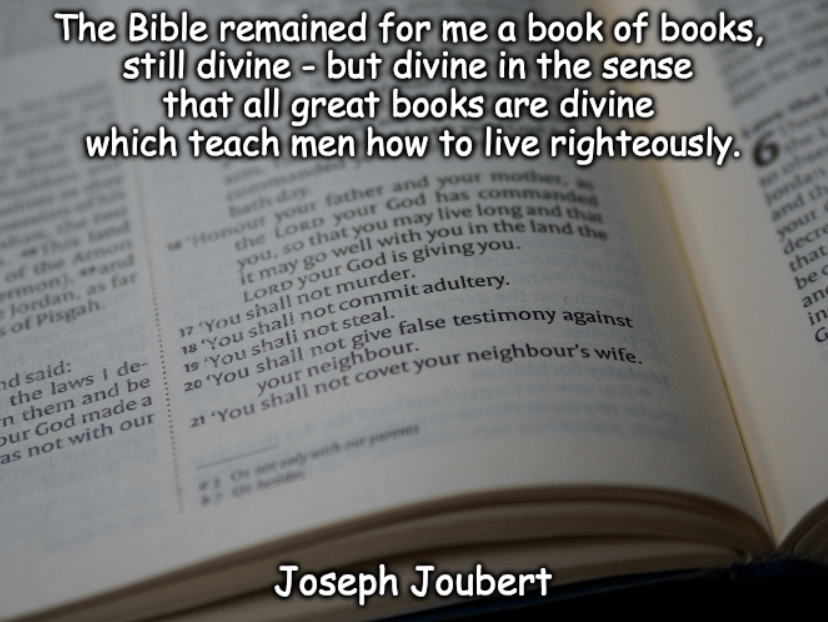
The Bible remained for me a book of books, still divine – but divine in the sense that all great books are divine which teach men how to live righteously.
How many people make themselves abstract to appear profound. The most useful part of abstract terms are the shadows they create to hide a vacuum.
> Many people use abstract, vague, or complicated language to appear deeper, smarter, or more philosophical than they actually are. Abstract terms can cast a kind of “shadow”: they conceal the fact that there is actually little concrete content or clear thought behind them.
In other words: it is a critique of ‘pseudo-profoundness’ and ‘jargon’. Someone might use difficult, abstract words to camouflage a void of ideas.
In short:
– 🧠 ‘Abstract language use’ can be genuinely useful, but also misleading.
– 🎭 Some people use it to appear important or profound.
– 🌫️ Vague terms can conceal the fact that there is little clear content.
✍️ Author:
This saying is usually attributed to Joseph Antoine René Joubert. – Born: 1754
– Died: 1824
– Nationality: French
– Known as: ‘moralist, essayist, and writer of aphorisms’.
Joubert was primarily known for his short, sharp thoughts on language, thought, literature, and morality.
📚 Origin:
The statement likely comes from Joubert’s collected thoughts and notes, which were not published until after his death. His aphorisms appeared in works such as:
– “Recueil des pensées de M. Joubert” — published in the 19th century
– Later also in collections such as “Pensées, essais, maximes et correspondance”.
🇫🇷 Possible original thought:
> “Combien de gens se rendent abstraits pour paraître profonds.”
That means:
> “How many people make themselves abstract to appear profound.”
The second sentence about abstract terms creating “shadows” to hide a void seems to be a related or expanded formulation of the same thought.
We must respect the past, and mistrust the present, if we wish to provide for the safety of the future.
– 🕰️ ‘Respect for the past’
The past contains experience, tradition and lessons that should not be dismissed lightly.
– 👀 ‘Distrust of the present’
The present must be approached critically: what seems self-evident or modern today is not therefore also wise or sustainable.
🌱 “Responsibility for the future”
Anyone who wants to build a good future does not do so by blindly following the present, but by learning from the past and making careful judgments in the present.
Simply put:
👉 ‘If we want to build the future safely, we must learn from the past and remain critical of the present.’
🏛️ Origin:
The statement comes from the posthumously published work of thoughts and aphorisms by Joseph Joubert.
French original wording:
> « It’s easy to respect your pass and be proud of your presence, so you can travel in the evening. »
Source:
– 📘 “Recueil des pensées de M. Joubert”
– 📍 Paris
– 📅 1838
– ✍️ Published posthumously, with the involvement of Chateaubriand
Important nuance:
The often quoted English version reads:
> “We must respect the past, and mistrust the present, if we wish to provide for the safety of the future.”
That English formulation is ‘substantially correct’, but not entirely literal.
The French “travailler à l’avenir” means more literally:
– ‘working on the future’
– ‘working for the future’
– ‘preparing the future’
👤 Author:
-Joseph Joubert (1754–1824)
– 🇫🇷 French moralist and essayist
– Known for his short, aphoristic notes and thoughts
– Hardly self-published his work during his lifetime; much of it did not appear until after his death
Joubert is known for thoughtful statements about:
– wisdom
– time
– tradition
– moral judgment
– human limitations
This quote fits very well in that typical, reflective style.
Never write anything that does not give you great pleasure. Emotion is easily transferred from the writer to the reader.

The saying means that a writer should not write in a cold, dutiful, or uninvolved way.
Whatever the writer feels while writing — pleasure, enthusiasm, sincerity, emotional energy — tends to pass into the text.
That emotional tone is then felt by the reader as well: emotion is contagious in writing.
In other words:
strong writing does not depend on technique alone;
it also depends on genuine feeling and personal engagement.
Origin:
The quotation can be traced to Joseph Joubert’s Pensées.
More precisely:
Chapter 23: Des Qualités de l’Écrivain, § 58,1850 edition
The commonly cited English wording is likely a translation or loose rendering, rather than the exact original French phrasing.
Its circulation is well supported by the existence of early English translations from:
1866, 1899
Author:
Joseph Joubert (1754–1824)
French moralist, essayist, and writer of aphoristic reflections.
He published little during his lifetime; much of his work appeared posthumously.
For that reason, many of his sayings became known through later editions of his notes and reflections, especially the Pensées.
Misery is almost always the result of thinking.

– ‘Much human suffering arises not only from what happens, but from how we think about it.’
– It is not always the event itself that causes the most pain, but:
– worrying
– overanalyzing
– negative interpretations
– anxious expectations
– dwelling on memories or worries
In other words:
– A problem can really exist.
– But the ‘extra misery’ often originates in the mind:
– “What if it goes wrong?”
– “Why is this happening to me?”
– “This will never get better.”
👉 The saying aligns with philosophical and spiritual ideas from, among others:
– ‘Stoicism’
– ‘Buddhist insights’
– modern psychology regarding ‘rumination/worrying’
✍️ Author:
Usually attributed to Joseph Joubert (1754–1824), a French moralist and essayist.
Frequently quoted English form
– “Misery is almost always the result of thinking.”
🏛️ Origin:
The origin therefore likely lies with Joseph Joubert, known for his short, aphoristic statements.
Important nuance:
🧠 Philosophical meaning:
The saying does not say that all misery is “imagined.”
It does say that:
– facts and circumstances can be painful,
– but that ’thinking about them’ often increases the suffering.
Example:
– Fact: someone reacts curtly.
– Thinking: “He hates me, I do everything wrong.”
– Consequence: the mental reaction causes more misery than the situation itself.
Those who never retract their opinions love themselves more than they love the truth.
The saying:
> “Those who never retract an opinion love themselves more than the truth.”
means that people who ‘never retract anything’, ‘never admit they were wrong’, or ‘stubbornly cling to their earlier words’, sometimes demonstrate that they value their ‘pride’, ‘self-image’, or ‘being right’ more than the “truth”.
Core of the thought:
– It is not just about ‘disagreeing’.
– It is primarily about ‘refusing to retract oneself’.
– Such a refusal can indicate:
– self-love
– vanity
– stubbornness
– unwillingness to admit being wrong
In short:
👉 ‘Whoever never retracts anything may love themselves more than the truth.’ 🏛️ Origin:
The saying is attributed to the French moralist Joseph Joubert and is originally handed down in French as:
> «Ceux qui ne se rétractent jamais s’aiment plus que la vérité.»
Important nuance:
The French verb “se rétracter” means:
– to ‘retract’
– to ’take back’ something
– to go back on one’s words
– to admit that one was previously wrong
Therefore, this formulation is ‘more precise’ than a looser paraphrase such as:
> “He who never changes his mind…”
Origin in the sources:
– The statement circulates in collections of ‘quotes, aphorisms, and thoughts’ by Joubert.
– As with many of his aphorisms, there are ‘slight variations’ in wording.
– The ‘meaning’, however, remains the same.
👤 Author: Joseph Joubert (1754–1824). ✅
– French ‘moralist’
– ‘essayist’
– writer of short, sharp ‘aphorisms’
– known for thoughts on:
– truth
– character
– wisdom
– style
– inner honesty
Joubert wrote extensively in notes and loose thoughts, as a result of which his statements were later distributed in various editions and anthologies.
Justice is the truth in action.
– “Truth” is an insight or principle: knowing what is right.
– “Justice” only arises when that insight is ‘concretely translated into action’.
– In other words:
– truth without application remains abstract;
– justice is truth that ‘becomes visible in choices, laws, judgments, and behavior’.
Simply put:
– Finding something “true” is one thing.
– Acting on it ‘fairly, justly, and consistently’ is something else.
– ‘That’ is justice according to this quote.
🧭 Possible interpretations:
1. Moral:
– You know what is right, and you act accordingly.
– For example: not just saying that everyone is equal, but actually treating people equally.
2. Legal:
– The judiciary ought not only to know the rules, but also to put ’truth and fairness’ into practice. 3. Philosophical:
– Justice is not a theory, but ‘embodied truth’.
– The quote therefore establishes a strong link between:
– truth
– morality
– action
Author:
👤 Joseph Joubert (1754–1824) was:
– a French writer and moralist,
– known for his ‘aphorisms, thoughts, and maxims’,
– closely related to the tradition of short, sharp philosophical statements.
He published little during his lifetime; many of his thoughts became known ‘posthumously’.
🏛️ Origin of the quote:
The well-known French formulation is:
> “La justice est la vérité en action.”
– This formulation is generally attributed to Joseph Joubert.
– It also fits his style well in terms of content: short, moral-philosophical, and aphoristic. – ‘The exact primary source citation’ (which notebook, which edition, or which posthumous collection) is less frequently provided directly on popular citation sites.
You won’t find poetry anywhere if you don’t bring it with you.
It is better to debate a question without settling it than to settle a question without debating it.
The statement reverses an intuitive expectation: we think that the ‘result’ (the solution) is the only thing that counts. But Joubert argues that the ‘process’ — the conversation, the joint exploration — is more valuable than the solution itself.
A solution reached without consultation lacks support, may solve the wrong problem, damages relationships, and fails to provide insight. A discussion without a solution, on the other hand, is never wasted effort: it increases understanding, maps out perspectives, and lays the foundation for better decisions later.
The idea aligns closely with the Socratic tradition:
The conversation itself has value, regardless of the outcome. The statement is particularly relevant in management, politics, education, and science — wherever support and understanding are at least as important as the answer.
Origin:
The quote comes from the “Pensées” (Thoughts) by Joseph Joubert, a collection of aphorisms and notes that he kept throughout his life but never published. After his death, his widow entrusted the notes to the writer Chateaubriand, who published a selection in 1838 under the title “Recueil des pensées de M. Joubert”.
Author: Joseph Joubert (1754–1824) was a French moralist and essayist, belonging to the tradition of the great French moralists such as La Rochefoucauld and Pascal. Throughout his life, he filled letters and notebooks with thoughts on human existence and literature in a concise, aphoristic style — but published nothing during his lifetime. The statement fits perfectly with who he was: someone who valued the exploration of ideas over the recording of conclusions.
To teach is to learn twice.

The saying “Teaching is learning twice” means that you understand and remember a subject better when you explain it to others.
Why?
– 📚 You must ‘properly organize’ the learning material
– 🧠 You notice where your own knowledge is still ‘unclear’
– 🗣️ By explaining something, you ‘deepen’ your understanding
– 🔁 Repetition and wording strengthen learning
In short:
‘whoever teaches, also learns again – and often more deeply than before.’
🏛️ Origin:
A well-known French quote:
> “Enseigner, c’est apprendre deux fois.”
That literally means:
> “Teaching is learning twice.”
The saying comes from the tradition of pedagogical and philosophical statements about learning and teaching.
👤 Author:
The statement is ‘attributed to’:
Joseph Joubert (1754–1824)
– 🇫🇷 French moralist and essayist
– Known for short, wise statements about education, thinking and literature
⚠️ Small nuance:
As with many famous quotes:
– the wording is often used in different languages and variants
– it is not always possible to determine with absolute certainty the exact form in which Joubert himself wrote it down
But in reference works and collections of quotations this saying is quite commonly attributed to Joubert.
A part of kindness consists in loving people more than they deserve.

This quote means that ’true kindness’ consists not only of being nice to people who “deserve” it, but also of:
– ‘showing leniency’ towards someone’s faults
– being ‘forgiving’
– seeing people ‘as more than their shortcomings’
– giving love, understanding, or goodwill, even when someone is imperfect
In short:
👉 ‘Kindness is not only a reward for good behavior, but also a conscious choice to be humane and generous.’
👤 Author:
This quote is ‘usually attributed to Joseph Joubert’ (1754–1824), a French essayist and moralist. – Name: Joseph Joubert
– Nationality: French 🇫🇷
– Known for: short, sharp moral and philosophical aphorisms
🏛️ Origin:
The idea likely comes from the work of Joseph Joubert, more specifically from his ‘aphorisms and notes’, which were published after his death. Important:
– The best-known English version reads:
> “Kindness consists in loving people more than they deserve.”
– Therefore, the precise wording may differ by language or edition
Probable origin:
– from Joubert’s ‘Pensées’ / posthumous notes
– published posthumously in the 19th century
🌍 Possible original formulation:
Various versions circulate, but the idea is usually linked to a French formulation to this effect:
> “La bonté consiste à aimer les gens plus qu’ils ne méritent.”
Note: the ‘exact original formulation’ cannot always be found identically in all sources, as Joubert’s work has often been handed down in collections and translations.
Never cut what you can untie.

When you go in search of honey you must expect to be stung by bees.

– People often find it difficult to ‘really face themselves’.
– The path to self-knowledge, inner truth and authenticity is often:
– uncomfortable 😖
– confrontational 🪞
– lonely 🚶
– full of doubt ❓
– Many people prefer to follow:
– expectations of others
– social rules
– safe habits
In short:
👉 ‘The most difficult path for a person is often the path to their own true self.’
✍️ Free interpretation
Hesse probably means that:
– self-discovery is not romantic or easy;
– anyone who really wants to become themselves must let go of old certainties;
– inner growth often begins with crisis, confusion or alienation.
This fits very well with Hesse’s work, in which themes such as:
– identity
– spiritual growth
– individuality
– inner struggle
keep coming back.
✅ Auteur: Hermann Hesse.
– The quote is generally attributed to him.
🗂️ Origin:
– The original German version reads approximately:
> “Nichts auf der Welt ist dem Menschen more souther, als den Weg zu gehen, die zu sich selbst führt.”
– This quote comes from “Demian” (1919), a well-known novel by Hermann Hesse.
The aim of argument, or of discussion, should not be victory, but progress.

– A “discussion” should not be used to “crush the other person” or to “be right at all costs”;
– Rather, it should allow each person to:
– better understand a subject,
– correct their mistakes,
– advance the discussion,
– progress together.
💡 In other words,
The true purpose of an exchange of ideas is not to win a verbal battle, but to “seek the truth” or to “improve oneself intellectually and morally.”
👤 Author: This quote is generally attributed to Joseph Joubert. About him:
– Full name: Joseph Joubert
– Dates: 1754–1824
– Nationality: French 🇫🇷
– Profession: moralist, essayist, thinker
Joubert is best known for his “carnets / pensées / correspondance” and philosophical reflections on the mind, morality, education, and literature. 🏛️ Origin:
The phrase is known in English as:
> “The aim of argument, or of discussion, should not be victory, but progress.”
⚠️ Important note:
– The French version quoted today is often a translation or a reformulation.
– As with many ancient quotations, the exact wording can vary depending on the edition and collection.
📚 Likely Source: This thought is linked to posthumous collections of his notes and maxims, notably:
– « Pensées de Joseph Joubert »
– or editions of his « carnets / pensées / correspondance »
🧠 Philosophical Idea Behind the Quote:
This sentence defends a noble vision of dialogue:
– listen before responding 👂
– seek to understand rather than dominate
– admit that we can learn from others
– make discussion a tool for progress
It therefore opposes:
– ego clashes,
– sterile polemics,
– the need to triumph at all costs.
✍️ Simple Rephrasing:
– ‘A discussion is not meant to win, but to move forward.’
– ‘The goal of a debate is not to defeat the other, but to progress together.’
He who has imagination without learning has wings but no feet.

Innocence is always unsuspicious.

Children need role models more than critics.
The direction of our mind is more important than its progress.

💡 Summary: Joseph Joubert reminds us that it is not enough to simply move forward; we must also ensure that we are heading in the right direction. A good mental attitude is the foundation for everything that follows.
Words, like glass, obscure when they do not aid vision.
Original French text:
> « Les mots, comme le verre, obscurcissent quand ils n’aident pas la vision. »
Core meaning:
– ‘Words must clarify.’
– If language ‘does not help to see or understand something better’, it actually has a ‘blurring’ effect.
– The saying therefore criticizes:
– vague language use
– unnecessary rhetoric
– verbosity
– words that stand between us and reality
Briefly formulated
– ‘Good words provide insight.’
– ‘Bad or superfluous words hinder insight.’
📚 Origin:
– The quote is linked to the ‘posthumous notes / aphorisms’ of Joseph Joubert. – It is usually placed in the context of his “Pensées” or related posthumously published collections of notes.
– Because Joubert’s work was largely published ‘after his death’, the following circulate:
– various formulations
– minor text variants
– free translations
The well-known English form is:
> “Words, like glasses, obscure when they do not aid vision.”
– That is correct in substance,
– but “glasses” shifts the image slightly towards ‘spectacles’,
– whereas the French “verre” literally means ‘glass’.
👤 Author: Joseph Joubert (1754–1824)
– He was a ‘French moralist and aphorist’.
– The statement fits well with his well-known ideas regarding:
– clarity of style
– sober language
– language as a means to insight
Carefully formulated:
– The attribution is ‘very likely and common’. – As with more Joubert quotations, the ‘exact source is not always uniform’ due to the posthumous editions.
Politeness is the flower of humanity.
This statement means that “politeness” is one of the most beautiful and refined expressions of being human.
– “Politeness” goes beyond mere manners.
– It also refers to:
– 🤝 respect for others
– 💬 friendliness in social interaction
– 💡 social civilization
– ❤️ attention to the feelings of others
The metaphor “the flower” suggests something beautiful, gentle, and valuable:
just as a flower adorns the plant, so politeness adorns humanity.
🧠 In other words:
> ‘Politeness reveals the best in humanity.’
Or even simpler:
– Without politeness, living together can become strained.
– With politeness, human contact becomes more pleasant and dignified. Origin:
The statement is usually attributed to the French moralist and essayist:
✍️ Author: Joseph Joubert 1754–1824, Nationality: 🇫🇷 French
The original thought likely comes from his moral and philosophical notes, in which he often formulated short, wise aphorisms. A well-known French form is:
> “La politesse est la fleur de l’humanité.”
⚠️ Small nuance:
With this type of quote, the ‘exact source’ is sometimes difficult to establish, because statements by Joubert were often published later from his notes and collected works.
However, the ‘common attribution’ is indeed to Joseph Joubert.
Space is to place what eternity is to time.

The aphorism:
> “Space is to place as eternity is to time.”
expresses an ‘analogy’ between two pairs:
– ‘space ↔ place’
– ‘eternity ↔ time’
Core idea:
– “Space” is the encompassing, abstract whole.
– “Place” is a specific, concrete positioning within that space.
– “Eternity” is not simply “a great deal of time”, but something conceived above or outside of time.
– “Time” is the successive, measurable duration in which we live.
Simply put:
– A “place” is to “space” what a moment or duration in time is to something greater.
– Just as “time” is a limited, human experience, so “place” is a bounded determination within “space”. Philosophical implication: The saying distinguishes:
– the ‘absolute’ from the ‘determined’
– the ‘comprehensive’ from the ‘localized’
– the ‘supratemporal’ from the ’temporal’
👉 In other words: “space is more than place, just as eternity is more than time”.
📚 Origin:
The thought is usually associated with Joseph Joubert and his posthumously published notes.
– Joubert wrote in French.
– Many of his aphorisms have been preserved in his ‘notebooks’.
– These were published after his death, especially in the tradition of the “Pensées”.
Important nuance:
– The English formulation:
> “Space is to place as eternity is to time”
is a well-known form of transmission.
– The ‘precise French formulation’ has not always been generally quoted in exactly that fixed form. – Therefore, it is safer to say:
– the ’thought’ stems from Joubert’s notebooks’ “Pensées” tradition,
– the ‘well-known quotation form’ may be a later editorial or translated formulation.
👤 Author: Joseph Joubert ✅
– Joseph Joubert (1754–1824) was a French moralist and aphorist.
– The statement fits his style well:
– short
– metaphysical
– suggestive
– aphoristic
Source-critical formulation:
It is most careful to write:
> ‘This aphorism is generally attributed to Joseph Joubert and has been handed down via his posthumously published notebooks, known as the “Pensées”‘.
That is more accurate than pretending that there exists a single universally identical, directly verifiable French “canonical” text.
Make what is vice in others a quality in you.

Freedom is a tyrant, controlled by its whims.
Those who never take back an opinion love themselves more than the truth.

The punishment for bad princes is to be thought worse than they are.
Error agitates; truth rests.
A dream is half a reality.
Friendship is a drought-resistant plant.

We always lose the friendship of those who lose our esteem.

Be gentle and forgiving to everyone; don’t be gentle and forgiving to yourself.

> “Be gentle and forgiving to everyone; do not be so to yourself.”
– 🤝 ‘Treat others with kindness,’ patience, and understanding.
– ⚖️ ‘Do not judge the faults of others too harshly’: everyone has their weaknesses, their limitations, their circumstances.
– 🪞 ‘Be more demanding of yourself’: don’t make too many excuses, work on improving yourself.
– 🌱 The central idea is therefore: ‘forgiveness for others, moral rigor for oneself.’
It’s not about mistreating oneself or lacking self-esteem, but rather about practicing a form of ‘personal discipline’ and ‘humility.’
✍️ Author: This maxim is generally attributed to Joseph Joubert — sometimes cited simply as Joubert.
– Joseph Joubert: French writer and moralist
– Dates: 1754-1824
– Known for his “thoughts, maxims, and moral reflections”
📚 Origin:
The phrase comes from the tradition of the ‘French moralists,’ those authors who formulated brief observations on human conduct, wisdom, and morality.
It is associated with Joseph Joubert’s posthumous collections of thoughts, notably his “Pensées” or “Pensées, maximes et essais” (Thoughts, Maxims, and Essays).
👉 It is therefore not exactly an anonymous folk proverb, but rather a ‘literary and moral maxim.’
Without the spiritual world the material world is a disheartening enigma.
This maxim means that:
– the ‘material world’ – nature, the body, visible things, physical facts – appears incomplete if considered alone;
– without a ‘spiritual’ dimension – soul, conscience, God, morality, meaning, beauty, purpose – reality becomes difficult to understand;
– the world then risks appearing as an ‘enigma’, that is to say something obscure, mysterious, even absurd;
– and this riddle is ‘discouraging’, because it gives neither deep meaning nor consolation.
✨ Simple rewording:
> ‘If we only recognize matter, the world becomes difficult to explain and bear; it is the spiritual dimension which gives it its meaning.’
🕊️ Philosophical interpretation:
The sentence expresses a ‘spiritualist’ vision: for Joubert, reality cannot be reduced to matter. The visible world needs an invisible background – moral, religious or metaphysical – to become intelligible.
It is therefore opposed to a strictly ‘materialist’ conception of the world.
📚 Origin:
The phrase is usually attached to Joubert’s posthumous collections, notably his “Pensées” or notebooks. Joubert published almost nothing during his lifetime; his reflections were published after his death, notably by Chateaubriand and then by other publishers.
⚠️ Please note: like many quotes from Joubert, the exact reference may vary depending on the edition. But the attribution to Joseph Joubert is common and plausible.
👤 Author: Joseph Joubert
This formula is ‘generally attributed to Joseph Joubert’ — 1754-1824, French moralist and essayist, known especially for his “Pensées”, aphorisms and fragments published after his death.
➡️ This is not really a ‘popular saying’, but rather a ‘philosophical or spiritual maxim’.
There is no freedom unless a strong and powerful will ensures the established order.

Everything a father says to his family should inspire either love or fear.

The phrase places a strong emphasis on the ‘word of the father’: it must never be neutral or innocuous. Every word he addresses to his family must produce one of two effects:
– “Love” — when he encourages, protects, and shows tenderness;
– “Fear” — not raw fear, but “respect mingled with deference,” which Joubert carefully distinguishes from terror.
The central idea is that paternal authority lies in the “quality and weight of the word.” A father whose words inspire neither—that is, whose remarks fall on deaf ears—has lost his moral role within the family. Words must “touch,” either through warmth or through seriousness.
This is a very classical conception, rooted in the French moralistic tradition and in a hierarchical vision of the family inherited in part from Antiquity (the Roman ‘pater familias’). Joubert does not advocate brutality: the fear he describes is that of a child who would not want to disappoint a beloved father, not that of a subject facing a tyrant.
Author and source: The quote is from Joseph Joubert, taken from his “Thoughts” (full title: “Thoughts on the Family and the Home”), published in 1838.
Joubert (1754–1824) was a French moralist and essayist, the author of an entirely posthumous body of work: he published nothing during his lifetime. After his death, his widow commissioned Chateaubriand to gather his scattered notes, notebooks, and loose sheets to create a collection of “Thoughts” (“Pensees”).
Context within the work:
In the “Thoughts,” the quotation is part of a broader reflection on domestic authority and family ties. It is followed by maxims in the same vein: “Severity makes parents more tender. We love those from whom we are feared with a respectful fear.”
