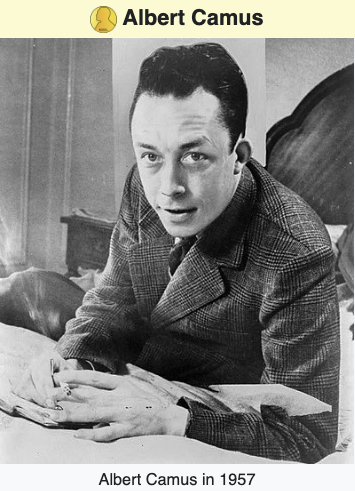
Albert Camus:
(Mondovi, French Algeria, 7 November 1913 – Villeblevin, 4 January 1960).
French philosopher, journalist and writer of novels, essays and plays. He received the Nobel Prize in Literature in 1957.
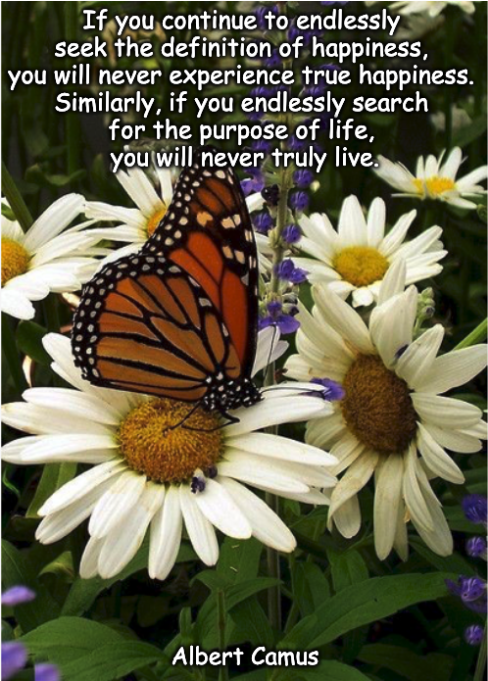
You will never be happy if you continue to search for what happiness consists of. You will never live if you are looking for the meaning of life.
In the depth of winter, I finally learned that there was in me an invincible summer.
Autumn is the second spring when every leaf is a flower.
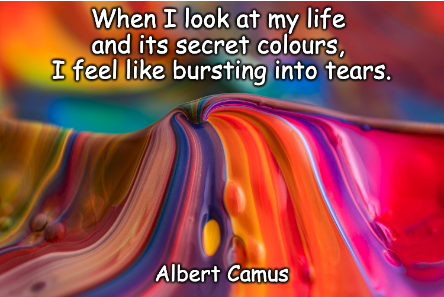
When I look at my life and its secret colours, I feel like bursting into tears.
If you continue to endlessly seek the definition of happiness, you will never experience true happiness. Similarly, if you endlessly search for the purpose of life, you will never truly live.
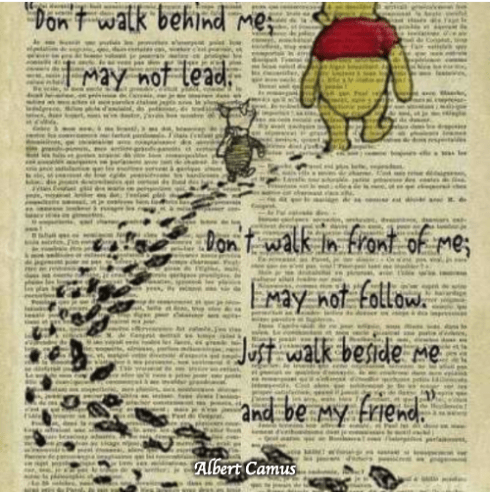
Don’t walk in front of me… I may not follow
Don’t walk behind me… I may not lead
Walk beside me… just be my friend.
You cannot create experience. You must undergo it.

Only truth can face injustice. Truth, or love.

The only means to fight the plague is honesty.
But the heart has its own memory, and I have forgotten nothing.
Source: Quote by Albert Camus, from his novel “La Chute” (1956), translated as “The Fall.”
If man fails to reconcile justice and freedom, then he fails at everything.
Autumn is a second spring when every leaf is a flower.
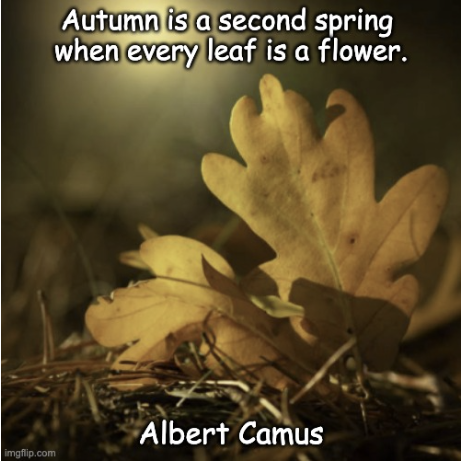
The line is a small paradox built to overturn the usual association of autumn with decline and death. Where spring is the season of new growth, autumn is usually cast as the season of dying — leaves fall, colors fade, the year winds down. Camus flips that: He calls the leaves “flowers,” meaning that the vivid reds, oranges, and golds of autumn are their own kind of blossoming — a final, brief flourishing of color and beauty before winter, rather than mere decay.
It fits Camus’s broader philosophical outlook (closely tied to his idea of the absurd and his attention to sensory, physical joy in the world, especially visible in his essays about the Mediterranean and Algeria):
Rather than treating aging, ending, or decline as pure loss, he suggests that endings can have their own beauty and intensity — sometimes more vivid than the beginning. It’s a meditation on finding vitality and renewal in what looks like decline, and, by extension, an invitation to see the later stages of life (or any cycle) as another kind of flowering rather than only a falling away.
Author & Origin:
It comes from Camus’s essay collection “L’Été” (“Summer”), published in 1954. Camus wrote it in French; the commonly cited English translation reads:
“Autumn is a second spring when every leaf is a flower.”
The original line is closer to “L’automne est un deuxième printemps où chaque feuille est une fleur.”
A note of caution worth passing on:
This is one of those quotes that circulates constantly on calendars, mugs, and social media, often stripped of context, and misattributions are common with lines like this. I don’t have the exact essay or page pinned down with certainty (Camus wrote several pieces collected in “L’Été”, including “Retour à Tipasa” and “Noces à Tipasa,” and this line is often linked to his writing about his native Algeria).
If the world was comprehensible, there would be no art.
There always comes a time in history when anyone who dares to say that two and two make four is punished by death. The teacher knows it well.
The tragedy of old age is not that one is old, but that one is young. Inside this aging body is a heart still as curious, still as hungry, still as full of longing as it was in youth. I sit at the window and watch the world pass by, feeling like a stranger in a strange land, unable to relate to the world outside, and yet within me, there burns the same fire that once thought it could conquer the world. And the real tragedy is that the world still remains, so distant and elusive, a place I could never quite grasp.
All systems of morality are based on the idea that an action has consequences that legitimize or cancel it. A mind imbued with the absurd merely judges that those consequences must be considered calmly. It is ready to pay up. In other words, there may be responsible persons, but there are no guilty ones, in its opinion.
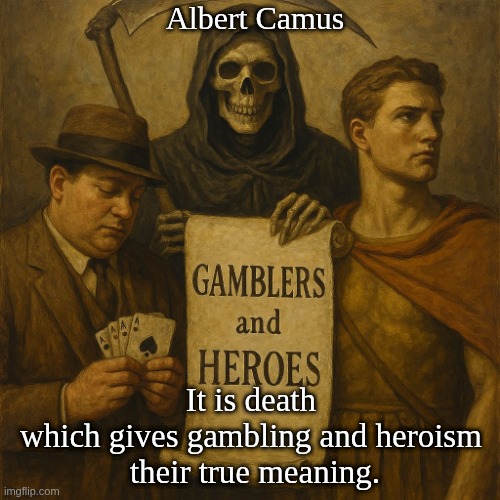
It is death which gives gambling and heroism their true meaning.
The beautiful September sky – and a kind of fury, rage, despair and love suddenly came to my heart.
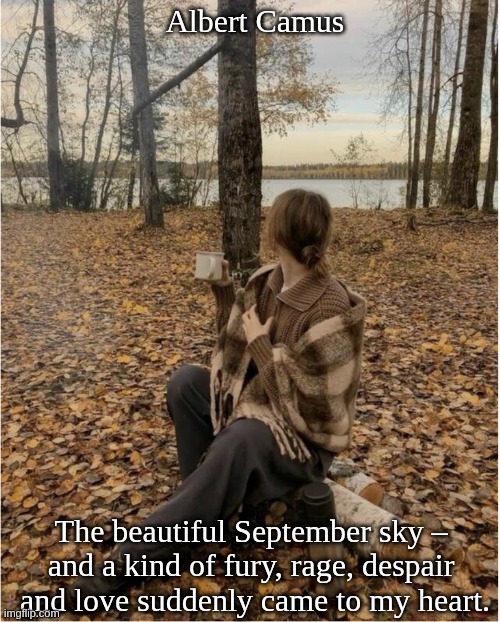
Camus describes a sudden rush of powerful, conflicting emotions provoked by the beauty of the September sky. The contrast is central:
– The beautiful sky:
suggests serenity, freedom, and the vitality of nature.
– Fury, anguish, and despair:
reflect inner suffering and awareness of life’s harshness or absurdity.
– Love:
expresses his intense attachment to life despite that suffering.
In essence, the passage captures a characteristically Camusian experience:
– ’the world can be overwhelmingly beautiful even while human existence feels painful, irrational, and tragic’.
✍️ Author: Albert Camus (1913–1960), French-Algerian writer and philosopher
Origin: “Notebooks, 1935–1942”
— originally published in French as “Carnets I: ‘Mai 1935–février 1942’
– Camus’s notebooks were published in French after his death; the first volume appeared in 1962.
A commonly cited version is:
> “The beautiful September sky. And suddenly a sort of anguish, rage, despair, and love rises up in me.”
The underlying French is generally given as:
> « Le beau ciel de septembre. Et tout à coup une sorte d’angoisse, de rage, de désespoir et d’amour monte en moi. »
Wording differs among English translations: “anguish” may become “fury,” and ‘monte en moi’ may be rendered as “rises within me,” “wells up in me,” or “comes to my heart.”
It is a literary quotation or reflective notebook entry. Its meaning comes from its imagery and emotional contrast rather than from a fixed figurative expression.
I imagine you, all the time.
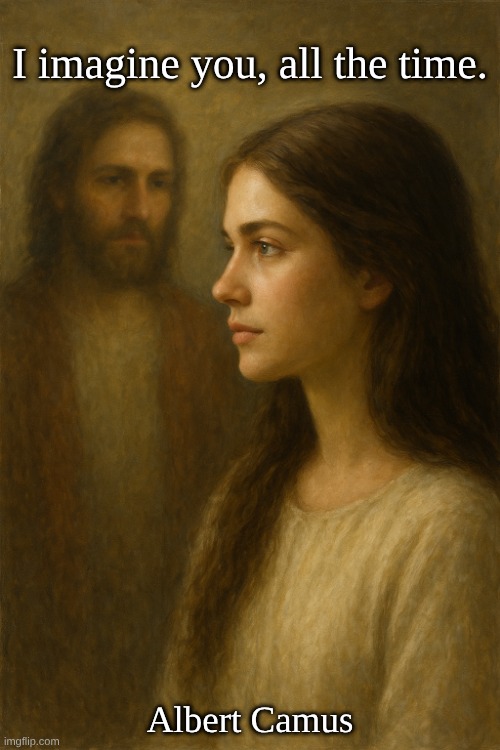
Origin: The expression is of biblical origin. It goes back to passages from the Old Testament, including the Psalms (16:8), and is attributed to David.
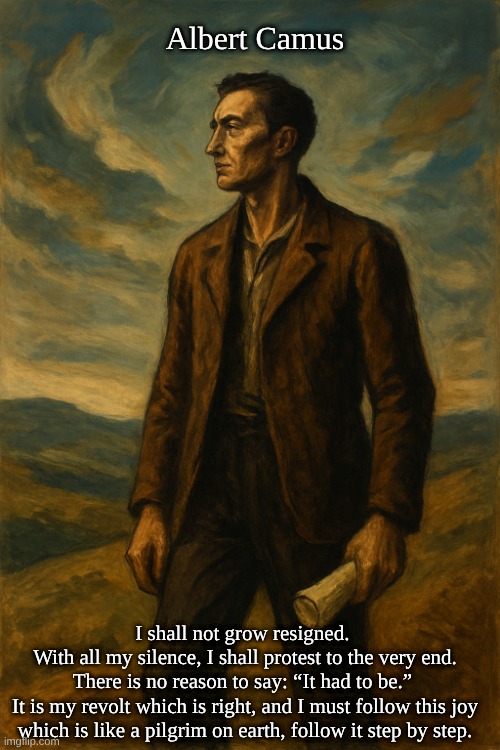
I shall not grow resigned. With all my silence, I shall protest to the very end. There is no reason to say: “It had to be.” It is my revolt which is right, and I must follow this joy which is like a pilgrim on earth, follow it step by step.
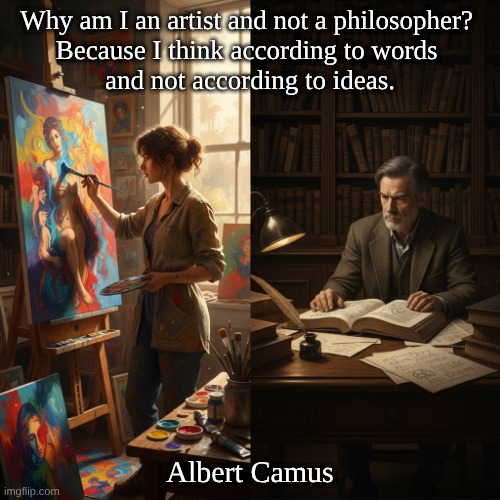
Why am I an artist and not a philosopher? Because I think according to words and not according to ideas.
An intellectual is someone whose mind watches itself.

But I also love you in my sleep, carry you with me in my dreams.

This phrase expresses a ‘deep, constant, and unconditional love.’ It means that love for the beloved doesn’t end with waking life, but also permeates the subconscious and the world of dreams. It’s a declaration of total attachment, where the presence of the loved one is constantly felt, even in the unconsciousness of sleep. It suggests that the beloved is an integral part of the speaker’s existence, a source of comfort and happiness, even in the darkness of night.
📜 Origin and Author:
This quote is often attributed to Albert Camus, a French writer, philosopher, and playwright famous for his existentialist and absurdist works. It is said to come from his novel “The First Man,” published posthumously in 1994. In this unfinished autobiographical novel, the protagonist, Jacques Cormery (who represents Camus himself), explores his past and his relationships, particularly with his mother. The phrase could be interpreted as an expression of the deep and complex filial love Camus felt for his mother.
🖋️ Context: “The First Man” is an introspective work in which Camus revisits his childhood in Algeria, his relationship with his illiterate and silent mother, and his quest for identity. The phrase could be spoken by the narrator to his mother, or perhaps to a lover, but within the context of the novel, it resonates particularly with the unconditional and sometimes difficult love he feels for his mother. It testifies to the depth of his feelings and the central place she occupies in his life, even in his most intimate and personal moments.
