Peggy Toney Horton:
West Virginia, USA
American journalist, author and blogger.
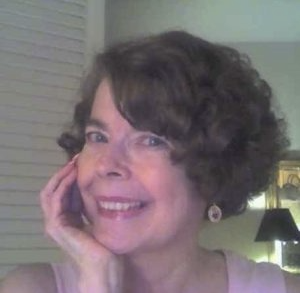
Whenever it is a damp, drizzly November in my soul, I shall recall the memory of warm, sunny, late summer afternoons like this one, and be comforted greatly.
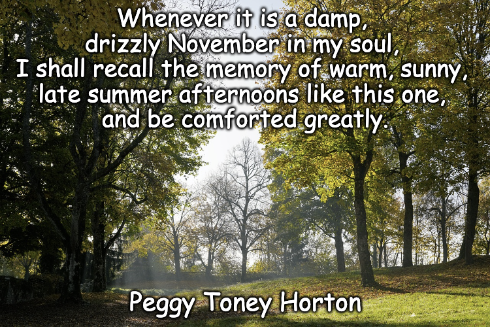
The sentence describes using a happy memory to overcome sadness:
– “A damp, drizzly November in my soul”:
is a metaphor for depression, gloom, or emotional coldness.
– Remembering ‘warm, sunny late-summer afternoons’ provides comfort and restores emotional warmth.
In simpler terms:
‘When I feel bleak or unhappy, I will remember beautiful days and feel better.’
Origin and authorship 📚:
The complete sentence is widely attributed to Peggy Toney Horton, an American writer and poet. However, its most memorable phrase is an unmistakable adaptation of the opening paragraph of Herman Melville’s “Moby-Dick” (1851), Chapter 1, “Loomings”:
> “Whenever I find myself growing grim about the mouth; whenever it is a damp, drizzly November in my soul…”
Horton’s version turns Melville’s image of inner melancholy into a reflection on memory and consolation.
Best attribution:
If quoting the entire sentence, you can write:
> “Whenever it is a damp, drizzly November in my soul, I shall recall the memory of warm, sunny, late summer afternoons like this one, and be comforted greatly.”
> Peggy Toney Horton, echoing Herman Melville’s “Moby-Dick”.
The attribution to Horton is common online, although a ‘clearly documented original print source for the quotation is difficult to establish’. The phrase “a damp, drizzly November in my soul” itself should unquestionably be credited to Herman Melville.
What could be more exciting than an October day? It’s your birthday, Fourth of July, and Christmas all rolled into one.
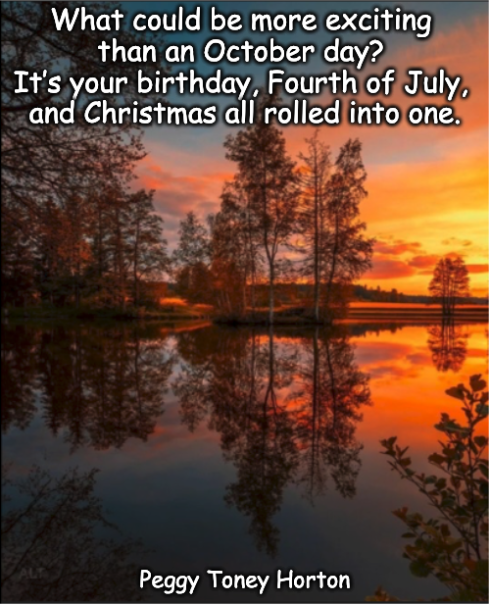
This sentence uses a ‘rhetorical question + comparison’ structure to convey ‘extreme excitement or anticipation’. The author combines three major celebratory occasions to create a vivid image:
– 🎂 Birthday → personal joy and being the center of attention
– 🎆 Fourth of July → fireworks, celebration, communal excitement
– 🎄 Christmas → gift-giving, magic, anticipation
By saying an October day feels like ‘all three combined’, the speaker emphasizes a feeling of ‘maximum excitement’. This phrasing is often used in contexts related to:
– 🍂 Harvest festivals
– ⚾ Baseball (World Series season)
– 🎃 Halloween anticipation
– 🏫 School/sports events in autumn
✍️ Author: Peggy Toney Horton?
On all the quote websites where this saying by Peggy Toney Horton appears (and there are many), no specific source is cited.
– So, I don’t have reliable, ‘confirmed information’ linking this exact quote to Peggy Toney Horton.
– It’s possible this quote appears in a poem, essay, or book attributed to her — but I don’t have verified access to that source.
🔍 Origin:
Similarly, I ‘don’t have confirmed details’ about:
– The original publication (book, poem, article, or speech)
– The date it was written
This is October for me. Withdrawing into my own world, blocking out everything except the beauty of the season, my reflections, and my relationship with God, I find that this is enough to sustain me through the long cold winter, and beyond.
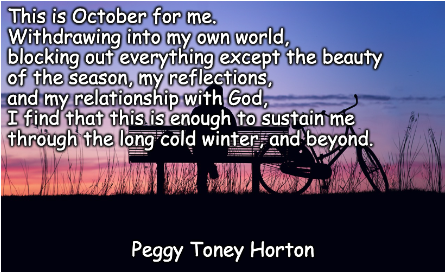
🍂 Seasonal Symbolism:
– October serves as a ‘metaphor for a transitional emotional state’ — between fullness (summer/life) and dormancy (winter/loss)
– The month becomes a ‘personal ritual marker’, not just a calendar reference
🚪 Withdrawing Into One’s Own World:
– Signals ‘intentional, chosen solitude’ — not isolation from despair, but retreat for ‘restoration’
– Fits a ‘grief-processing framework’, especially given the book’s context (see Origin below)
✨ The Three Sustaining Pillars:
1. ‘Beauty of the season’ 🍁:
— grounding through nature’s sensory richness
2. Personal reflections 🤔:
— inward emotional and mental processing
3. Relationship with God ✝️ :
— spiritual anchor and source of peace
❄️ “Sustain Me Through the Long Cold Winter, and Beyond”
– Winter:
= both ‘literal season’ and ‘metaphor for hardship/grief’
– Suggests these October practices act as ‘spiritual provisions’, stored up like a harvest, to carry the author through darker emotional seasons
– “And beyond” hints at ‘long-term resilience’, not just surviving one winter but life’s broader struggles
🕊️ Reading Through the Book’s Lens:
Given the source title, the passage likely reflects:
– Grief over the ‘loss of her mother’
– October as a ‘season of mourning and remembrance’
– Faith as the ‘coping mechanism’ carrying her forward
📚 Origin:
– Book: “Somewhere in Heaven My Mother Is Smiling”
– Genre: Appears to be a ‘Christian inspirational memoir/devotional’, likely centered on ‘grief, faith, and maternal loss’
– Platform cited: Goodreads (quote attribution)
✍️ Author:
– Peggy Toney Horton
– Based on the book’s title and tone, she appears to write in the ‘Christian inspirational/grief-memoir tradition’, similar to authors like Max Lucado or Sheila Walsh
– The reflective, faith-centered voice in this quote aligns with that genre’s typical style 💛.
Ah, lovely October, as you usher in the season that awakens my soul, your awesome beauty compels my spirit to soar like a leaf caught in an autumn breeze and my heart to sing like a heavenly choir.
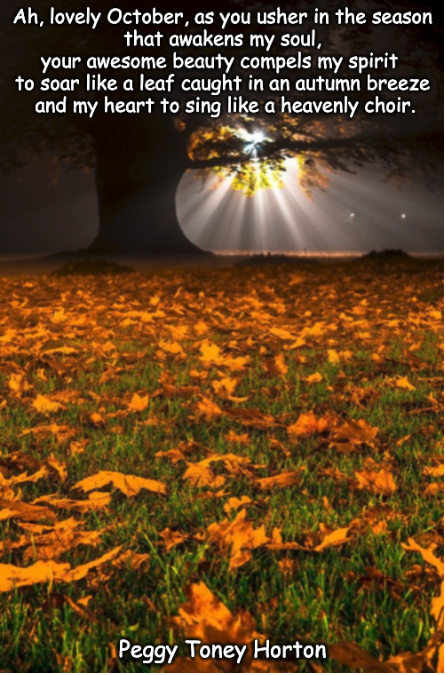
It’s a poetic apostrophe, a direct address to the month as if October were a person. Roughly:
– “Season that awakens my soul”:
Autumn stirs something deep in her, a sense of renewal and heightened feeling, even though it’s also the season of things dying back.
– “Spirit to soar like a leaf caught in an autumn breeze”: She feels lifted and carried along, as lightly as a drifting leaf.
– “Heart to sing like a heavenly choir”:
The beauty is so overwhelming that it produces something close to reverence or worship.
Overall it’s an expression of pure delight in October, treating the season as a spiritual experience as much as a visual one. Its warm, sentimental tone is why it turns up so often in magazine editorials and autumn quote roundups.
Origin:
‘I couldn’t trace it to a specific book’. It appears to come from Horton’s autumn-themed writing, which is often quoted around the fall season. She is also credited with a companion line that opens with “Ah, September!” and calls that month a doorway to the season that awakens her soul, loved mainly as a prelude to her beloved October. The two lines read like a pair, with September as the doorway and October as the full arrival.
Author:
The sentence is credited to Peggy Toney Horton, author, and many quote collections repeat that credit (including one that lists it alongside her September counterpart).
My beloved October has returned—with its brilliant colors, cool temperatures, and sunny, cloudless, azure skies, and I must enjoy it before it escapes for another year.
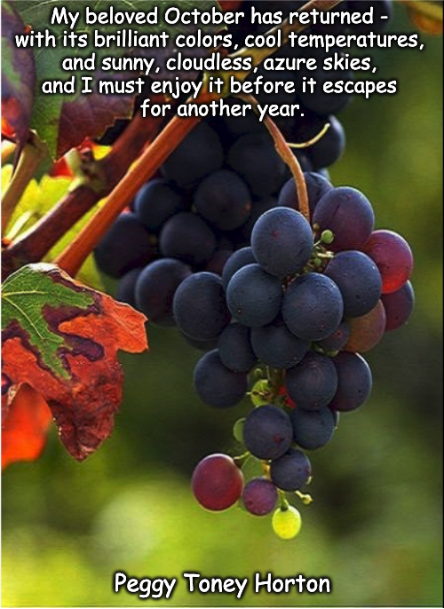
The sentence is a short tribute to October.
The writer greets the month as a beloved friend who has come back, and names what she loves about it: the brilliant autumn foliage, the cool air after summer heat, and the clear, sunny, deep-blue skies. The last clause gives it a bittersweet edge. October is brief, so she feels she must enjoy it fully before it “escapes for another year.” It is a seasonal version of ‘carpe diem’:
‘Appreciate a fleeting, lovely time while you have it.’
Origin:
The sentence is attributed to the book “Somewhere in Heaven My Mother Is Smiling”. It is a 124-page paperback, published by Xlibris on February 10, 2011 (ISBN-10 1456856111; ISBN-13 978-1456856113). The personal, nostalgic tone suggests it comes from a short essay or reflection about October rather than a poem or a standalone saying. I haven’t seen it on the page itself, and I couldn’t find the book through my own searches. The source is a quote roundup that cites the book, plus the publication details supplied, so the exact chapter and page number are unconfirmed.
Author:
Peggy Toney Horton. Quote Ambition and other roundups credit her with this sentence. She is a West Virginia writer who was the daughter of a coal miner, and she writes about family, faith and Appalachian life. The attribution is well supported, but it rests on secondary sources, not on the book itself.
Ah, September! You are the doorway to the season that awakens my soul, but I must confess that I love you only because you are a prelude to my beloved October.
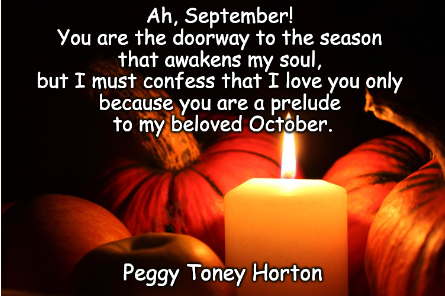
The line personifies September as a “doorway” — a threshold rather than a destination in itself. The speaker’s love for September isn’t really about September’s own qualities; it’s anticipatory. September matters because of what it promises: October. The “confession” is the emotional turn — an admission that this isn’t pure appreciation of the present moment but excitement for what’s coming next. It’s a common move in autumn writing: treating the early transitional month as valuable mainly as a herald of the “real” payoff, October, with its fuller fall color, cooler air, and cultural associations (Halloween, harvest, peak foliage).
Origin:
The trail runs cold here. The quote circulates widely across quote-aggregator sites, greeting-card content, and seasonal listicles — Goodreads lists it under tags like October, prelude, season, September, soul, and a Yahoo roundup of September quotes includes it alongside lines from Jacqueline Kennedy Onassis and Faith Baldwin — but none of these trace it back to an original book, poem, essay, or publication. That’s typical of “inspirational quote” material: it gets endlessly recirculated online with an attributed name, but the original source was either never indexed or has been lost in the copying.
Author:
Peggy Toney Horton ‘is credited everywhere this quote appears’, but she isn’t a documented literary figure in the usual sense — no Wikipedia page, no traceable bibliography. Several other September/autumn quotes are attributed to her in similar quote collections (e.g., “As the alluring song of September begins to whisper in my ear, my passionate spirit yearns for the splendor of its promise”), suggesting she may have written a body of seasonal/inspirational quotes, possibly self-published, greeting-card material, or blog content, but I can’t confirm more than that from available sources.
As the alluring song of September begins to whisper in my ear, my passionate spirit yearns for the splendor of its promise.
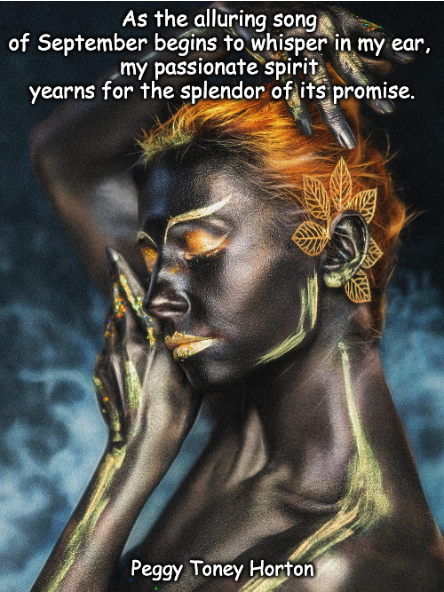
The line personifies September as a seductive, musical presence — its “alluring song” — that stirs something in the speaker. “Passionate spirit” and “yearns” frame the arrival of the season not just as a shift in weather, but as an emotional pull: a longing or anticipation for what’s coming. “Splendor of its promise” suggests the focus is on anticipation — the beauty September is about to unfold — rather than beauty it already holds. It fits Horton’s broader style: warm, nostalgic, faith-inflected reflections on the seasons, memory, and family (she has a companion line about October calling it “the season that awakens my soul”).
Origin:
The quote isn’t tied to one specific famous published work with a clear citation. It circulates on quote-aggregator sites (Goodreads, IZ Quotes, Quote Garden, The Guardian, and various “September quotes” roundups) with identical wording and consistent attribution to her, and a couple of her other quotes have been picked up in published quote-collection books (“She Said What? Quotable Women Talk Aging” by Dr. Kathleen Cannon; “Quotes to Live Your Life By!” by Emma Careford). Given her body of work — personal essays and seasonal reflections published in “The Charleston Gazette” and blogs like “Peggy’s Ponderings” — this line most likely comes from one of those essays or blog posts rather than from a poem or book chapter, but no specific original source is cited anywhere I found.
Author:
Peggy Toney Horton is a real, documented personal-essay writer and columnist who lives in a small town near Charleston, West Virginia. She’s a long-time contributor to the “Charleston Gazette-Mail” (notably its “Essays on Faith” column), and her work has also appeared in “USA Deep South”, “All Things Girl,” “Midlife Collage”, “Bewildering Stories”, “Front Porch Magazine”, “Page & Spine”, “Memoirabilia”, and “A Quiet Courage.” She’s the author of several books, including “Somewhere in Heaven My Mother Is Smiling” (2011) — which was among the top 100 imported books in China in 2011–2012 — along with “Unseen Angels”, “Sweet Whispers of Youth”, “Stop the World and Get Off”, “Does God Want Us to Be Happy”, “Cries of a Broken Spirit”, “Sunshine Hollow”, ‘Dancing With Sugarplums”, and “She Did It Her Way”. She lost her son to cancer in 2020, and some of her more recent essays reflect on that grief.
