Truman García Capote:
(New Orleans, 30 September 1924 – Los Angeles, 25 August 1984).
American writer. He wrote fiction, non-fiction, short stories and plays. His best-known works are In Cold Blood (1966) and the novella Breakfast at Tiffany’s (1958). At least 20 films and television series have been made from his works.

Aprils have never meant much to me, autumn seems like the season of beginning, spring.
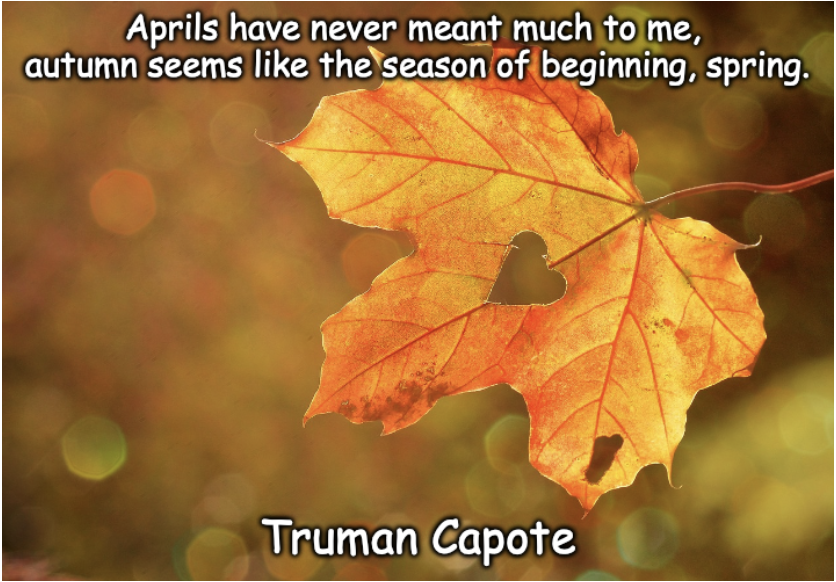
Capote reverses the usual symbolism of the seasons:
– ‘April/spring’ conventionally represents renewal and new beginnings.
– For the narrator, however, ‘autumn’ feels like the true season of renewal.
– The final word, “spring,” metaphorically renames autumn as his personal spring.
The compressed wording can be understood as:
> “April has never felt important to me; autumn feels like the real season of beginnings—my spring.”
It also reflects the experience of city life:
‘after the stillness or dispersal of summer, autumn often brings people back, begins new routines, and creates a sense of renewed possibility’.
✍️ Textual note:
The standard wording uses the plural “autumns,” rather than the singular “autumn”:
> “Aprils have never meant much to me, autumns seem that season of beginning, spring.”
📖 Author and origin:
This sentence is by Truman Capote.
It appears in his 1958 novella “Breakfast at Tiffany’s”, spoken by the unnamed narrator:
> “Aprils have never meant much to me, autumns seem that season of beginning, spring.”
Some quotation databases cite the collection “Breakfast at Tiffany’s and Three Stories”, but the line itself comes from the novella. It is from Capote’s prose, not originally from the 1961 film screenplay.
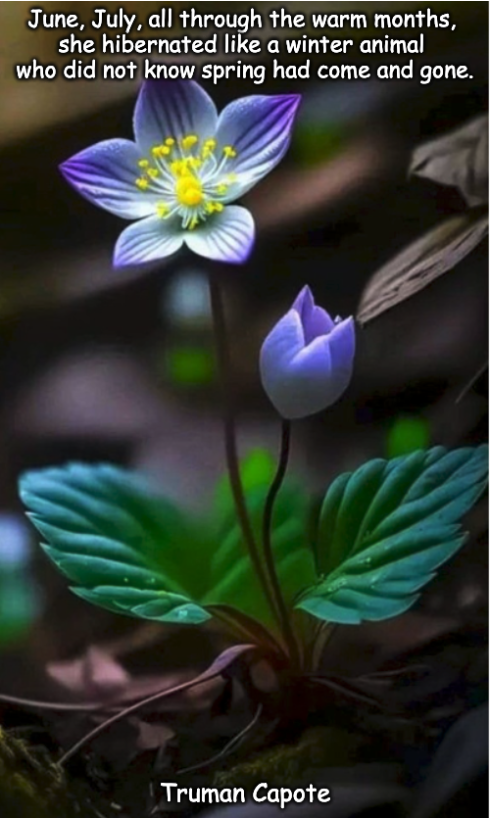
June, July, all through the warm months, she hibernated like a winter animal who did not know spring had come and gone.
In plain words:
– “to hibernate” = to do nothing, to isolate oneself, to be passive, to sleep/hide away.
– “like a winter animal” = like an animal that normally hibernates in the winter.
– “that did not know that spring had come and gone” = she misses the period of awakening, renewal, life, and opportunities.
👉 The sentence thus suggests ‘isolation, lethargy, depression, or emotional numbness’ — someone does not empathize with the seasons or with the life around her.
📚 Origin:
This is a ‘literary imagery’: a poetic comparison from a book.
✍️ Author: Attributed to Truman Capote.
📖 The passage is from “The Grass Harp” by Capote from 1951.
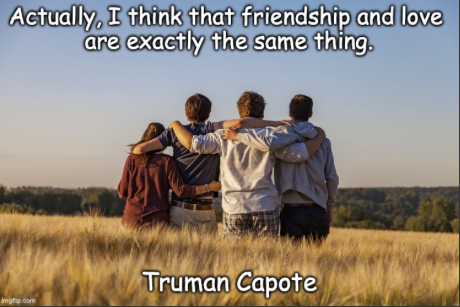
Actually, I think that friendship and love are exactly the same thing.