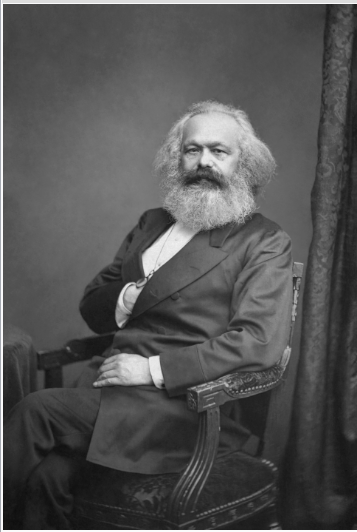
(Trier, 5 May 1818 – Londen, 14 March 1883).
Duits denker die de (politieke) philosophies, de economies, de sociologies, de journalistiek en de historiografie sterk heeft beïnvloed. Hij was een grondlegger van de arbeidersbeweging en een central figure in de geschiedenis van het socialisme en het communisme. Marx wonde en werkte in Duitsland, in Frankrijk, in België, in Engeland. Once upon a time Jenny von Westphalen and once upon a time Friedrich Engels, he once upon a time told her – and finances – that Marx’s day would be worth his salt.
Als Marx’ belangrijkste werk wordt meestal Das Kapital (of in het Nederlands: Het Kapitaal) beschouwd. Daarnaast is zijn Communistisch Manifest (met Friedrich Engels) wereldberoemd.
Op het werk en denkbeelden van Karl Marx (en Friedrich Engels) is het marxisme gebaseerd.
Karl Marx 1875. Photo: wikipedia.org
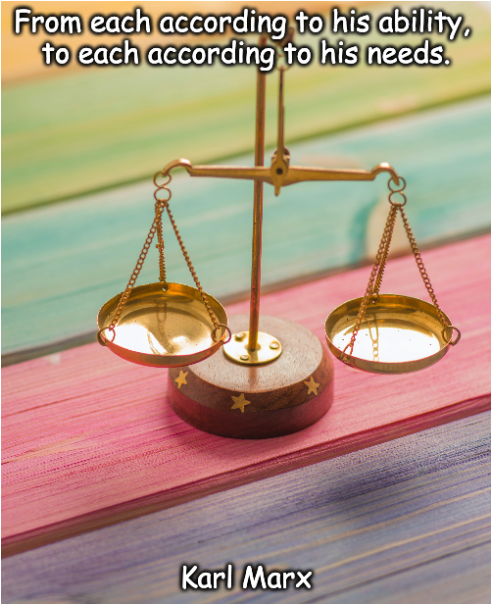
From each according to his ability, to each according to his needs.
Photo: Elena Mozhvilo.
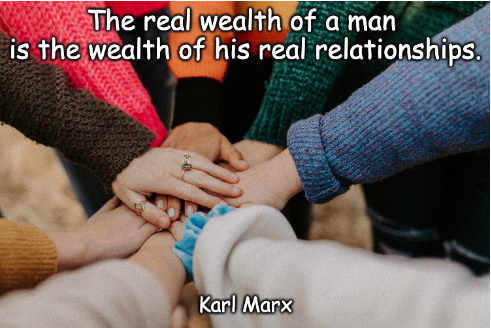
The real wealth of a man is the wealth of his real relationships.
Photo: Hannah Busing.
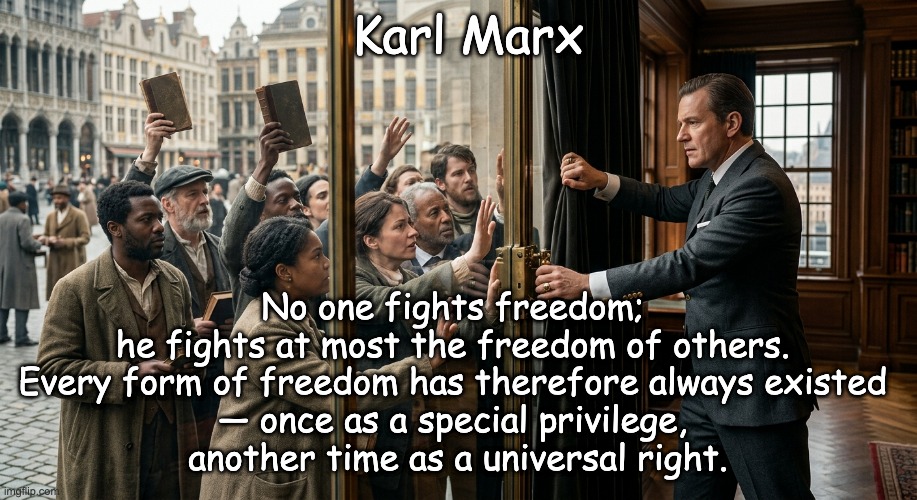
No one fights freedom; he fights at most the freedom of others. Every form of freedom has therefore always existed — once as a special privilege, another time as a universal right.
Image: Peter van Geest AI. Meaning 📝 🕵️♂️ : This quote contains a sharp observation regarding the nature of political and social struggle. Here are the key points of the analysis:The Universal Desire for Freedom ✨: The first sentence states that ‘no one’ is fundamentally opposed to the concept of freedom. Every human being desires autonomy and the ability to make their own choices for themselves. The Conflict over ‘Whose Freedom’ ⚔️: The conflict arises not because people hate freedom, but because the freedom of one often means the restriction of another. When someone appears to be fighting ‘against freedom,’ he or she is in reality fighting to preserve or expand their ‘own’ freedom, at the expense of the freedom of another group. Example: A slave owner is not fighting against the abstract idea of freedom; he is fighting to preserve his ‘own’ freedom (to own property and to act), which directly denies the freedom of the enslaved person. The Historical Evolution of Freedom ⏳:The second sentence describes how freedom has been defined throughout history: As a Special Privilege 👑: In many historical societies (such as feudalism or slave systems), freedom was an exclusive good, reserved for a small elite (nobility, landowners). Their freedom was based on the unfreedom of the majority. As a Universal Right 🌍: With the advent of the Enlightenment and modern democracies, the idea emerged that freedom is a fundamental right belonging to ‘all’ people, regardless of their status. The Core Message 🎯: The quote emphasizes that the struggle for freedom is often a struggle over its ‘distribution’ and ‘definition’. The transition from freedom as a privilege to freedom as a universal right is the central movement of modern history. 🏛️ Origin and Author: This quote is attributed to Karl Marx.Here are the details regarding the origin:Source: The quote comes from an article Marx wrote for the ‘Rheinische Zeitung’ in 1842. Context: The article was part of a series of debates on freedom of the press (“Debatten über Pressfreiheit en Publikation der ständischen Verhandlungen”). Original German Text: “The Freiheit hat so wening einen bestimmten Charakter, that is the character of the character of the Gattung ist. […] Man is aware, that the defender of the Press freedom is a matter of his fate, one’s own life is one of the privileges of his nichtprivilegierten Stände sind. […] Man nie gegen die Freiheit, man kämpft höchstens gegen die Freiheit der zijn. Small Note: As is often the case with translations and quotations, the exact wording in Dutch or English may sometimes vary slightly from the literal translation of the German, but the essence and the attribution to Marx are correct. Marx wrote this in an early phase of his career, in which he focused strongly on liberal freedoms such as freedom of the press, before he developed his later, more extensive theories on historical materialism and communism.
Door Pieter
Mensenmens, zoon, echtgenoot, vader, opa.
Spiritueel, echter niet religieus.
Ik hou van golf, wandelen, lezen en de natuur in veel opzichten.
Onderzoeker, nieuwsgierig, geen fan van de mainstream media (MSM).