Sii un libero pensatore e non accettare tutto ciò che senti una verità. Sii critico e valuta ciò in cui credi.
Una hirundo non facit ver.
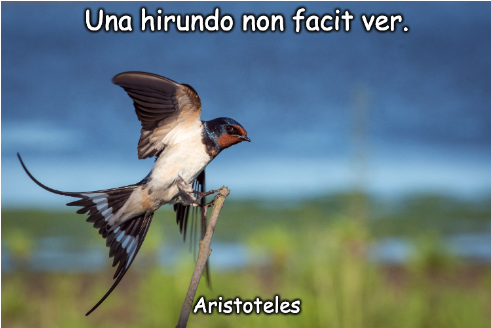
> ‘One favorable sign or one positive event is not proof that everything is permanently good or that a trend has truly begun.’
In other words:
do not jump to conclusions too quickly based on a single example.
Example:
– If a company makes a profit for one month, that does not mean it is financially healthy.
– If it is warm for one day in March, it is not really summer yet.
🏛️ Origin:
The expression dates back to ‘classical antiquity’, particularly to the idea that a ‘swallow’ is a sign of warmer weather. But one swallow returning early does not mean that the warm season has truly begun.
The original thought was often rather:
> *One swallow does not make a spring.”
✍️ Author: Aristotle?
Yes, the best-known and oldest literary source is indeed Aristotle — often misspelled as ‘Aistoteles’.
In his “Nicomachean Ethics”, Book I, Aristotle uses a similar formulation:
> “For just as one swallow or one beautiful day does not make a spring, so one day or a short time does not make a person happy and prosperous.”
📌 Important nuance:
Aristotle is probably ‘not the originator’ of the saying. He presumably uses it as a proverb or metaphor already known at the time. Therefore, you can say:
– Oldest known source: Aristotle
– ‘Probable author: unknown / folk wisdom from ancient Greece’.
– Became known via:
Aristotle and later Latin and European proverb collections
📚 Related version
The same expression exists in English:
> “One swallow does not make a summer.”
And in Latin, one encounters forms such as:
> “Una hirundo non facit ver”*
> “One swallow does not make a spring.”
