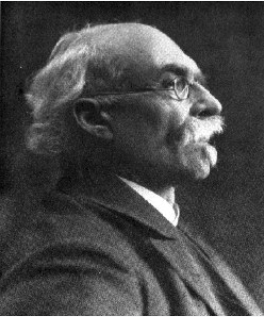
Hans Vaihinger:
(Nehren, 5 September 1852 – Halle (Germany), 18 December 1933).
German philosopher. He was a Neo-Kantian philosopher and is best known for his book “Die Philosophie des Als Ob” (1911). In his work, he combines Immanuel Kant’s transcendental idealism with elements from evolutionary theory and positivism.
The human imagination of the world is an immense web of fictions full of logical contradictions.
– Humans do not perceive the world in a purely or completely objective way.
– They construct a ‘mental model’ of the world.
– This model consists of concepts, categories, simplifications, and assumptions.
– Many of these assumptions are not ultimate truths, but rather ‘useful fictions’.
– Although they may be logically problematic or even contradictory, they help us understand the world and act within it.
🧩 What does “fiction” mean here?
For Vaihinger, “fiction” does not simply mean “lie” or “nonsense.”
For him, a fiction is an assumption that one knows or suspects is not entirely true, but which is nevertheless practically helpful.
Examples of such “as-if” fictions:
– We act ‘as if’ mathematical points, lines, or numbers were real things.
– We speak of the “I” as if it were a fixed, unchanging entity.
– In legal scholarship, companies or states are treated “as if” they were “persons.”
– In science, we work with models that simplify reality.
These thought patterns are not necessarily literally true, but they work.
👤 Originator: Hans Vaihinger.
– Born: 1852
– Died: 1933
– Nationality: German
– Profession: Philosopher
– Known primarily for his theory of the “Philosophy of As If.”
📖 Work:
> ‘The Philosophy of As If. System of the Theoretical, Practical, and Religious Fictions of Humanity.’
– First published: 1911.
– Vaihinger developed the basic ideas earlier, around the 1870s.
– The work is influenced by Immanuel Kant, but also closely resembles later pragmatic and constructivist schools of thought.
🔍 Vaihinger’s core idea:
> People constantly act and think ‘as if’ certain assumptions were true—even though, strictly speaking, they are not.
This means:
– Truth is not always the only criterion.
– Utility, orientation, and the ability to act also play a significant role.
– Many of our concepts are tools, not direct reflections of reality.
