(10 February 1775 – 27 December 1834).
English essayist, poet, and antiquarian, best known for his Essays of Elia and for the children’s book Tales from Shakespeare, co-authored with his sister, Mary Lamb (1764–1847).
Friends with such literary luminaries as Samuel Taylor Coleridge, Robert Southey, William Wordsworth, Dorothy Wordsworth and William Hazlitt, Lamb was at the centre of a major literary circle in England. He has been referred to by E. V. Lucas, his principal biographer, as “the most lovable figure in English literature”.
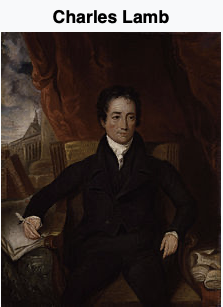
Charles Lamb. Portret: Henry Hopper Meyer – wikipedia.org
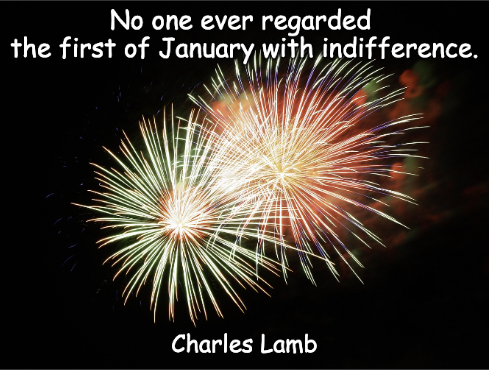
No one ever regarded the first of January with indifference.
Photo: Eric Spaete. Meaning: This quote emphasizes that January 1st, as the beginning of a new year, often evokes strong emotions in people. Many people make plans or resolutions, reflect on the past year, or celebrate the new year with friends and family. Origin: The quote suggests that January 1st is an important milestone in time, often seen as an opportunity for renewal and change. Author: This quote comes from Charles Lamb, an English essayist and poet who lived in the 19th century. Summary: January 1st is a time of reflection and emotion, and this quote captures the essence of how people experience this day.
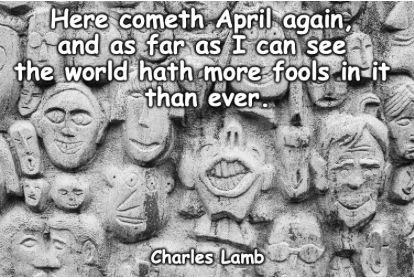
Here cometh April again, and as far as I can see the world hath more fools in it than ever.
Photo: Andrew Seaman. 🧐 Meaning and Context: 🕵️♀️ Analysis of the Quote: “Here comes April again…” The Literal Meaning:At first glance, the meaning is quite simple and cynical: The speaker notes that it is April again (the month of April 1st / All Fools’ Day). He observes the world around him and concludes that the number of ‘fools’ or ‘madmen’(fools) seems to have increased since the last time it was April. The Context: All Fools’ Day: This quote comes from an essay dedicated to April 1st. In that context, the quote is less of a harsh insult and more of a ‘playful, somewhat melancholic reflection’ on human nature. In his essay, Lamb actually celebrates ‘folly’. He invites the reader to set aside their dignity for a moment and join in the harmless nonsense of the day. The remark that there are “more fools than ever”can therefore also be read as: “There are once again enough people willing to not be serious for a while.”✍️ Author:Charles Lamb (Elia) (1775–1834). Who was Charles Lamb? He was a highly respected English essayist, poet, and antiquarian. He is known for his personal, humorous, and sometimes whimsical writing style. He wrote many of his most famous essays under the pseudonym ‘Elia’. 📚 Origin and Source: This quote does ‘not’ come from a personal letter, but from one of his published essays. The Exact Source:Author:Charles Lamb (under the pseudonym Elia). Essay: “All Fools’ Day”*(1 April). Collection: This essay was part of his most famous collection: Essays of Elijah. First Publication: The ‘Essays of Elijah’ were first published as a collected volume in 1823 (although the essays themselves had already appeared in magazines before that, such as ‘The London Magazine’). Where does the confusion with letters come from? It appeared in a “letter collection (published in 1838)”. This is likely how the quote website (A-Z Quotes) categorized it. It is possible that the quote was ‘also’ cited in a letter from Lamb, or that the website used a posthumous collection of his works (which contained both letters and essays and was published after his death in 1834) as a source. However, the primary and original source is the essay “All Fools’ Day” from 1823. 😊
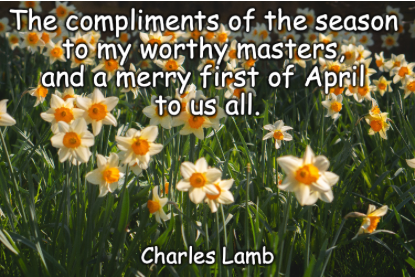
The compliments of the season to my worthy masters, and a merry first of April to us all.
Photo: Eilis Garvey. Meaning 🤔: A Mix of Joy and Mockery. This phrase carries a rich layer of meanings: Joy and Celebration: It is a celebration of the beginning of spring, the time of renewal and joy. The “compliments of the season” likely refer to the warmth and light that spring brings. Mockery and Satire: Lamb was known for his satirical writing style. The reference to “worthy masters” may be meant ironically, as a playful jab at authority, or as a way to challenge social hierarchy. Universal Equality: The wish for a “happy first of April to us all” suggests a sense of universal equality. It reminds us that we are all human, with our own virtues and flaws, and that we can laugh and enjoy the little things in life together. 🕵️♂️ Origin: A Mystery Unraveled. The most likely author of this quote is Charles Lamb (1775-1834). He was a renowned English essayist and poet, known for his lively writing style and sharp observations. The sentence comes from his essay titled “On the Origin and Customs of Fools’ Day.” This essay was published in the magazine “London Magazine” in 1821. It is important to note that the essay was part of a broader collection of essays known as the “Essays of Elijah,” which Lamb wrote under the pseudonym “Elijah.” 📚 The Context: A Time of Change: The essay was written during a time of great social and political change in England. The Industrial Revolution was in full swing, and society was in flux. Lamb’s essay can be seen as a reflection on these changes, a way to explore and understand the complexity of human existence. 🌟 Why the Quote Is Still Relevant Today: Lamb’s quote is still relevant today because it reminds us to: To Laugh: Life can be tough sometimes, but it is important to laugh and enjoy the little moments. To Reflect: The quote invites us to think about our own values and beliefs, and about our place in the world. To Come Together: It reminds us of the importance of community and the fact that we are all connected.
New Year’s Day is every man’s birthday.
Meaning: The quote suggests that each new year is an opportunity for personal renewal and reflection. It emphasizes the idea that everyone, regardless of their actual date of birth, has the opportunity to start over and set new goals. Origin:Context of the Publication “The Essays of Elia”: This is a collection of essays in which Lamb shares personal observations and reflections on life, society, and human nature. The work is known for its humor, nostalgia, and Lamb’s unique style, which often includes autobiographical elements. Summary:Charles Lamb uses this quote to emphasize the symbolism of the new year as a time for new possibilities and personal reflection.
It is the privilege of friendship to talk nonsense, and to have her nonsense respected.
Image: Peter van Geest AI. Meaning 📌 🧠 : “Real friendship creates a safe space” , where you can say silly, irrational, or playful things without being judged. “Nonsense” here isn’t an insult—it means “goofy talk, rambling, inside jokes, unfiltered thoughts”. The key idea: “a true friend treats even your unserious words with kindness and attention”, because they value “you”, not just your “serious” side. ✍️ Author:Charles Lamb (1775–1834). English essayist, poet, and letter-writer, best known for ¨Essays of Elia”.🏛️ Origin: The line is “attributed to Charles Lamb’s letters” (his personal correspondence), and is commonly cited from collections published after his lifetime, such as: “The Letters of Charles Lamb”(various edited editions). Sometimes also cited within broader collections of “the Lambs’ correspondence”. ✅ In short: “It’s from Lamb’s correspondence (letters), later compiled in published letter collections”, rather than being originally published as a standalone aphorism. 🔎 Notes & Interpretation Detail: The phrase “her nonsense” uses “friendship” as a feminine noun (a traditional literary style), meaning: friendship’s nonsense → “the nonsense that happens within friendship”, and the gentle respect it receives.
Door Pieter
Mensenmens, zoon, echtgenoot, vader, opa.
Spiritueel, echter niet religieus.
Ik hou van golf, wandelen, lezen en de natuur in veel opzichten.
Onderzoeker, nieuwsgierig, geen fan van de mainstream media (MSM).