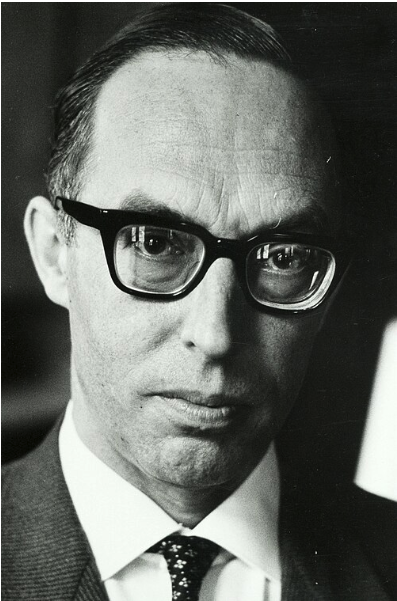
Henri Emile Phaff:
(born 1914) .
Dutch author, editor, and correspondent, known for his work in the field of aphorisms and architecture, particularly focused on the city of Haarlem. Among other works, he wrote the book “Ambtelijke aforismen” (Civil Service Aphorisms), which first appeared in 1968 and went through multiple reprints until 1980. This work contains sharp, often ironic observations on bureaucracy and government information, such as the famous statement:
“Two types of information almost always come too late: sexual education and government information.”
In addition to his literary work, Phaff was active at the Association of Dutch Municipalities, where he wrote reports on subjects such as car wrecks and transparency within the administration. He also published on the restoration of historic buildings, such as the Haarlem City Hall and the Grote or St. Bavokerk.
In his work, Phaff combined a love of language with a deep commitment to the public domain and cultural heritage.
Freedom: that which remains once the demands of society have been met.
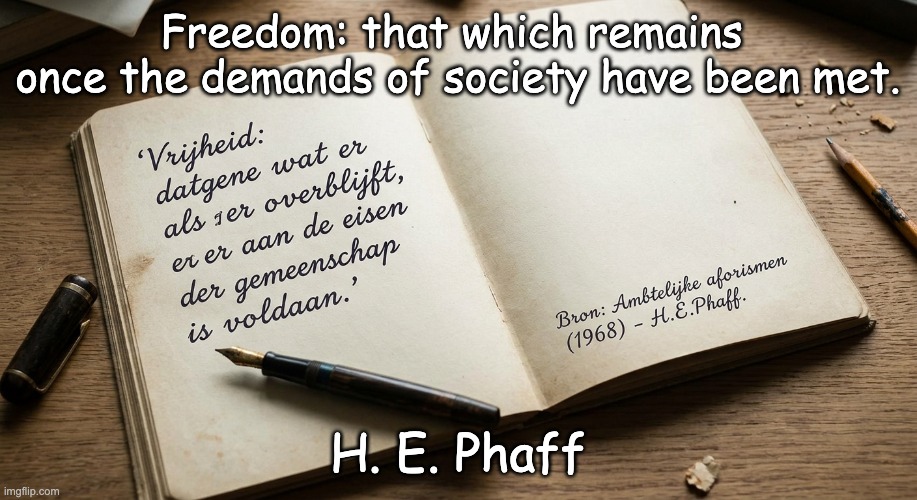
This saying emphasizes a ‘conditional’ view of freedom. It suggests that freedom is not an absolute, unlimited right, but rather something that is earned or obtained ‘after’ one has fulfilled the obligations and responsibilities associated with being part of a society.
In this view:
– Community comes first:
The demands of the community (such as laws, social norms, and civic duties) take precedence.
– Freedom is the residue:
What remains of personal choices and actions ‘after’ fulfilling these demands is what is considered ‘freedom’.
– Limited freedom:
It implies that the scope for individual freedom is limited and defined by the boundaries set by society.
It is a rather pragmatic and perhaps even somewhat cynical view of freedom, which emphasizes social order and conformity over individual autonomy. Origin:
The source of this saying is the collection “Ambtelijke aforismen” (Civil Service Aphorisms), published in 1968. An aphorism is a short, pointed, and often witty or cynical statement that attempts to convey a general truth or wisdom. In this case, it concerns aphorisms related to civil service life and bureaucracy.
This specific quote is one of the many sharp observations found in this collection that highlight the relationship between the individual and the community or government (often perceived as coercive).
Author: H. E. Phaff.
The author of “Ambtelijke aforismen” is H. E. Phaff.
Although Phaff may not be one of the most famous literary figures, he is known for his sharp pen and his ability to observe the peculiarities of human behavior and society with humor and irony. His aphorisms are often cynical and reveal a deep insight into the complexity of human nature and the interaction between the individual and the social structures of which we are a part. Phaff’s work invites reflection and offers an often refreshing, albeit sometimes somewhat somber, perspective on the world around us.
