Quintus Curtius Rufus:
(?-53)
Romeins senator (ook benoemd tot consul als homo novus) en historicus die leefde onder het principaat en een geschiedenis van Alexander de Grote schreef.

Canis timidus vehementius latrat quam mordet.
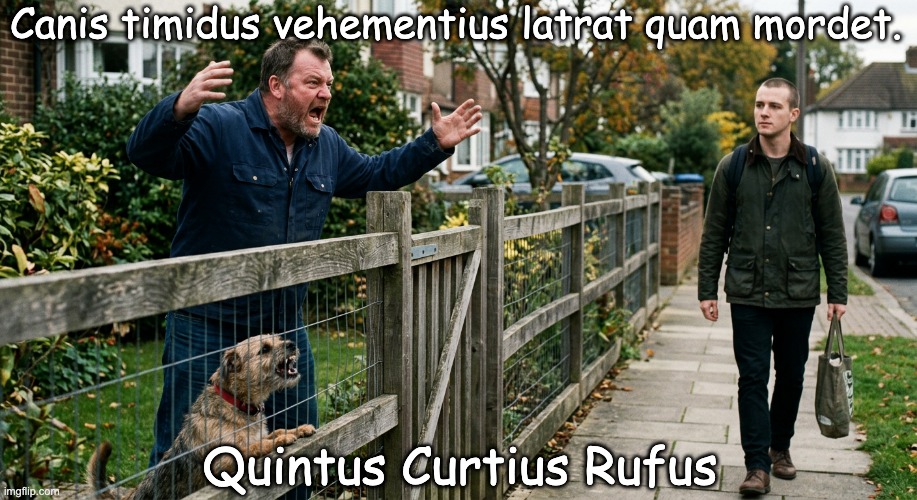
People who frequently threaten, swear, or use strong words are usually not the ones who actually take action (violence). Anyone who expresses their aggression audibly — “barks” — has, as it were, already lost that energy in the sound, and rarely actually takes any action. The saying is often used to reassure someone who is afraid of a threat or an angry reaction from another person.
A well-known side note reads: “Barking dogs don’t bite, but who shoots a barking dog?” — a variation indicating that a threat must sometimes be taken seriously after all.
Origin:
The saying is a classic folk proverb without an identifiable individual originator. Virtually every European language has an equivalent:
– English: “His bark is worse than his bite” / “Barking dogs seldom bite”
– German: “Hunde, die bellen, beißen nicht”
– French: “Chien qui aboie ne mord pas”
The idea can be traced back to classical antiquity. In the historical work of the Roman historian Quintus Curtius Rufus, the sentence “Canis timidus vehementius latrat quam mordet” (“A frightened dog barks more fiercely than it bites”) appears, a passage from Book VII, Chapter 4, verse 13 of his work on the campaigns of Alexander the Great. Through popular usage and later collections of proverbs (such as Erasmus’s “Adagia” in the 16th century), this classical comparison has spread throughout Europe and eventually found a permanent place in Dutch as well. Author:
There is an identifiable source for the underlying Latin phrase: Quintus Curtius Rufus, a Roman historian (presumably active in the 1st century AD, although the exact dating is disputed among classicists). He wrote “Historiae Alexandri Magni”, a historical work about Alexander the Great, in which the aforementioned phrase appears. Important to note: this is a historical prose work, not a poem — the concise, proverbial form as it circulates today has been slightly modified over the centuries compared to the original.
