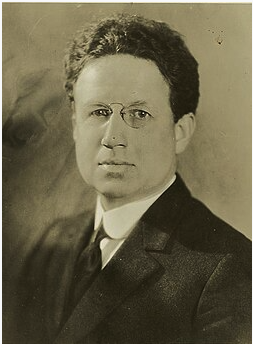
Harry Emerson Fosdick:
(May 24, 1878 – October 5, 1969).
American pastor.
Fosdick became a central figure in the fundamentalist–modernist controversy within American Protestantism in the 1920s and 1930s and was one of the most prominent liberal ministers of the early 20th century. Although a Baptist, he was called to serve as pastor, in New York City, at First Presbyterian Church in Manhattan’s West Village, and then at the historic, inter-denominational Riverside Church in Morningside Heights, Manhattan.
Liberty is always dangerous, but it is the safest thing we have.

The statement is a deliberate ‘paradox’: freedom is usually pitted against security — as if one has to choose between the two. Fosdick reverses that reasoning.
– “Freedom is always dangerous” — Freedom entails risks: people can make bad choices, power can be abused, democracy can fail. This is an honest acknowledgment, not naive idealism.
– “But it is the safest good we possess” — The ‘alternative’ to freedom — oppression, authoritarianism, control — is far more dangerous in the long run. Lack of freedom provides a false sense of security that always proves fragile.
The core of the idea: whoever trades freedom for security ultimately loses both. It is an idea that Fosdick, as a liberal theologian, voiced in the context of the rise of fascism and totalitarianism in the 1930s — a time when many people seemed willing to sacrifice freedom for order and security. The quote aligns thematically closely with Benjamin Franklin’s famous statement: “Those who would give up essential liberty to purchase a little temporary safety deserve neither liberty nor safety.”
Author: Harry Emerson Fosdick (1878–1969)
American Liberal Protestant minister, teacher, and writer. He was an early practitioner of pastoral counseling and an advocate for cooperation between the church and psychiatry.
From 1926 to 1946, Fosdick served as minister of the interdenominational Riverside Church in New York City. He wrote 40 books from an evangelical-liberal perspective and was likely the best-known and most respected preacher of his generation.
Origin:
The quote can be found in “The Home Book of Quotations, Classical and Modern” (1937), edited by Burton Egbert Stevenson — which means the statement dates back to at least 1937 or earlier. Some sources link it to his “Riverside Sermons” from 1958, but the first documented appearance is therefore from the 1930s.
