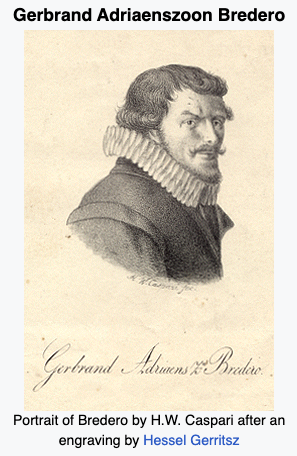
Gerbrand Adriaenszoon Bredero:
(Amsterdam, March 16, 1585 – Amsterdam, August 23, 1618).
Dutch poet, playwright, and rhetorician, not of highly cultivated Renaissance literature, but of popular poetry. His most important work is the comedy Spaanschen Brabander from 1617, ’the pinnacle of Dutch comedy in the Golden Age’.
To grease someone’s palm.

To bribe someone, or to give money (or a gift) to someone in order to gain a favor, influence their actions, or secure preferential treatment. It implies a corrupt or secretive exchange — slipping money into someone’s hand to get what you want.
> “He greased the official’s palm to get the permit approved faster.”
Origin:
The expression dates back to at least the ’16th century’ in English, though the concept of bribery through literal hand-payments is ancient and universal. The imagery is vivid and practical: coins placed into someone’s palm make the hand feel “greased” — smooth, slippery, ready to move in your favor.
Early written appearances trace to ‘John Palsgrave’s “Lesclarcissement de la langue françoyse” (1530), an early French-English language guide, and similar phrases appear in works from that era onward.
The metaphor likely draws on two related ideas:
– ‘Lubricating a mechanism’ — just as grease makes gears turn smoothly, money makes bureaucracy or favors flow more easily.
– ‘The physical act of palming coins’ — a bribe was literally pressed into the receiver’s open hand.
The French equivalent, “graisser la patte” (“to grease the paw”), shares the same imagery and was in use around the same period, suggesting a common European cultural idiom rather than a single point of invention.
Author:
There is ‘no single author’ — it is a ‘folk idiom’ that evolved organically in common speech. It was not coined by any one writer, but rather emerged from the everyday language of trade, politics, and commerce in late medieval and early modern Europe, where bribery was a routine (if frowned upon) part of daily life.
