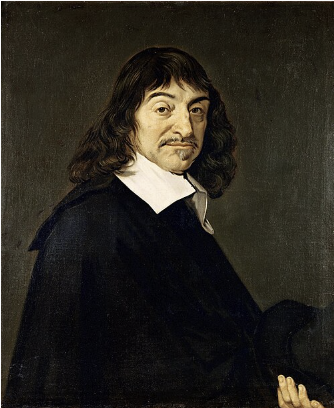
René Descartes:
Latinized Renatus Cartesius (The Hague-en-Touraine, March 31, 1596 – Stockholm, February 11, 1650)
A philosopher and mathematician of French origin who lived a large part of his life in the Republic of the Seven United Netherlands. His approach to the problem of knowledge and the nature of the human mind played an important role in the development of philosophy. He is known for his statement “Cogito, ergo sum” and is generally regarded as the father of modern philosophy. He was one of the first not only to reject the philosophy of Aristotle but also to replace it with his own philosophical system. In doing so, he laid the foundation for the 17th-century movement of rationalism. Descartes was strongly influenced by advances in physics and astronomy and was one of the central figures of the Scientific Revolution. He provided the first idea of what natural science would offer in the future.
Doubt is the beginning of wisdom.
1. A world of fixed truths: In the 17th century, religious dogmas and scientific beliefs were rarely questioned.
2. Descartes’ method: Descartes was not satisfied with this. He decided to radically question ‘everything’ he thought he knew. 3. The Goal: He did not do this to become cynical, but rather to find a foundation that was ‘absolutely certain,’ something that could not be doubted.💡 The Ultimate Result: “Cogito, ergo sum.” Descartes’ process of doubt led to his most famous insight: He could doubt the existence of the world, his own senses, and even mathematical truths. The paradox: The only thing he could not doubt was the fact ’that he was doubting.’ The conclusion: If he doubted, he was thinking. And if he was thinking, he must exist. The quote: This led to the legendary statement: “Cogito, ergo sum” (I think, therefore I am). For Descartes, doubt was therefore not the endpoint, but the ‘indispensable first step’ on the road to unshakeable truth. 🧠 A Note of Self-Awareness: The quote from blogger Peter Ros: “That statement, was it by Descartes or by Aristotle after all? I doubt…” The fact that we even doubt the author of the statement about doubt brings things full circle in a beautiful way. It is a perfect example of how doubt forces us to dig deeper for the truth.
