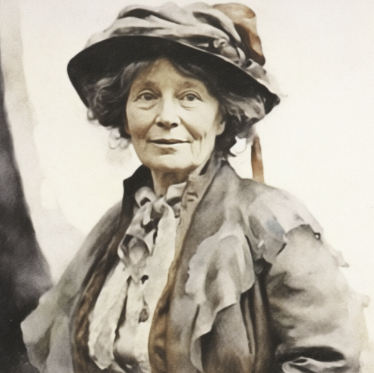
Born Leonore von Stosch.
(Washington, 7 November 1872 – New York, 10 February 1956).
American violinist and poet. In 1927, she won the Pulitzer Prize for poetry.
Leonora Speyer. Photo: poemanalysis.com
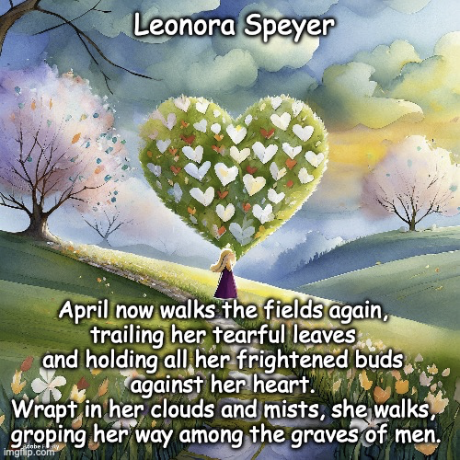
April now walks the fields again, trailing her tearful leaves and holding all her frightened buds against her heart. Wrapt in her clouds and mists, she walks, groping her way among the graves of men.
Image: Peter van Geest AI. Meaning 🌧️: The poem is a melancholic and symbolic description of the month of April, but specifically seen in the context of the period immediately after the First World War. It is far from the cheerful, spring-like April we often see in poetry. April as a Mourning Figure: The month of April is personified as a woman (“her tearful leaves,” “her frightened buds,” “Wrapped in her clouds and mists”). She is portrayed as a sad and fearful figure. The Trauma of War: Dragging her leaves and holding her “frightened buds” close to her heart suggests grief, loss, and a need for protection. This is a strong parallel with the suffering and death that the First World War had caused. Walking among the graves: The line “She walks, feeling her way among the graves of men” is a direct reference to the massive losses and numerous cemeteries that resulted from the war. The month of April, which traditionally represents new life, is confronted here with a world full of death and sadness. Uncertainty and hope: The image of “scared buttons” suggests an uncertain future. While there is potential for new life (buds), this is overshadowed by fear and loss. 📚 The Origin and the Bundle: Author:Leonora Speyer (née von Stosch), an American violinist and poet. Poem: The poem is probably called “April”.Collection: It was published in her poetry collection “A Canopic Jar”.Publisher & Year: Published by E. P. Dutton & Company in 1921.Royal Award: For this collection Leonora Speyer received the prestigious ‘Pulitzer Prize for Poetry’ in 1922. 🌍 The Historical Context (World War I) 🌍:After the Great War: The poem was written and published shortly after the end of the First World War (1914-1918). A world in mourning: The world was still in deep mourning and the consequences of the war were visible everywhere. The Devastation: The trench warfare, the massive casualties and the destruction of entire landscapes had an enormous impact on the art and literature of the time. Lost Generation: Many artists of this period, including Speyer, struggled with the trauma and loss of an entire generation of young people. ✍️ The Author:Leonora Speyer ✍️. Life: Leonora von Stosch was born in Washington, D.C., the daughter of a Prussian count and an American mother. She started her career as a professional violinist. Marriage: She married first Louis Meredith Howland, and later Sir Edgar Speyer, a British banker. Poetry: She did not begin writing poetry until later in life, but her work was praised for its musicality and emotional depth. Academy of American Poets: She was an important member of the Academy of American Poets. Style: Her poetry is often characterized by a rich imagination and a sensitivity to the complexity of the human experience. 🌳 Summary and Conclusion 🌳: The lines you quoted are a powerful example of how literature and art processed the aftermath of World War I. Leonora Speyer uses the image of April to express a sense of sadness, loss and uncertain hope. The poem is a tribute to those who lost their lives and a reflection on the challenges of building a new world in the shadow of great tragedy.
Door Pieter
Mensenmens, zoon, echtgenoot, vader, opa.
Spiritueel, echter niet religieus.
Ik hou van golf, wandelen, lezen en de natuur in veel opzichten.
Onderzoeker, nieuwsgierig, geen fan van de mainstream media (MSM).