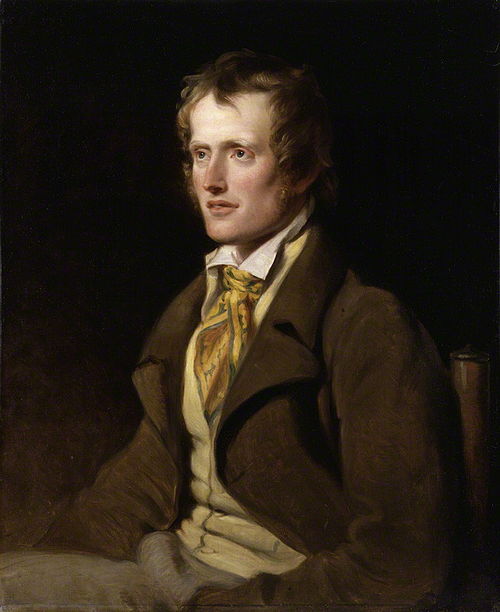
John Clare:
(13 July 1793 – 20 May 1864).
English poet. The son of a farm labourer, he became known for his celebrations of the English countryside and his sorrows at its disruption.
His work underwent major re-evaluation in the late 20th century; he is now often seen as a major 19th-century poet. His biographer Jonathan Bate called Clare “the greatest labouring-class poet that England has ever produced. No one has ever written more powerfully of nature, of a rural childhood, and of the alienated and unstable self.”
I love to see the cottage smoke curl upwards through the trees. The pigeons nestled round the cote on November days like these.
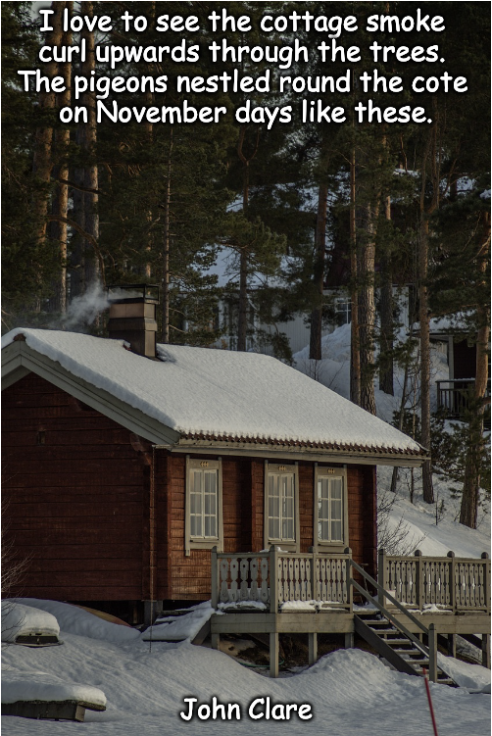
The complete stanza reads:
> I love to see the cottage smoke
> Curl upwards through the trees,
> The pigeons nestled round the cote
> On November days like these;
> The cock upon the dunghill crowing,
> The mill sails on the heath a-going.
Clare is expressing affection for an ordinary late-autumn countryside scene:
– “Cottage smoke curl upwards”: –
evokes warmth, domestic comfort, and still November air.
– “The pigeons nestled”
suggests birds huddling or resting for shelter.
– “Cote”:
means a small shelter for animals—here, a ‘dovecote or pigeon house’
– “November days like these”
describes cold, quiet, fading autumn days.
Rather than presenting November as merely bleak, Clare finds beauty and comfort in its humble, familiar details. The stanza reflects his characteristic love of everyday village life and closely observed nature.
✍️ Author and origin:
The lines are by John Clare (1793–1864), the English poet celebrated for his close observation of rural life. They come from his poem “Autumn,” generally dated/published in 1821 in “The Village Minstrel, and Other Poems”.
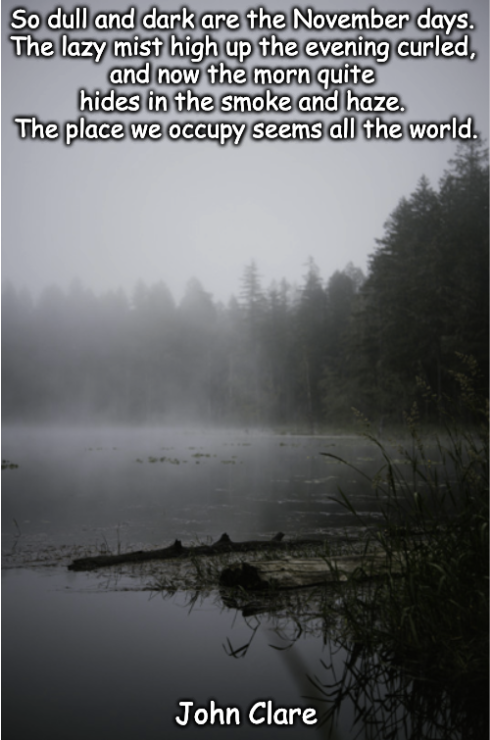
So dull and dark are the November days. The lazy mist high up the evening curled, and now the morn quite hides in the smoke and haze. The place we occupy seems all the world.