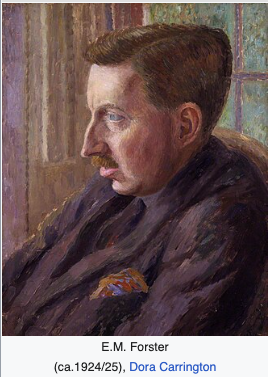
Edward Morgan Forster:
(Marylebone, London, January 1, 1879 – Coventry, June 7, 1970).
English novelist and essayist.
His work frequently explores the clash between two cultures and the unbridgeable nature of the differences between them. He drew inspiration for his novels from his travels to Egypt, Germany, and India. His most famous novel is “A Passage to India”, a depiction of life in India under British rule. The book illustrates the prejudices held by both the British and the Indians toward one another, as well as the conflicts that arise as a result.
In other works—such as “A Room with a View” and “Howards End” (often considered his finest achievement)—the conflict between social classes plays a significant role. Forster himself, who hailed from the upper-middle class, was particularly drawn to young men from the working class. This very cultural divide is also central to “Maurice”—written in 1914 but published posthumously in 1971—which stands as his only novel with an explicitly homosexual theme.
The house was very quiet, and the fog—we are in November now—pressed against the windows like an excluded ghost.

– Literally:
It is a silent November day, and thick fog surrounds the house and presses against its windows.
– Figuratively:
Forster personifies the fog as a ‘ghost shut outside’, creating a claustrophobic, eerie atmosphere.
– In context:
The image follows ‘Mrs. Wilcox’s death’ and accompanies the Wilcox family’s discussion of her wish that Margaret Schlegel should inherit Howards End. The ‘excluded ghost’ can therefore suggest Mrs. Wilcox herself—physically absent and, in a sense, excluded when her family disregards her final wish.
– The parenthetical phrase “we are in November now” is characteristic of Forster’s conversational, self-aware narrator, who briefly addresses the reader while moving the story’s chronology forward.
The sentence thus combines weather, mood, and symbolism:
The fog is both a real November fog and an image of a suppressed or excluded presence.
📚 Author and origin:
The sentence is by E. M. Forster and appears in Chapter XI of his novel “Howards End”, first published in 1910.
