(Geneva, 27 September 1821 – there, 11 May 1881).
Swiss philosopher, poet and critic.
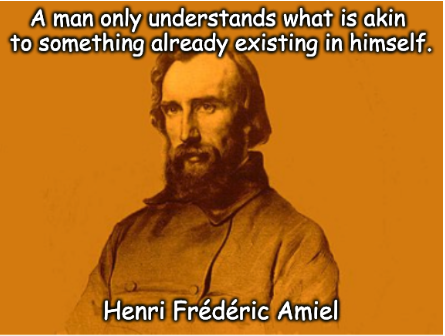
Henri Frédéric Amiel. Photo: biografieonline.it
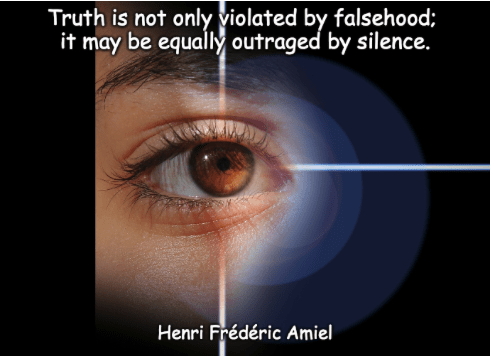
Truth is not only violated by falsehood; it may be equally outraged by silence.
Photo: Gerd Altmann. Meaning📜 :This quote touches upon a deep moral truth: Lies are Active Evil: Everyone understands that a direct lie (“untruth”) destroys the truth. It is an active attack on the facts. 🤥⚔️ Silence is Passive Evil: Amiel states that silence ‘when one knows the truth’ is just as harmful. It is a form of moral cowardice. By saying nothing, you allow a lie to prevail or injustice to continue. It is a “violence” against the truth because it stifles the truth and strips it of the power to bring about change. 🤐🚫 The Core Message: Sometimes silence is not gold, but betrayal. The quote calls for moral courage to stand up and speak, especially when it is difficult or uncomfortable, to protect the truth. 🗣️✊ 🧐 An Important Note: “Fake Quotes” In the age of internet quotes, it is always good to remain critical. Although the sentence corresponds very strongly with Amiel’s philosophical ideas, the exact wording is sometimes difficult to trace back to a specific, quoted passage in the original French texts. This is often the case with old translations and paraphrases that have taken on a life of their own. That said, the ‘spirit’ and the ‘core message’ of the quote are unmistakably ‘Amielian’, and the attribution to him is generally accepted as the most likely source of this wisdom ✍️ The Author: The quote, especially in its English form, is widely attributed to: Henri-Frédéric Amiel. A Swiss philosopher, poet, and critic from the 19th century. 🇨🇭 The Origin: The quote likely stems from his most famous work, his intimate diary titled “Journal Intime”. This diary was published posthumously and contains thousands of pages of philosophical reflections. 📓🖊️
A man only understands what is akin to something already existing in himself.
Photo by wikipedia
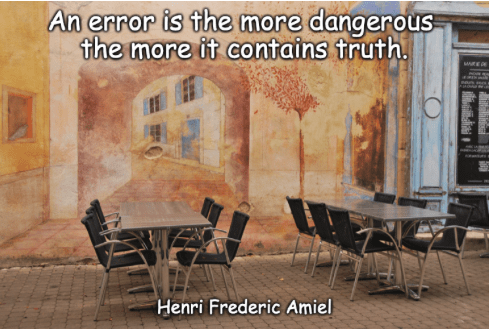
An error is the more dangerous the more it contains truth.
Photo: Boudewijn Huysmans. Meaning 🤔 📖 🎓: The saying is a sharp observation regarding the nature of deception and persuasiveness. Here are the key points of the meaning: 🕵️♂️ The Power of the Mix: A lie or a false theory (an “error”) is much more persuasive if it is not ‘completely’ untrue. When an untruth is mixed with undeniable facts or truths, it becomes much harder to recognize the error. 🛡️ Defense Mechanism: The ’truth’ in the error acts as a shield. If someone attacks the error, the defender can point to the true elements to legitimize the entire theory. ⚠️ The Danger of Credibility: A completely absurd claim is quickly dismissed. But a theory that is 90% true and 10% a dangerous error can entice people to accept that 10% as truth as well. 💡 Practical Examples: Propaganda: Mixing factual events with an ideological distortion. Conspiracy theories: Starting with a real problem or fact and attaching an unproven, erroneous conclusion to it. Misleading Advertising: Emphasizing one true benefit to sell a product that is otherwise disadvantageous. ✍️ Author: The Swiss philosopher and poet Henri-Frédéric Amiel. 📅 Life: He lived from 1821 to 1881. 🇨🇭 Background: He was a philosopher, poet, and critic, and a professor of aesthetics and philosophy in Geneva. 🧠 His Work: Amiel is best known for his posthumously published diary, “Journal Intime” (Intimate Diary). This is a monumental work of introspection, in which he recorded his thoughts, doubts, observations, and philosophical musings over a period of more than thirty years. 🔍 His Style: He was known for his sharp psychological insights and his ability to analyze complex human emotions and thoughts. This saying is a perfect example of his ability to capture a profound truth in a concise sentence. 📚 Origin: The origin of this specific statement lies, like most of Amiel’s famous quotes, in his diary. 📖 “Journal Intime”: The saying likely comes from one of the many notes in his “Journal Intime.” Although the exact date or specific diary excerpt may vary depending on the translation or edition, the thought is consistent with his philosophical and psychological explorations. 🌟 Posthumous Fame: Amiel published relatively little during his lifetime, and his work was not immediately noticed. It was the publication of parts of his diary, after his death, that brought him worldwide recognition as one of the great introspective thinkers of the 19th century. 💡 In summary: Amiel’s statement is a timeless warning: be most critical of the ideas that seem closest to the truth, for that is precisely where the greatest danger of deception lies.
So long as a person is capable of self-renewal they are a living being.
Photo: Susan Wilkinson. Meaning 💡: This quote is about the essence of ‘real’ life. It suggests that merely breathing and biological functioning is not enough to be a fully living being. Self-renewal: This refers to the ability to grow, learn, change and adapt. It’s about avoiding stagnation and being open to new experiences and perspectives. A living being: According to this quote, you are only truly ‘alive’ if you continue to go through this process of self-renewal. Once you stop learning and growing, you begin to die in some way, even though you remain biologically alive. 🌱 Origin: It often appears in collections of quotations and is attributed to various thinkers. However, it may be a paraphrase or translation of an idea expressed by Amiel in his famous diary. ✍️ Author:Henri Frédéric Amiel (1821-1881) was a Swiss philosopher, poet and critic. His best-known work: He is best known for his extensive diary, “Journal Intime”. This diary, which he worked on for almost forty years, contains profound introspective thoughts, philosophical reflections and observations on human nature. Style and themes: Amiel’s diary shows a constant struggle with self-doubt, a desire for truth and an in-depth analysis of his own inner life. His thoughts on personal growth, introspection and the importance of an authentic life fit well with the message of the quote. It is very likely that the essence of this quote comes from his deep introspection. In short, while the exact wording may not be Amiel’s verbatim, the quote reflects a core idea that is prominent in his work and philosophy: “true vibrancy comes from a continuous process of inner growth and change.”
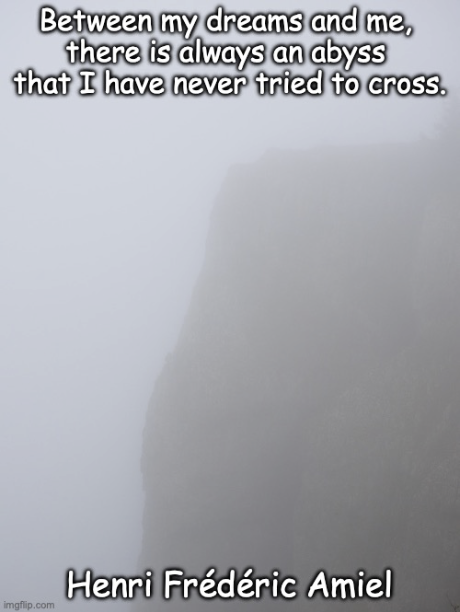
Between my dreams and me, there is always an abyss that I have never tried to cross.
Photo: Hans. Meaning 🤔: This quote reflects a feeling of ‘passivity’ and ‘powerlessness’. It suggests that there is an unbridgeable gap between the speaker’s dreams and goals and his or her reality. The speaker recognizes this gap and seems to accept that he or she will never attempt to bridge it. Possible interpretations: Melancholy and resignation: The speaker may be troubled by his or her inability to realize dreams, but also seems to be resigned to it. Existential anxiety: The abyss can symbolize the fundamental gap between the individual and the world, or between the current state and the desired state of being. Not taking action: The speaker acknowledges that he or she has never attempted to cross the abyss, which may indicate a lack of motivation, fear of failure, or simply a lack of action. 📚 Origin and Author: The quote comes from the ¨Journal intime¨ by the Swiss philosopher and poet Henri-Frédéric Amiel (1821-1881). He wrote this diary throughout his life, and it contains numerous reflections on his own inner life, his relationships and the world around him. Although Jean Cocteau is sometimes mentioned as an alternative author, the source is clearly Amiel’s Journal intime. 🎨 Related Themes: – Melancholy and resignation – Existential anxiety – Passivity and action – Dreams and reality
Door Pieter
Mensenmens, zoon, echtgenoot, vader, opa.
Spiritueel, echter niet religieus.
Ik hou van golf, wandelen, lezen en de natuur in veel opzichten.
Onderzoeker, nieuwsgierig, geen fan van de mainstream media (MSM).