Humbert Wolfe:
(1885–1940) was an English poet and translator.
Here are the key details about his life and work:
Early Life:
He was born in Kendal, Westmorland, into a family of minor gentry. He was largely self-educated and worked as a journalist and editor for various publications, including “The Daily Mail” and “The Westminster Gazette”.
Poetry Style:
Wolfe is known for his classical, polished, and often ironic verse. His style is characterized by precise form, witty epigrams, and a sometimes cynical or detached view of human nature. He was associated with the Georgian poets but had a distinct, more intellectual voice.
Major Works:
– “The White Horse” (1916) – His first major collection.
– “The Glass Grove” (1925) – Often considered his masterpiece, featuring poems like “The Ballad of the Goodly Beasts” and “The Owl.”
– “The White Horse” (1916)
– “The Glass Grove” (1925)
– “The Blind Tower” (1931)
– “The Last Word” (1937)
– Translation:
He was also a respected translator of Greek poetry, particularly the works of Theocritus and Bion, which he rendered into elegant English verse. His translations were influential in introducing these classical idylls to a wider English-speaking audience.
– Legacy:
Wolfe is often remembered for his technical skill and his ability to blend classical forms with modern sensibilities. While not as widely read today as some of his contemporaries, he is appreciated by those interested in early 20th-century English poetry for its craftsmanship and wit.

Listen! The wind is rising, and the air is wild with leaves. We have had our summer evenings, now for October eves!
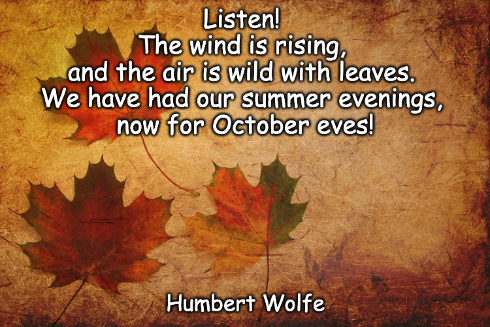
The lines:
> “Listen! The wind is rising, and the air is wild with leaves. We have had our summer evenings, now for October eves!”
mean that:
– ‘The weather is changing’ (the wind is picking up and autumn is arriving).
– ‘Leaves are flying’ in the air—an autumn image.
– The speaker is basically saying:
“We’ve had the pleasures of summer nights; now autumn is here—time for October evenings.”
It’s a ‘mood-shift’ from warm, lingering summer into cooler, more dramatic October nights.
🏛️ Origin:
These lines are from the poem “The Octave” by Humbert Wolfe (published in his collections in the early 20th century).
✍️ Author: Humbert Wolfe
– Poem: commonly cited as “The Octave”
📌 Quick context / vibe:
Wolfe’s writing often leans into:
– ‘dramatic seasonal imagery’
– a sense of ‘inevitable change’
– a poetic ‘announcement’ tone (“Listen!”)
🔍 Note (about attribution certainty):
Poetry lines are sometimes reposted online with errors. But ’this specific wording’ is widely associated with Humbert Wolfe, especially via references to “The Octave.”
