George Arnold:
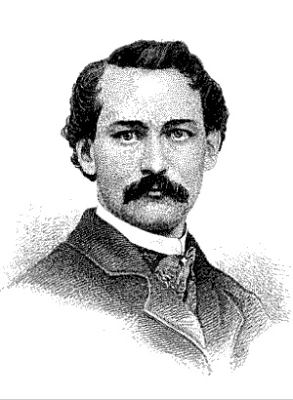
(June 24, 1834 – November 9, 1865) was an American author and poet.
He was born in New York City on June 24, 1834. After briefly attempting a career as a portrait painter, he turned to writing and became a regular contributor to Vanity Fair and The Leader. A contemporary of Walt Whitman, Arnold was likewise a patron of Pfaff’s beer cellar.
O sweet September, thy first breezes bring. The dry leaf’s rustle and the squirrel’s laughter. The cool fresh air whence health and vigor spring. And the promise of exceeding joy hereafter.
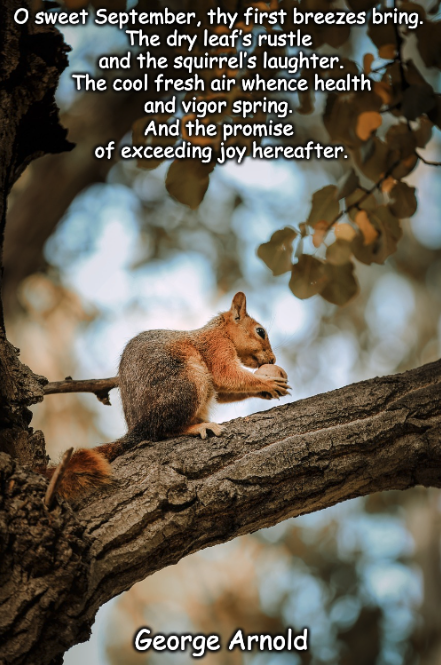
The speaker addresses September directly, personifying it as a welcome visitor:
– “thy first breezes” — September’s first cool winds.
– “the dry leaf’s rustle and the squirrel’s laughter” — the characteristic sounds of early autumn: falling leaves and chattering squirrels.
– “whence health and vigor spring” — the cooler, fresher air restores energy after summer’s heat. ‘Whence’ means “from which.”
– “the promise of exceeding joy hereafter” — September seems to promise great happiness still to come.
The final phrase can be read in two ways:
1. Seasonally:
anticipation of autumn’s harvest, beauty, and pleasures.
2. Spiritually:
the falling leaves suggest age and death, while “hereafter” hints at joy beyond death or in heaven.
Thus, the stanza celebrates autumn not as decline alone, but as a season of renewal, expectation, and hope.
✍️ Author and origin:
The lines are attributed to George Arnold (1834–1865), an American poet and journalist—not to be confused with the English poet Matthew Arnold.
They are generally presented as lines from Arnold’s poem “September.” The original is usually punctuated as one continuous sentence:
> “O sweet September! thy first breezes bring
> The dry leaf’s rustle and the squirrel’s laughter,
> The cool fresh air whence health and vigor spring,
> And promise of exceeding joy hereafter.”
Arnold’s poems circulated in nineteenth-century periodicals and were collected after his death, notably in volumes such as Drift:
“A Sea-Shore Idyl, and Other Poems” (1866) and “Poems Grave and Gay” (1867). The precise first periodical appearance of these lines is not consistently identified in modern quotation sources, but the attribution to George Arnold is longstanding.
It is a ‘poetic stanza’, rather than a traditional proverb or anonymous saying. It should also not be confused with Arnold’s longer poem commonly titled “September Days,” which begins, “Sweet is the voice that calls…”
