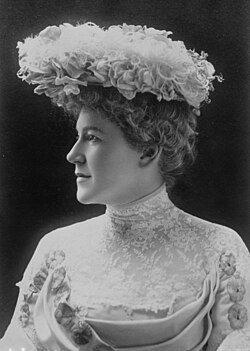
Ella Wheeler Wilcox:
(November 5, 1850 – October 30, 1919).
American author and poet. Her works include the collection Poems of Passion and the poem “Solitude”, which contains the lines “Laugh, and the world laughs with you; weep, and you weep alone.” Her autobiography, The Worlds and I, was published in 1918, a year before her death.
I will cast my August days behind me with my May, nor strive to drag them into autumn’s place, nor swear I hope when I do but remember. Now violet and rose have had their day. I’ll pluck the soberer asters with good grace and call September nothing but September.
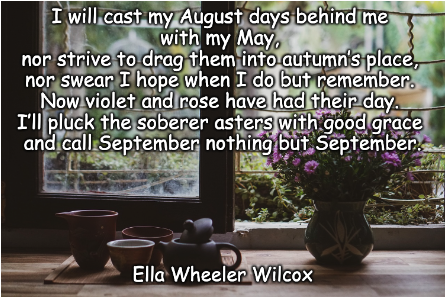
The poem uses the turn from summer into autumn as a metaphor for aging gracefully. The speaker resolves not to cling to youth or force it to linger past its season:
– “I will cast my August days behind me with my May” — she’ll let go of both her spring (youth) and late summer (still-vigorous adulthood) rather than stretch them artificially.
– “Nor strive to drag them into autumn’s place” — she won’t pretend to still be young.
– “Nor swear I hope when I do but remember” — she won’t dress up nostalgia as forward-looking hope; she’s honest that she’s now looking back, not forward.
– “Violet and rose have had their day” — the flowers of spring and summer (youth, romance, passion) have already bloomed and passed.
– “I’ll pluck the soberer asters with good grace” — asters are plainer, autumn flowers; she chooses to embrace this quieter, later stage of life willingly rather than resent it.
– “Call September nothing but September” — the core line: she refuses to pretend September is still summer. She’ll accept each season — and each stage of life — for exactly what it is, without denial or wishful renaming.
Origin:
The lines are the closing sestet of a 14-line sonnet titled “September.”
The octave (the opening half, not in your original quote) describes the speaker’s life reaching its “long radiant Summer” at last, and watching autumn approach — not with frost or cold, but with a calm that only comes once the “fevered solstice” of youthful passion has passed. It appears in her “Complete Poetical Works” (Delphi Classics edition, p. 1135).
Author:
Ella Wheeler Wilcox (1850–1919),
the popular American poet best known for lines like “Laugh, and the world laughs with you.”
