How sociable the garden was. We ate and talked in the given light. The children put their toys on the grass. All the warm wakeful August night.
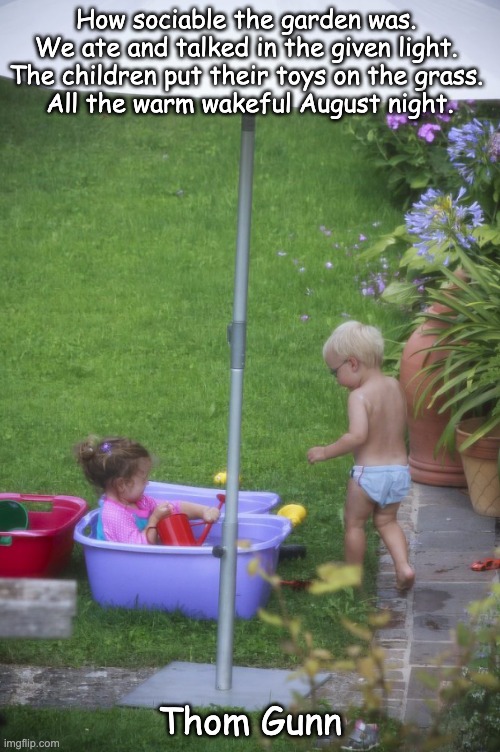
The verse captures a warm, contented summer evening in a garden with family. A few things stand out:
– “Sociable the garden was”
— the garden itself is personified as the sociable one, as if the space actively hosted and welcomed the gathering, rather than simply being a backdrop for people being sociable.
– “We ate and talked in given light”
— suggests natural, unforced illumination (the fading daylight, offered rather than sought), evoking ease, grace, and things simply provided without effort.
– “The children put their toys to grass”
— children abandoning their toys on the lawn conveys innocence and unselfconscious trust, a family evening where nothing needs tidying or minding.
– “All the warm wakeful August night”
— closes on a restless, unslept night as something pleasurable rather than a problem — capturing that particular late-summer feeling where the warmth and stillness make everyone linger outdoors far longer than usual.
Overall, it’s a nostalgic, domestic snapshot of contentment — family, season, and place fused into a single memory, held up with quiet tenderness.
Origin:
The lines come from the poem
“Last Days at Teddington.”
Teddington is a suburb in southwest London, and the poem appears to be a retrospective, elegiac piece — a memory of a particular household or place, viewed with hindsight.
Author:
Thom Gunn (1929–2004), the Anglo-American poet.The lines appear as: “How sociable the garden was. We ate and talked in given light. The children put their toys to grass All the warm wakeful August night.”
— Thom Gunn, Last Days at Teddington
Gunn was born in England, associated early on with “The Movement” poets, and later moved to San Francisco, where his work increasingly loosened into free verse and engaged with subjects like sexuality, drug use, and — most famously, in “The Man with Night Sweats” (1992) — the AIDS crisis. His style is often noted for combining formal control (rhymed, metered stanzas like this one) with intimate, direct subject matter. This quatrain’s warmth sits within his broader tendency to hold ordinary, tender moments up against an awareness of time and loss.
