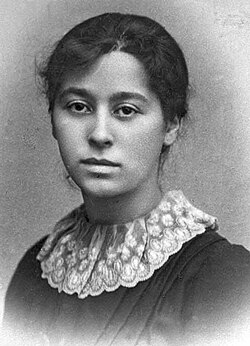
Amy Judith Levy:
(10 November 1861 – 9 September 1889).
English essayist, poet, and novelist best remembered for her literary gifts; her experience as the third Jewish woman at Cambridge University, and as the second Jewish student at Newnham College, Cambridge; her feminist positions; her friendships with others living what came later to be called a “New Woman” life, some of whom were lesbians; and her relationships with both women and men in literary and politically activist circles in London during the 1880s.
The London trees are dusty-brown beneath the summer sky. My love, she dwells in London town, nor leaves it in July.
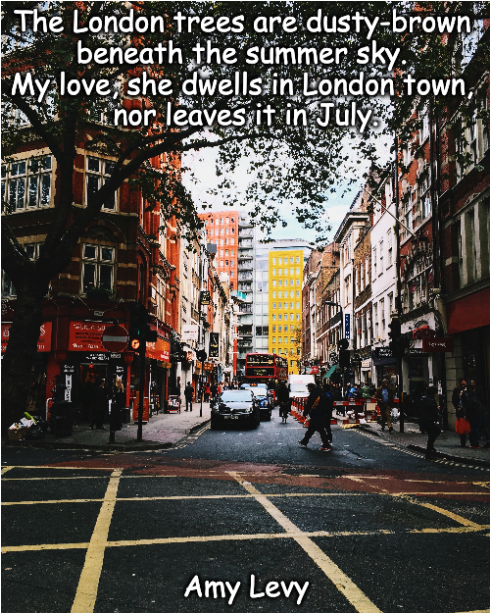
It is essentially an urban love poem that reverses the usual romantic preference for nature over the city. Where Victorian poetic convention often idealized escaping to the countryside in the summer, Levy’s speaker chooses to remain in a hot, dusty, unglamorous London—precisely because the person she loves lives there. The poem captures a very modern, metropolitan form of longing: love not experienced in pastoral settings, but in busy streets, chance encounters, and the pain of near-meetings in a big city. It is also often interpreted as a poem with a queer undertone, given that Levy’s romantic relationships were focused on women, and “London in July” is one of the poems in which she writes about her desire for another woman with an unusual directness for her time.
Origin:
The poem begins:
> The London trees are dusty brown
> Under the summer sky;
> My beloved, she lives in London,
> And does not leave it in July.
The poem continues with the speaker wandering through the “diverse and intricate maze” of London streets and squares, half hoping, half despairing that she will encounter the woman she loves amidst the crowd – at one point she confesses that every face on the street seems to bear “the face of one woman.” It ends on a note of contented resignation: instead of longing for rural brooks and the sea (the fashionable summer escape from the city), the speaker declares that simply being in London – with the possibility, however small, of an encounter with her beloved – is “enough.”
Author:
This is by Amy Levy (1861-1889), from her poem “London in July,” part of the posthumously published collection “A London Plane-Tree and Other Verse” (1889).
Amy Levy was an English poet and novelist, one of the first Jewish women to attend Cambridge (Newnham College). She was closely associated with the literary and feminist circles of late Victorian London and was notably a pioneer in the use of Symbolist techniques in English poetry, likely influenced by French writers. She committed suicide at the age of only 27; Oscar Wilde was one of those who wrote a eulogy for her.
