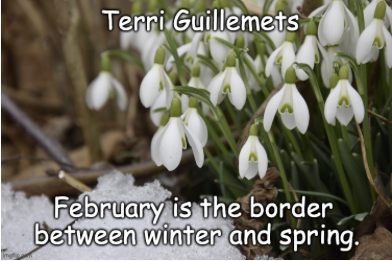
Terri Guillemets:
Terri Guillemets is a quotation anthologist and writer from Phoenix, Arizona — it’s a pen name for Terri A. Woodhull (born 1973). Since childhood she has spent most of her free time reading, journaling, and collecting quotations, and in 1998 she created The Quote Garden website (quotegarden.com), one of the most long-standing online quotation collections and the first to feature a wide variety of special occasion topics.

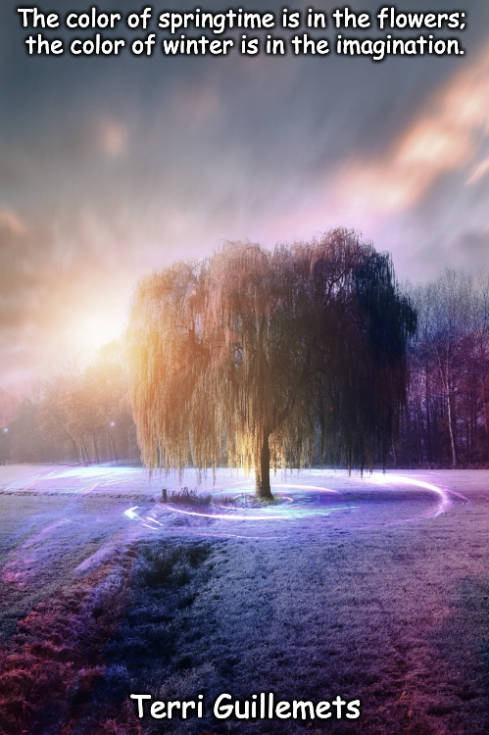
The color of springtime is in the flowers; the color of winter is in the imagination.
The quiet of October is refreshing. The quiet of November, oppressing.

October—the true heart of autumn—the perfect blend of daydream and reality, with amazing weather, a beautiful quiet, and soul-calming breezes which lead the way to the comforting slow-down of the year.

I drifted into a summer nap under the hot shade of July, serenaded by a cicada lullaby to drowsy warm dreams of distant thunder.

A Taste of Summer.
This isn’t an idiom in the traditional sense, which typically uses common phrases to convey a separate meaning (like “kick the bucket”). Rather, this is a piece of evocative, descriptive prose. It captures a distinct summer feeling:
– Drifting into a summer nap: This sets a relaxed, lazy, and almost involuntary tone. It’s a natural, easy surrender to sleep.
– Under the hot shade of July: This is a vivid oxymoron. Shade is usually cool, but “hot shade” perfectly describes that heavy, humid heat of mid-summer where even the shade isn’t a complete escape.
– Serenaded by a cicada lullaby: This is a beautiful image. The buzzing and clicking of cicadas, a sound synonymous with hot summer days, is re-imagined as a soothing song.
– Drowsy warm dreams of distant thunder: This completes the sensory experience. The warmth of the day seeps into the dreams, which are gently stirred by the anticipation or memory of a summer storm. The word “distant” keeps the thunder from being a threat, making it a comforting, rolling sound.
In essence, the quote is a sensory snapshot of a perfect, lazy summer afternoon. ‘It evokes feelings of relaxation, warmth, and the simple beauty of nature’s sounds.’
🕵️♂️ Author: This beautiful quote is attributed to Terry Guillemets.
She is an American author, aphorist, and quotation anthologist. She is known for her skill in crafting concise, poetic, and often profound statements. Her work frequently explores themes of nature, life, and the simple joys of existence.
This particular quote comes from a larger collection of her work, often shared and celebrated on platforms dedicated to inspirational and descriptive quotes. It’s a testament to her ability to use words to paint a vivid and relatable picture.
Autumn mornings―sunshine and crisp air, birds and calmness, year’s end and day’s beginnings.
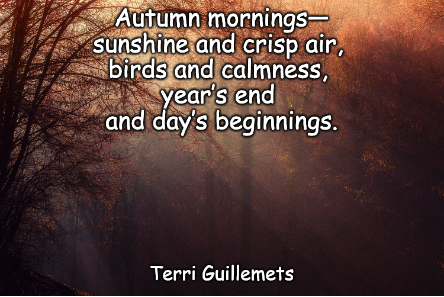
The saying celebrates the gentle contrast of an autumn morning:
– “Sunshine and crisp air” evokes bright light combined with cool, fresh weather.
– “Birds and calmness” suggests quiet nature—not complete silence, but peaceful sounds.
– “Year’s end” presents autumn as the closing or waning part of the natural year.
– “Day’s beginnings” refers to morning and renewal.
Its central idea is the meeting of ‘ending and beginning’:
autumn signals decline and the approach of winter, while every morning still offers freshness, light, and a new start.
✍️ Author and origin:
The quotation is generally credited to Terri Guillemets, an American quotation collector and writer associated with “The Quote Garden” website:
> “Autumn mornings: sunshine and crisp air, birds and calmness, year’s end and day’s beginnings.”
> — Terri Guillemets
It appears to be one of Guillemets’s own modern sayings rather than a traditional proverb or a quotation from an older literary work. It is commonly circulated online through quotation collections, especially “The Quote Garden”. An exact original composition or first-publication date does not appear to be widely documented, so it is safest to cite it simply as an online quotation by Guillemets.
📝 Punctuation:
The version most commonly found uses a ‘colon’ after “Autumn mornings.” This version uses a dash:
> “Autumn mornings―sunshine and crisp air…”
Both are understandable, but the colon is likely closer to the commonly published wording.
February is the border between winter and spring.