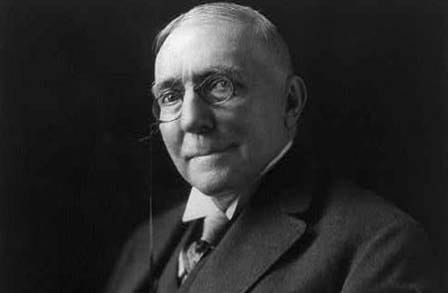
James Whitcomb Riley:
(Greenfield, Indiana, 7 October 1849 – Indianapolis, 22 July 1916). American writer and poet.
In 1870, Riley began writing for local newspapers and, after settling in Indianapolis, for the Indianapolis Journal. In 1883, he published The Old Swimmin’ Hole and ‘Leven More Poems after which he signed a contract with a publishing house. He was later elected a member of the American Academy of Arts and Letters from whom he received a gold medal for his work in 1912.
The James Whitcomb Riley Hospital for Children in Indianapolis is named after him.
Ah! How sweet to seem, love, drugged and half aswoon with this luscious dream, love, in the heart of June.
> “Oh, my love, how delightful it is to feel dreamy, intoxicated, and almost faint with pleasure in this rich, beautiful June daydream.”
Word-by-word sense 🌿:
– “Ah!” — an emotional exclamation.
– “How sweet to seem” — how pleasant it is to ‘feel as if’ one is in a dreamlike state.
– “love” — the speaker is addressing a beloved person.
– “drugged” — not literally drugged; figuratively ‘intoxicated’ by beauty, warmth, romance, fragrance, or happiness.
– “half aswoon” — almost swooning/fainting; overcome with emotion or delight. “Aswoon” is poetic/archaic.
– “luscious dream” — a rich, sensuous, beautiful reverie.
– “in the heart of June” — in mid-June, or at the height of early summer; also suggests fullness, warmth, fertility, and romance.
📌 Is it an idiom?
Not really. It is ‘a literary quotation’, not a common idiom.
The phrase “in the heart of June” is metaphorical: “heart of” means the center, peak, or most intense part of something.
✍️ Origin and author:
The quotation is generally attributed to James Whitcomb Riley (1849–1916), the American poet known as the “Hoosier Poet.”
It is from a short lyric often cited under the title “In the Heart of June” or in collections of Riley’s poetry. Riley frequently wrote nostalgic, romantic, and pastoral verse about childhood, nature, rural life, and sentiment.
📝 Plain modern paraphrase:
> “My love, how wonderful it feels to be overcome by this dreamy, beautiful summer moment in mid-June.”
Long about knee-deep in June, ’bout the time strawberries melts on the vine.
The expression “knee-deep in June” — means something like:
– in the midst of the full, languid abundance of June 🌿
– ‘deep in early summer’, when everything is growing, blooming, and ripening
– an atmosphere of ‘warmth, tranquility, abundance, and rural slowness’
– around the time that ‘strawberries are so ripe that they almost “melt” on the plant’ 🍓
So it is not an exact calendar date, but a poetic designation of ’the full June summer’.
📜 Original English line:
The phrase comes from the poem “Knee-Deep in June” by the American poet James Whitcomb Riley. The famous opening lines read roughly:
> Tell you what I like the best—
> ’Long about knee-deep in June,
> ’Bout the time strawberries melts
> On the vine,—some afternoon…
In more modern English:
> “I’ll tell you what I like best —
> around the time we’re knee-deep in June,
> about when strawberries melt on the vine…”
✍️ Author:
– James Whitcomb Riley
– Born: 1849
– Died: 1916
– American poet from Indiana
– Nickname: “The Hoosier Poet”
– Known for his rural, dialect-rich poetry
🌾 Why “knee-deep in June”?
The imagery works in two ways:
– Literally rural: in June, grass, clover, or crops sometimes stand knee-high.
– Figuratively poetically: as if the month of June itself is a field, river, or warm summer abundance in which you stand up to your knees. So it means: ‘not just June, but being completely immersed in June’.
🍓 “Strawberries melts on the vine”
The line “strawberries melts on the vine” is deliberately dialectal English. Standard English would be:
> “strawberries melt on the vine”
Riley often used regional colloquialisms. The intention is:
– strawberries are ‘overripe, soft, and juicy’
– they seem to almost ‘melt on the plant’
– this reinforces the image of a warm, ripe, languid summer June
🟡 Is it an old saying?
Not originally. It sounds like a folk saying, but it is in fact a ‘literary expression from Riley’s poem’. Due to the popularity of the poem, the phrase did later come to sound proverbial. 📌
