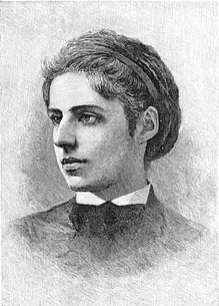
Emma Lazarus:
(July 22, 1849 – November 19, 1887).
American author of poetry, prose, and translations, as well as an activist for Jewish and Georgist causes. She is remembered for writing the sonnet “The New Colossus”, which was inspired by the Statue of Liberty, in 1883. Its lines appear inscribed on a bronze plaque, installed in 1903, on the pedestal of the Statue of Liberty. Lazarus was involved in aiding refugees to New York who had fled antisemitic pogroms in eastern Europe, and she saw a way to express her empathy for these refugees in terms of the statue.The last lines of the sonnet were set to music by Irving Berlin as the song “Give Me Your Tired, Your Poor” for the 1949 musical Miss Liberty, which was based on the sculpting of the Statue of Liberty (Liberty Enlightening the World). The latter part of the sonnet was also set by Lee Hoiby in his song “The Lady of the Harbor” written in 1985 as part of his song cycle “Three Women”.
Ten o’clock, the broken moon hangs not yet a half-hour high, yellow as a shield of brass. In the dewy air of June, poised between the vaulted sky and the ocean’s liquid glass.
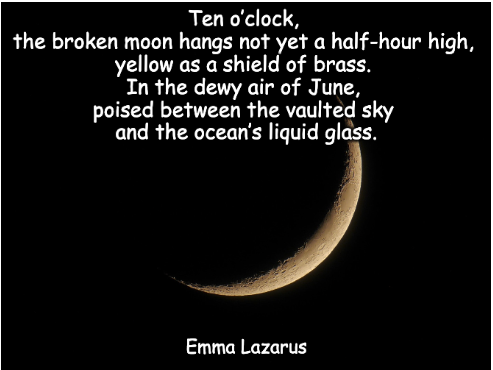
The lines describe a ‘summery June night by the sea’, around ten o’clock in the evening.
Image by image:
– “Ten o’clock” → It is evening, shortly after nightfall.
– “the broken moon” → Probably a **non-full moon, for example a half or crescent moon. “Broken” suggests something incomplete or fragmented.
– “has not been high for half an hour yet” → The moon has only just risen and is still low above the horizon.
– “yellow as a shield of copper” → The moon has a warm, golden-yellow or coppery color. The image of a “shield” gives it something round, old, and almost mythical.
– “the dewy air of June” → A humid, soft summer air, typical of a warm night. – “balancing between the vaulted sky and the liquid glass of the ocean” → The moon seems to float between the dome of the sky and the smooth, mirroring sea. “Liquid glass” is an image for a calm ocean that reflects like glass.
🎭 Literary significance:
The passage primarily evokes an atmosphere of:
– 🌙 silence
– 🌊 sea and moonlight
– ✨ wonder
– 🕊️ peace and beauty
– 🌌 a moment between heaven and earth, almost timeless
It is therefore not about a moral or fixed wisdom, but about a ‘nature impression’: a refined description of a moon hanging low above a still sea. ✍️ Author:
– Emma Lazarus
— American poet, 1849–1887
– Best known for her sonnet “The New Colossus”, the lines of which appear on the Statue of Liberty:
> “Give me your tired, your poor…”
📚 Origin:
– The passage comes from the poem “A June Night”
– The poem is included in her poetry collections, including “The Poems of Emma Lazarus” from 1888, published posthumously.
– The lines therefore originate from ’19th-century American poetry’, not from a folk saying or proverbial tradition.
