Thích Nhất Hạnh:
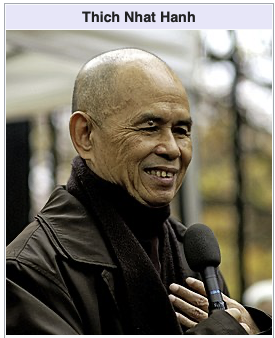
(born Nguyễn Xuân Bảo) (Huế (Union of Indochina), 11 October 1926 – Huế (Vietnam), 22 January 2022) was a Vietnamese Buddhist monk, peace activist, poet and writer who lived in France as an exile for much of his life.
Thích is not a personal surname, but a monastic title adopted by virtually all Vietnamese Buddhist monks and nuns upon their ordination. It is derived from ‘Thích Ca’, the Vietnamese adaptation of ‘Shakya’ (as in Shakyamuni, the Buddha). By adopting this title, monks symbolically indicate that they are leaving their birth family behind and becoming part of the ‘family of the Buddha’. Almost all Vietnamese monks and nuns therefore have ‘Thích’ as the first part of their name, regardless of their actual background.
Nhất Hạnh is his Dharma name (Pháp danh), the name he was given at his monastic ordination. This name roughly means ‘one action’ or ‘unity of practice’.
His birth name was Nguyễn Xuân Bảo:
Nguyễn = the surname (family/clan name, one of the most common in Vietnam)
Xuân Bảo = his first name(s)
So, in summary: ‘Thích Nhất Hạnh’ is composed of a monastic title (Thích) followed by his Dharma name (Nhất Hạnh) — not a traditional first name and surname as in his birth name, Nguyễn Xuân Bảo.
Throughout his life, he campaigned for peace, non-violence and the alleviation of suffering. Newspapers called him the most influential Buddhist of the past century, after the Dalai Lama.
In the 1970s, he introduced the Western world to the concept of mindfulness, about which he published the book The Miracle of Mindfulness in 1975. He has more than a hundred books to his name.
When you touch one thing with deep awareness, you touch everything.
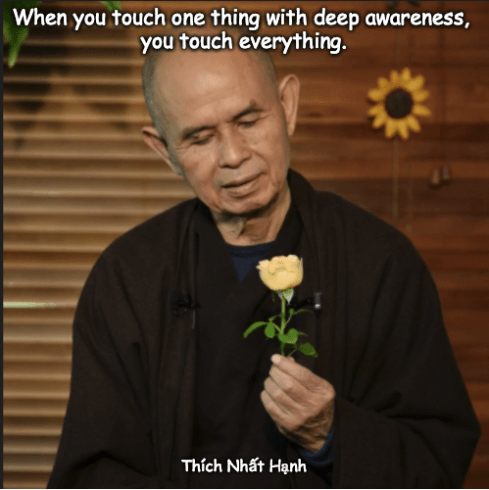
The quote expresses one of Thích Nhất Hạnh’s central teachings: ‘interbeing’ — the idea that nothing exists separately by itself.
In simple terms:
– If you look deeply at ‘one thing’ — a flower, a cup of tea, your breath, another person — you can see that it contains many other things.
– A flower contains ‘sunshine, rain, soil, clouds, time, and human care’.
– A cup of tea contains ‘water, earth, labor, weather, and the whole chain of life’.
– So, by truly seeing one thing clearly, you begin to see its connection with ‘everything else’.
🧘 “Deep awareness” means:
– Mindfulness
– Full presence
– Looking beyond the surface
– Seeing causes, conditions, and connections
It is not just physical touching.
It means ’touching reality with insight and mindfulness’.
🌏 Buddhist background:
The saying is rooted in Buddhist teachings such as:
– Dependent origination:
— everything arises because of causes and conditions.
– Emptiness:
— things do not exist independently or separately.
– Interbeing:
— Thích Nhất Hạnh’s term for the interconnected nature of all life.
📚 Origin:
The exact wording is widely circulated as a quotation from ‘Thích Nhất Hạnh’s mindfulness teachings’, especially his teachings on ‘interbeing’ and “looking deeply.”
However, the quote is often shared online without a precise book-and-page citation. So, if used in academic writing, it is safest to write:
> ‘Attributed to Thích Nhất Hạnh’ rather than claiming a specific source unless you can verify it in a printed edition.
✨ Core message:
> ‘When we are fully present with even one small part of life, we can realize its deep connection with all of life.’
It is a teaching about ‘mindfulness, interconnectedness, reverence, and compassion’.
👤 Author: This saying is ‘commonly attributed to:
– Thích Nhất Hạnh’ (1926–2022),
– Vietnamese Zen Buddhist monk, teacher, peace activist, and founder of “Plum Village.”
You are not walking towards a goal. Walking is also not a means. Walking isn’t even a goal anymore. Enjoy every step, because you have already arrived.
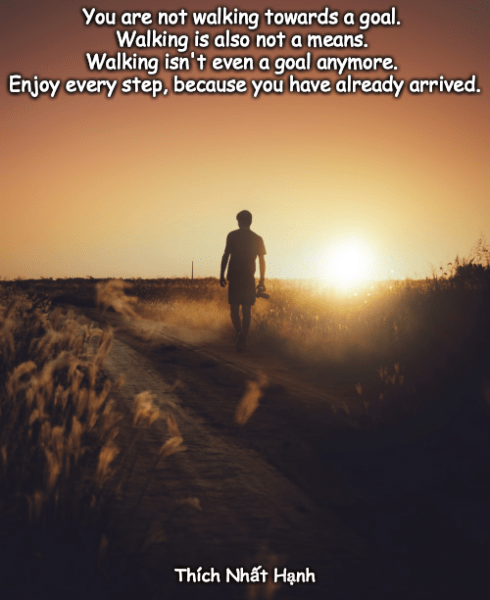
‘Not walking towards a goal’ | Rejects the idea that life is only about future outcomes (success, enlightenment, a “better” self). |
‘Walking is not a means’ | Your steps are not just tools to get somewhere else – they are not instrumental. |
‘Walking isn’t even a goal’ | Even “mindfulness” or “enlightenment” should not become another object of craving. |
‘Enjoy every step’ | The practice is in the ‘present sensation’ – the breath, the footfall, the contact with the earth. |
‘You have already arrived’ | Ultimate reality (peace, wholeness, presence) is ‘already here’, not in the future. You don’t need to become – you need to ‘be’. |
🧘 Author Attribution: Thích Nhất Hạnh (or closely derived from his teachings)
– This exact phrasing is ‘not a single verbatim quote’ from his books, but it is a ‘faithful paraphrase’ of his core teaching on ‘mindful walking’ (‘kinh hành’ – walking meditation).
– The Zen master and peace activist Thích Nhất Hạnh (1926–2022) often said things like:
> “I have arrived, I am home” – a repeated mantra in his walking meditations.
> “Walk as if you are kissing the Earth with your feet.”
> “There is no way to happiness – happiness is the way.”
– The quote you shared condenses his philosophy:
‘Arrival is not a future destination, but a present awareness.’
📖 Origin & Context:
– Tradition:
Vietnamese Zen Buddhism (Thiền) blended with ‘Engaged Buddhism’ – mindfulness as everyday practice, not just monastic retreat.
– Key texts:
‘Peace Is Every Step’ (1991), ‘The Long Road Turns to Joy:
A Guide to Walking Meditation’ (1996), ‘You Are Here’ (2001).
– Practice context:
Thích Nhất Hạnh led walking meditations at Plum Village (France) and worldwide – slow, silent, aware steps, often with the inner mantra:
“I have arrived, I am home.”
– Philosophical roots:
‘Echoes of Chan/Zen non-dualism – the path and the goal are one; also ‘Madhyamaka’ (no separate “arriver” and “arrival”).
🧭 Why This Saying Resonates:
– It ‘dissolves the tyranny of the future’ – a common modern anxiety (always striving, never enough).
– It invites a ‘shift from “becoming” to “being”‘ – from productivity to presence.
– It is ‘not anti-goal’ – it simply says:
‘Don’t let the goal steal the journey.’
✨ Final Thought (in his spirit):
> “Breathing in, I calm body and mind. Breathing out, I smile. Dwelling in the present moment, I know this is the only moment.”
— Thích Nhất Hạnh 🌸
We are here to awaken from our illusion of separateness.
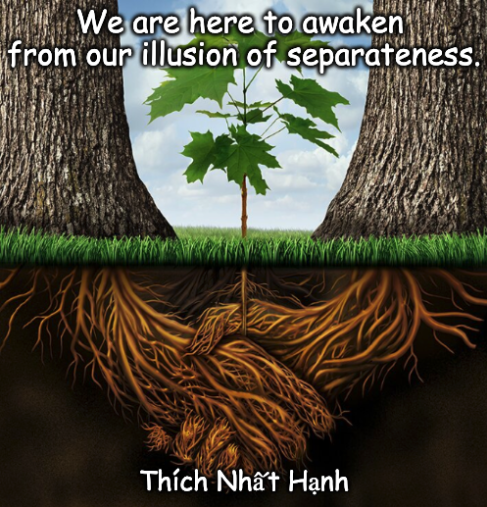
The phrase expresses the idea that our everyday sense of being separate, isolated individuals — cut off from other people, from nature, from the world — is not the ultimate truth but a kind of illusion. “Awakening” means seeing through that illusion and recognizing our deep interconnection with everything else. In Thich Nhat Hanh’s own teaching of “interbeing,” there is no separation between self and other, and everything is interconnected, and once a person truly grasps this, they are no longer caught in the idea that they are a separate entity. The line frames this recognition as the very purpose of spiritual life — “why we are here.”
Origin:
The exact original source (a specific book, talk, or date) is hard to pin down. It circulates as a free-floating quote across quote-aggregator sites, social media, and spiritual-inspiration blogs, often without citation to a particular text. A closely related version, “We’re here to awaken from the illusion of separateness,” is sometimes traced to Ram Dass’s book “How Can I Help? Stories and Reflection on Service”. Because the two phrasings are so similar, this looks like a case where a popular idea has been passed around so much that its precise textual origin has become blurred.
Author:
Most commonly attributed to Thich Nhat Hanh (1926–2022), the Vietnamese Zen Buddhist monk, peace activist, and founder of the Plum Village tradition. However, the near-identical phrasing is also attributed to Ram Dass (1931–2019), American spiritual teacher and author of “Be Here Now”. Given the conflicting attributions and lack of a verifiable primary source, I’d treat the authorship as uncertain rather than settled — Thich Nhat Hanh is the far more widely cited source, but it isn’t confirmed with certainty.
You must love in such a way that the person you love feels free.
Thích Nhất Hạnh’s teaching here centers on ‘upeksha’ — one of the four elements of true love in Buddhist thought, often translated as equanimity or freedom.
The core idea:
– Love shouldn’t be possessive or controlling.
If your love makes someone feel trapped, obligated, or diminished, it isn’t true love — it’s attachment or need dressed up as love.
– “Feels free… not only outside but also inside” is the key phrase. It’s not just about giving someone physical freedom (letting them make their own choices, keep their own friends) — it’s about them feeling ‘psychologically’ unburdened around you: not performing a role, not suppressing who they are just to keep you happy.
– True love expands a person rather than shrinking them. The broader teaching is that real love allows both people to keep growing as individuals, so love becomes a source of spaciousness rather than a cage.
Importantly, this isn’t a call for permissiveness or detachment. As one reflection on the quote puts it:
loving someone so they feel free doesn’t mean letting them do whatever they want whenever they want — otherwise you become the one who isn’t free, a slave to their whims.
It requires open communication, understanding, and presence. The freedom comes from loving with enough security that the other person doesn’t feel owned — not from an absence of care or commitment.
Origin:
The quote comes from Thích Nhất Hạnh’s book “True Love: A Practice for Awakening the Heart” (Shambhala Publications). The fuller passage reads:
“When you love, you bring freedom to the person you love. If the opposite is true, it is not true love. You must love in such a way that the person you love feels free, not only outside but also inside.”
It appears in his discussion of the four elements of true love — loving-kindness, compassion, joy, and equanimity/freedom — with this line illustrating the fourth.
Author:
Thích Nhất Hạnh (1926–2022) was a Vietnamese Zen Buddhist monk, teacher, author, and peace activist, widely known for popularizing mindfulness practice in the West and for founding the Plum Village tradition. He wrote extensively on love, mindfulness, and compassion, and this quote is one of his most widely shared teachings on relationships.
Our beliefs and thoughts are an extension of ourselves. They are our children and they are born every moment.
The saying means that our inner life is not separate from who we are.
– ‘Thoughts and beliefs are “extensions” of us’ because they shape how we speak, act, love, judge, and relate to the world.
– They are called “children” metaphorically because we “give birth” to them constantly.
– Once created, thoughts can continue beyond the moment:
– in our actions,
– in our speech,
– in our relationships,
– and in the effects we leave on others.
In Buddhist terms, this connects to ‘karma’
— not as fate or punishment, but as the continuing effects of our thoughts, words, and deeds.
🌱 Thích Nhất Hạnh Connection:
Thích Nhất Hạnh often taught that we continue through what we produce:
– our thoughts,
– our speech,
– our actions,
– our influence on others.
He taught that every thought carries our “signature.” A loving thought can nourish the world; an angry or hateful thought can also have consequences.
So the saying reflects his teaching on:
– ‘mindfulness’,
– ‘karma’,
– ‘interbeing’,
– ‘continuation after death’,
– and responsibility for one’s mental formations.
📚 Origin and Author:
✅ Likely authorial source:
– Thích Nhất Hạnh, or someone paraphrasing his teachings.
⚠️ Exact quote status:
– The exact wording — “Our beliefs and thoughts are an extension of ourselves…” — does ‘not appear to be one of his most reliably sourced direct quotations’.
– It is safer to cite it as:
> “Paraphrased from the teachings of Thích Nhất Hạnh”
or:
> “Inspired by Thích Nhất Hạnh’s teaching that our thoughts, words, and actions are our continuation.”
✨ Best Attribution:
> Inspired by Thích Nhất Hạnh:
Our thoughts, words, and actions are our continuation; they are the children we give birth to in every moment.
Or more simply:
> This saying reflects the teachings of Thích Nhất Hạnh, though the exact wording appears to be paraphrased.
Your smile proves that you are not a slave, but master of yourself and that you are, doing your best.
The saying does ‘not’ mean pretending to be happy or hiding pain.
Rather, it means:
– 😊 A mindful smile shows that you are ‘not completely controlled by anger, sorrow, fear, or stress’.
– 🧘 You still have some freedom inside yourself.
– 🌬️ By breathing and smiling gently, you return to awareness.
– 💪 You are choosing how to respond instead of reacting automatically.
– ❤️ “Doing your best” means meeting the moment with as much calm, compassion, and presence as you can.
In Thích Nhất Hạnh’s teaching, a smile can be a small act of ‘inner freedom’.
⚠️ Important Nuance:
This is not “toxic positivity.” Thích Nhất Hạnh did ‘not’ teach people to deny suffering. He taught that we can smile ’to our suffering’ with tenderness.
So the message is closer to:
> “Even when life is difficult, if you can breathe and smile gently, you are remembering that you are more than your suffering.”
📚 Origin:
The closest known source is Thích Nhất Hạnh’s mindfulness writings, especially:
“Peace Is Every Step: The Path of Mindfulness in Everyday Life”
– First published in 1991
– Edited by Arnold Kotler
– Contains teachings on mindful breathing, smiling, walking, and daily-life awareness
A closely related line often attributed to this book is:
>“A smile proves that you are not a slave, but a master of yourself.”
Similar teachings also appear in his works on the ‘half-smile’, such as:
– “The Miracle of Mindfulness”
– “Peace Is Every Step”
– “Present Moment Wonderful Moment”
👤 Author: Thích Nhất Hạnh
– Vietnamese Zen Buddhist monk
– Peace activist and mindfulness teacher
– 1926–2022
– Often affectionately called ‘Thầy’, meaning “teacher” in Vietnamese
He frequently taught that a gentle, mindful smile can help restore calm, awareness, and inner freedom.
When you wake up and you see that the Earth is not just the environment, the Earth is us, you touch nature of interbeing. And at that moment you can have real communication with the Earth. That is the highest form of prayer. In that kind of relationship, you will have the love, strength, and awakening you need to chgange your life.

Anxiety keeps us focused on the past or makes us worry about the future. If we can acknowledge our fear, we can realise that we are okay now. Today, we are still alive, and our bodies work wonders. Our eyes can still see the beautiful sky. Our ears can still hear the voices of our loved ones.

The saying means that ‘anxiety or fear often pulls us away from the present moment’:
– 🕰️ It can keep us trapped in memories of the ‘past’.
– 🔮 It can make us worry about what might happen in the ‘future’.
– 🌱 But if we gently acknowledge our anxiety, we can realize that ‘now, at this moment, everything is fine with us’.
The quote encourages mindfulness: noticing that we are living, breathing, seeing, hearing, and are still able to experience beauty and love.
Simply put:
> Anxiety causes us to live in the past or the future.
> Mindfulness brings us back to the present, where we can see that life is still there. 📚 Origin:
The phrasing you provided appears to be a ‘paraphrased version’ of a passage usually attributed to Thích Nhất Hạnh.
The most cited version is:
> “Fear keeps us focused on the past or worried about the future.
> If we acknowledge our fear, we can realize that we are fine now.
> Now, today, we are still alive and our bodies are functioning perfectly.
> Our eyes can still see the beautiful sky.
> Our ears can still hear the voices of our loved ones.”
It is usually associated with his book:
> “Fear: Essential Wisdom to Weather the Storm”
> by Thích Nhất Hạnh, published in 2012
Your version changes a number of words, specifically:
– “Fear” → “Worry”
– “worried about the future” → “makes us worried about the future”
– “works miraculously” → “does wonders”
It can therefore best be described as a ‘paraphrase or adapted quote’ of a teaching by Thích Nhất Hạnh.
👤 Author: Thích Nhất Hạnh
— a Vietnamese Zen Buddhist monk, poet, peace activist, and mindfulness teacher.
– Born: 1926
– Died: 2022
– Tradition: Zen Buddhism / Pruimendorp
– Known for: lessons on mindfulness, compassion, peace, breathing, and living intensely in the here and now.
Solitude is not about being alone high up in the mountains, or in a hut deep in the forest. It’s not about hiding ourselves away from civilization. Real solitude comes from a stable heart that does not get carried away by the crowd or our sorrows about the past, our worries about the future or our excitement about the present. We do not lose ourselves; we do not lose our mindfulness. To take refuge in our mindful breathing, to come back to the present moment, is to take refuge in the beautiful, serene island within each of us.
This saying means that ’true solitude is not simply being physically alone’.
Thích Nhất Hạnh is teaching that solitude is an ‘inner state’ rather than an outer location. You do not need to escape to a mountain, forest, monastery, or hut to experience real solitude.
Real solitude happens when:
– your heart is stable,
– your mind is not swept away by other people’s moods or opinions,
– you are not trapped in regret about the past,
– you are not consumed by anxiety about the future,
– you are not carried away by excitement or distraction in the present.
The central idea is:
> ‘True solitude is the ability to remain mindful, peaceful, and fully yourself wherever you are.’
When he speaks of taking refuge in ‘mindful breathing’, he means that the breath can bring us back to the present moment. Through mindful breathing, we return to the calm place within ourselves — what he calls the “beautiful, serene island within each of us.”
📚 Origin:
This passage is commonly found in Thích Nhất Hạnh’s teachings on ‘mindfulness, silence, and inner refuge’.
It is usually associated with his book:
> “Silence: The Power of Quiet in a World Full of Noise”.
> by Thích Nhất Hạnh
> Published by HarperOne, 2015
The wording may appear with small variations in different online quotations or excerpts, but the teaching is consistent with his Buddhist mindfulness tradition.
It also echoes an older Buddhist idea often summarized as:
> “Be an island unto yourself.”
That teaching encourages people to find refuge in mindfulness, awareness, and the Dharma rather than depending completely on external circumstances.
✍️ Author: Thích Nhất Hạnh
> Vietnamese Zen Buddhist monk, poet, peace activist, and mindfulness teacher
> 1926–2022
He was one of the most influential Buddhist teachers of the modern era and is known for bringing mindfulness practice into everyday life.
His teachings often focus on:
– mindful breathing,
– present-moment awareness,
– inner peace,
– compassion,
– nonviolence,
– simple living,
– finding refuge within oneself.
We have a tendency to think in terms of doing and not in terms of being. We think that when we are not doing anything, we are wasting our time. But that is not true. Our time is first of all for us to be. To be what? To be alive, to be peaceful, to be joyful, to be loving. And that is what the world needs most.
This quote contrasts “doing” with “being.”
– ‘Doing’ = being busy, producing, achieving, fixing, working.
– ‘Being’ = simply existing with awareness: being alive, present, peaceful, joyful, loving.
The message is that our value is ‘not only in what we accomplish’. We often feel guilty when we are not productive, but Thích Nhất Hạnh teaches that life is not merely a task list. Our first purpose is to ‘be fully present and alive’.
In short:
> ‘The world does not only need more activity; it needs more peaceful, loving, awake human beings.’
👤 Author:
The saying is widely attributed to Thích Nhất Hạnh — the Vietnamese Zen Buddhist monk, peace activist, poet, and mindfulness teacher.
His name is also written with Vietnamese accents as:
> Thích Nhất Hạnh
> 1926–2022
📚 Origin / Source:
The quote is commonly sourced to Thích Nhất Hạnh’s teachings on mindfulness and “being” rather than constant “doing.” It appears in collections and quotations associated with his book:
> “The Art of Living: Peace and Freedom in the Here and Now.”
> by Thích Nhất Hạnh
It is also consistent with themes found throughout his works, especially:
– ‘Being Peace’
– ‘The Miracle of Mindfulness’
– ‘Peace Is Every Step’
– ‘The Art of Living’
🌿 Core Idea:
The central teaching is:
– Don’t measure life only by productivity.
– Rest, presence, peace, joy, and love are not wasted time.
– A peaceful person contributes peace to the world.
– “Being” is the foundation for wise and compassionate “doing.”
✨ Simple Paraphrase:
> We are not here only to work and achieve. We are here first to truly live — to be present, peaceful, joyful, and loving. That kind of presence is exactly what the world needs.
If you want to make it far and realise your dreams, the first thing you have to do is learn how to take care of yourself.
– 🌱 ‘Self-care is the foundation of success.’
You cannot sustainably pursue dreams if you are exhausted, unhealthy, or emotionally overwhelmed.
– 🧘 ‘Inner balance comes before outer achievement.’
Taking care of your body, mind, emotions, and spirit gives you the strength to continue.
– ❤️ ‘Self-care is not selfish.’
It helps you become more stable, patient, focused, and capable of helping others too.
– 🛤️ “Make it far” means to go a long way in life, to endure, succeed, and keep moving toward your goals.
In simple terms:
> ‘To achieve your dreams, you must first protect and nourish the person who is going to achieve them — yourself.’
👤 Author: Thích Nhất Hạnh?
This quote is often attributed to Thích Nhất Hạnh, the Vietnamese Zen Buddhist monk, peace activist, and mindfulness teacher.
However:
– ⚠️ The ‘exact wording’ does not appear to be one of his most reliably sourced or famous quotations.
– It may be a ‘paraphrase or modern adaptation’ of his teachings.
– The idea strongly matches his philosophy: mindfulness, compassion, rest, self-care, and healing oneself before trying to transform the world.
📍 Origin:
The saying comes from the broader tradition of ‘mindfulness and Buddhist self-care teachings’, especially the kind taught by Thích Nhất Hạnh.
Thích Nhất Hạnh often taught that:
– we must care for our suffering,
– breathe mindfully,
– rest deeply,
– nourish our body and mind,
– and develop peace within ourselves before we can truly help others.
The quote is likely from this general body of thought rather than from a clearly confirmed ancient Buddhist text or exact book passage.
Spirituality is not about escaping the world; it is about fully embracing it with awareness.
True spirituality is not running away from ordinary life, problems, relationships, suffering, or society. Instead, it means being fully present in life with mindfulness, compassion, and awareness.🧘
– Spirituality is ‘not escapism’.
– It is not about avoiding pain, responsibilities, society, or human emotions.
– It is about meeting life directly — joy, suffering, work, relationships, conflict — with ‘awareness and compassion’.
– A spiritual person does not withdraw from the world out of fear; they learn to live in the world more consciously.
In simple words:
> ‘Real spirituality is not leaving life behind, but living life more deeply and mindfully.’
📚 Origin and Author:
Is it by Thích Nhất Hạnh?
Probably ‘not as an exact quote’.
The wording strongly resembles Thích Nhất Hạnh’s philosophy, but I would not attribute it to him as a direct quotation without a verified source from one of his books, talks, or official publications.
Thích Nhất Hạnh often taught that mindfulness should be practiced in everyday life — while walking, eating, working, speaking, listening, and helping others.
So the quote is very much ‘in the spirit of Thích Nhất Hạnh’, but likely a ‘modern paraphrase’.
🌸 Connection to Thích Nhất Hạnh:
Thích Nhất Hạnh taught “Engaged Buddhism”, which means spirituality should not be separated from real life and social responsibility.
Related ideas from his teachings include:
– Being present in the here and now.
– Bringing mindfulness into daily activities.
– Transforming suffering rather than avoiding it.
– Practicing compassion in the world, not outside of it.
So if you want to describe the quote accurately, you could say:
> This saying reflects the teachings of Thích Nhất Hạnh, especially his emphasis on mindfulness and engaged Buddhism, but the exact wording is not confirmed as his.
Your mind is like a piece of land planted with many different kinds of seeds. The quality of your life depends on the seeds you water. If you water a seed of peace in your mind, peace will grow. When the seeds of happiness in you are watered, you will become happy. When the seed of anger in you is watered, you will become angry. The seeds that are watered frequently are those that will grow strong.
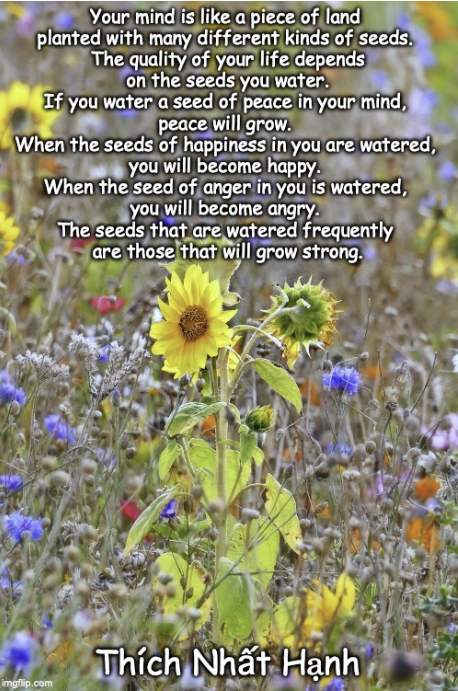
The teaching describes how the mind works using a garden metaphor. According to this framework, your mind contains countless “seeds” — seeds of joy, peace, compassion, and understanding, alongside seeds of anger, fear, craving, and despair. All of them lie dormant, “sleeping in the soil” of your consciousness.
None of these seeds disappear entirely, and none of them sprout on their own. What determines your emotional life is which ones you ‘water’ — through what you pay attention to, what you dwell on, who you spend time with, and what you repeatedly do or say. Water the seed of anger — through resentful thinking, retaliation, dwelling on grievances — and anger grows stronger and easier to trigger next time. Water the seed of peace — through mindfulness, compassion, calm attention — and peace becomes your more natural state.
A few implications embedded in this:
– ‘You’re not your emotions; you’re the gardener.’ Anger or sadness arising doesn’t mean you ‘are’ an angry or sad person — it means that seed got watered. This is meant to reduce shame and self-judgment while still taking responsibility for tending your inner life.
– ‘It applies to how you treat others too.’ Thầy taught that we water seeds in ‘other people’ as well — a kind word waters someone else’s seed of joy; a cruel one waters their seed of anger. So the practice extends into how you speak and act toward others.
– ‘It’s practical, not just poetic.’ The teaching underlies concrete practices — mindfulness, choosing wholesome company, catching yourself before feeding a destructive thought pattern — rather than just describing feelings abstractly.
Origin:
The metaphor draws on ‘store consciousness’ (Sanskrit: ‘ālaya-vijñāna’), a concept from Buddhist psychology, especially the Yogācāra school, which Thích Nhất Hạnh wrote about at length in books like “Understanding Our Mind” and “Transformation and Healing”. In this model, consciousness has two layers: a “store” where every experience and habit gets deposited as a seed, and everyday “mind consciousness,” where whichever seeds are watered rise up and become active thoughts, moods, or actions.
Author:
Thích Nhất Hạnh (1926–2022), the Vietnamese Zen Buddhist monk, peace activist, and founder of the ‘Plum Village tradition’. This particular passage appears in his book “Falling in Love with the Earth”, though he returned to the same seed imagery across many talks and writings throughout his life.
Each minute we spend worrying about the future and regretting the past is a minute we miss in our appointment with life – a missed opportunity to engage life and to see that each moment gives us the chance to change for the better, to experience peace and joy.

– The saying means that ‘worrying about what may happen and regretting what already happened pulls attention away from the present moment’.
– Its message is that ‘life is lived now’, and each moment is an opportunity to respond more wisely, peacefully, and compassionately.
– The phrase “appointment with life” suggests that being fully present is not passive; it is a real meeting with reality, where change and growth can happen.
✍️ Origin and author:
– This wording is ‘commonly attributed to Thích Nhất Hạnh’, the Vietnamese Zen Buddhist teacher known for teachings on mindfulness and presence.
– The quote is ‘often circulated online in slightly different forms’, and exact attribution can vary depending on the source.
– The core idea strongly matches Thích Nhất Hạnh’s teachings, but the ‘precise wording is difficult to verify as an exact canonical quotation’.
🌿 Closely related Thích Nhất Hạnh teaching:
– A well-known teaching closely aligned with this idea is:
> “Worrying means you live in the future.
> Regret means you live in the past.
> Peace is living in the present.”
– This is the ‘same mindfulness message’ in a shorter form: release future anxiety and past regret to return to the present.
I think that God is on Earth, in every living being. What we call “the divine” is nothing other than the energy of awakening, of peace, of understanding, and of love, which is to be found not only in every human being, but in every species on Earth.
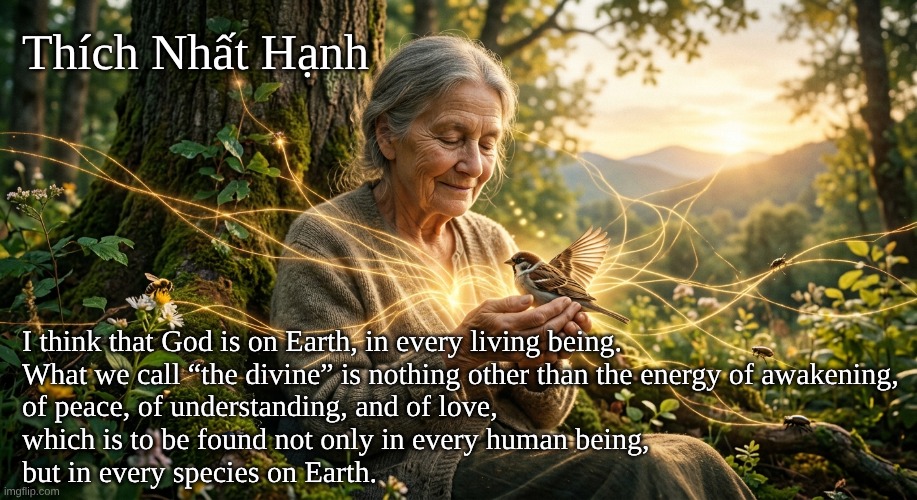
– Bridges the gap between religion and spirituality.
– Emphasizes that enlightenment and peace are accessible to everyone, in the here and now.
– Calls for an active role in creating a more peaceful and sustainable world.
– Reminds us that we are fundamentally connected to each other and to nature.
There is no way to happiness. Happiness is the way.
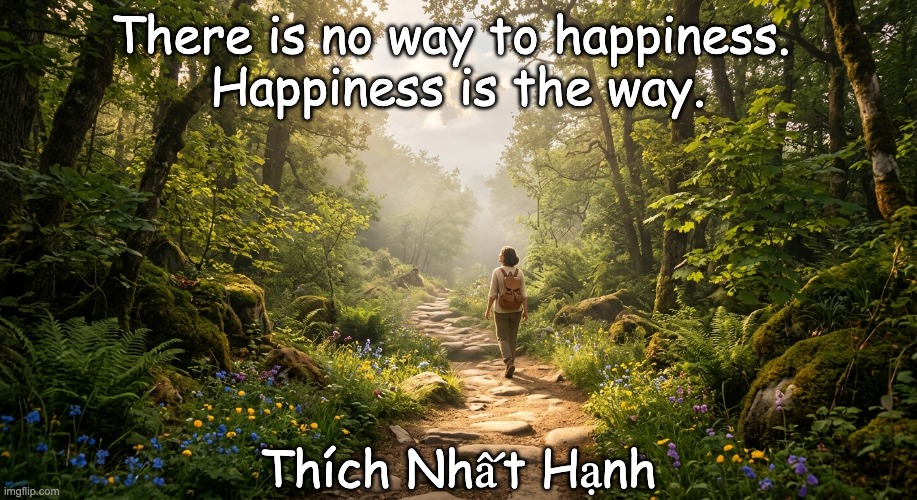
The saying pushes back against the common instinct to treat happiness as a destination — something you finally reach once you get the job, the relationship, or the achievement you’re chasing. Instead, it proposes that happiness isn’t a place at the end of a road; it’s a quality of ‘how you walk the road itself’.
A few layers to that:
– Practice over pursuit. If happiness is “the way,” it’s something enacted moment to moment — through mindfulness, presence, kindness, gratitude — rather than a prize won later. You don’t defer it to some future state.
– Non-attachment to outcomes. Much Buddhist thought holds that grasping for a future state (including “future happiness”) is itself a source of suffering. Treating happiness as a way of being ‘now’ sidesteps that grasping.
– Parallel structure. The fuller quote extends the same logic to peace and enlightenment — you don’t achieve peace and then act peacefully; acting peacefully ‘is’ peace. Same with enlightenment: not a finish line, but a way of engaging with each moment.
In short:
Stop treating happiness as a goal on the horizon, and start treating it as the manner in which you live right now.
Origin:
The line appears as part of a longer passage:
“There is no way to happiness, happiness is the way. There is no way to peace, peace is the way. There is no way to enlightenment, enlightenment is the way.”
A related version also appears in the book “The Art of Living: Peace and Freedom in the Here and Now”, phrased as “Liberation, enlightenment, and happiness are possible each step of the way. There is no way to happiness; happiness is the way.”
Author:
Most commonly attributed to Thich Nhat Hanh, the Vietnamese Zen Buddhist monk, teacher, and peace activist (1926–2022) who founded the Plum Village Tradition, a Vietnamese Thiền Buddhist monk and peace activist, founder of the Plum Village Tradition.
Worth noting:
The quote also circulates widely under self-help author Wayne Dyer’s name. Given how freely aphorisms like this get repeated and reattributed across quote sites, pinning down the very first source with certainty is difficult — but Thich Nhat Hanh’s attribution has the stronger grounding, since it ties to an actual published passage rather than just a floating quote card.
In order to rally people, governments need enemies. They want us to be afraid, so we will rally behind them. And if they do not have a real enemy, they will invent one in order to mobilize us.
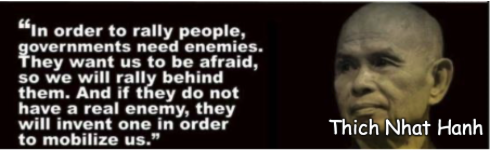
The saying means that ‘fear is often used as a political tool’:
– Governments can strengthen public loyalty by presenting a threatening “enemy.”
– Fear can make people more willing to:
– accept authority,
– support wars or harsh policies,
– tolerate loss of freedoms,
– unite behind leaders.
– If no obvious enemy exists, leaders may ‘exaggerate, distort, or create one’ in order to mobilize the population.
In short:
‘People are easier to control when they are afraid and believe they are under threat.’
✍️ Author:
The quotation is ‘widely attributed to Thích Nhất Hạnh’
— the Vietnamese Zen Buddhist monk, peace activist, and writer.
His name is correctly written:
> Thích Nhất Hạnh
> 1926–2022
📚 Origin:
The quote is commonly traced to Thích Nhất Hạnh’s writings and talks on war, fear, violence, and political manipulation, especially in the context of his peace activism and reflections after modern wars and terrorism.
A frequently cited source is his book:
> Thích Nhất Hạnh, “Calming the Fearful Mind: A Zen Response to Terrorism”.
> Parallax Press, 2005
The wording may appear online in slightly different forms, so it is best treated as a ‘popularly circulated quotation attributed to him’, rather than an ancient Buddhist proverb.
⚠️ Attribution note
– The idea fits very well with Thích Nhất Hạnh’s teachings on ‘fear, anger, enemy-making, and nonviolence’.
– However, online quote collections often repeat it without page numbers.
– If you need it for academic use, it would be safest to verify the exact wording in a printed edition of “Calming the Fearful Mind” or another primary source.
🕊️ Core message:
The saying warns against ‘political fear-mongering’ and invites people to look deeply before accepting official narratives about enemies. It reflects Thích Nhất Hạnh’s broader belief that the real enemies are often not people, but ‘fear, hatred, ignorance, and violence’.
No mud, no lotus.
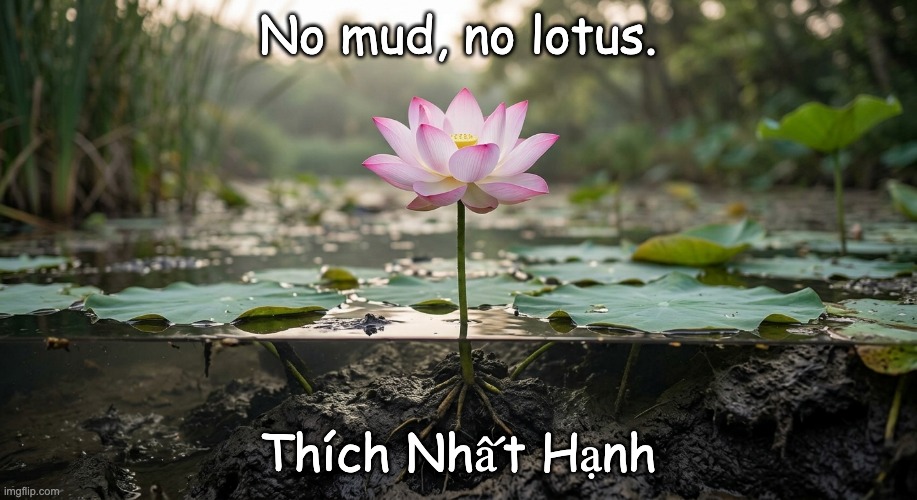
This powerful proverb is fundamentally about ‘resilience, transformation, and the necessity of suffering for growth.’
– The Lotus (Enlightenment/Joy):
The lotus flower is exquisite, pure, and beautiful. It symbolizes spiritual awakening, happiness, peace, and the realization of our true nature.
– The Mud (Suffering/Challenges):
The lotus does not grow in sterile soil or clear water. It ‘must’ grow out of thick, dark, mucky mud. The mud represents the difficulties, pain, suffering, and challenges we face in life.
– The Connection:
The saying teaches us that without experiencing and embracing the “mud” (our struggles), we cannot develop the “lotus” (our wisdom, compassion, and true happiness). Suffering is not something to be avoided at all costs; it is the very nutrient from which our inner beauty and strength emerge. You cannot have the beautiful flower without the messy, difficult conditions that nurture it.
☸️ Origin and Author:
The saying is deeply rooted in ‘Buddhist philosophy’.
While the concept is ancient and central to Buddhism (the idea that suffering, or ‘dukkha’, is the starting point for enlightenment), the specific, modern phrasing “No mud, no lotus” is most famously attributed to:
Thich Nhat Hanh
– He was a world-renowned Vietnamese Buddhist monk, Zen master, peace activist, author, and teacher.
– The Source:
He popularized this exact phrase in his many teachings and writings, most notably in his book titled “No Mud, No Lotus: The Art of Transforming Suffering” (published in 2014). In the book, he beautifully elaborates on how to acknowledge suffering, embrace it, and use mindfulness to transform it into peace and joy, just as the lotus transforms mud into a flower.
By living deeply in the present moment we can understand the past better and we can prepare for a better future.
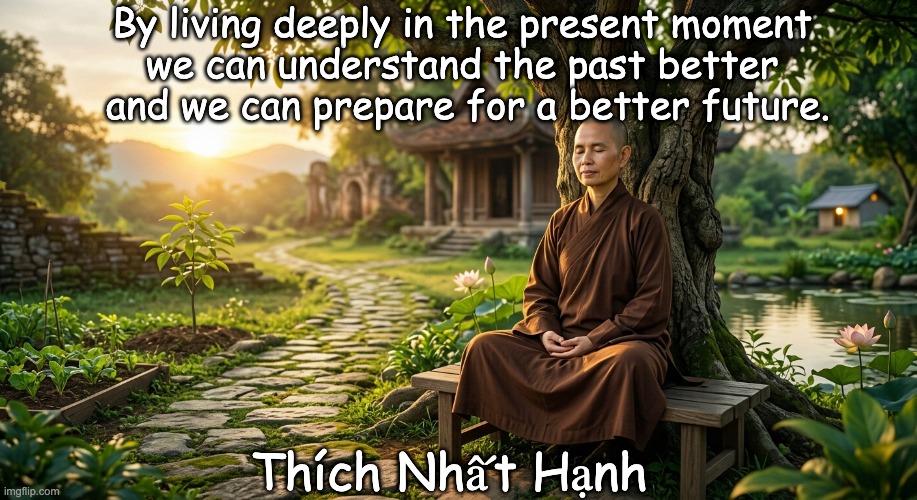
The quote suggests that by cultivating mindfulness and being fully present in each moment, we can gain a deeper understanding of our past experiences and actions. This understanding, in turn, allows us to make better choices in the present, which can lead to a more positive and fulfilling future.
Origin:
Thích Nhất Hạnh’s teachings are rooted in Zen Buddhism, which emphasizes the practice of mindfulness and meditation. This quote is a reflection of his belief that mindfulness is not just a technique for relaxation, but a way of living that can transform our lives and the world around us.
Author:
The quote is widely attributed to Thích Nhất Hạnh, who was a prolific writer and teacher. He authored many books on mindfulness, meditation, and peace, and his teachings have inspired millions of people around the world.
While you are walking, smile and be in here and now, and you will transform that place into paradise.
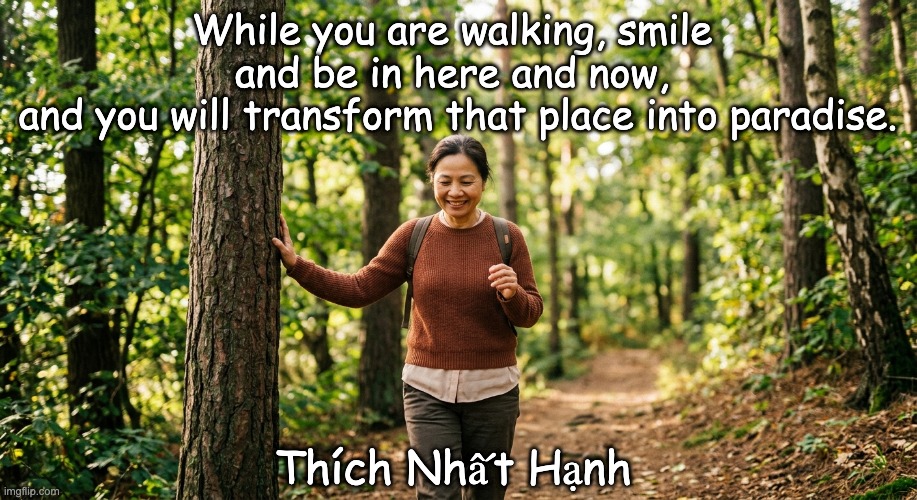
This beautiful quote encapsulates a core teaching of ‘mindfulness’. It suggests that our experience of reality is not predetermined by the external world, but rather by the quality of our presence and awareness.
‘This is a call to bring your full attention to the present moment.’ Instead of being lost in thought, worrying about the past or future, or rushing to a destination, you focus on the physical sensation of walking, the sights and sounds around you, and the simple act of breathing. The ‘smile’ is not just an outward expression, but an inner attitude of openness, kindness, and acceptance toward yourself and the present moment.
– “and you will transform that place into paradise”:
This is the transformative power of mindfulness. When you are fully present and aware, even the most mundane or challenging environment can be perceived with a sense of wonder, peace, and beauty. You stop judging the place as “good” or “bad” and simply experience it as it is. This shift in perspective can make any place feel sacred and full of possibility, effectively turning it into a “paradise” of your own making.
– Essentially, the quote teaches that ‘happiness and peace are not something to be found in a specific location or future time’, but are qualities that ‘can be cultivated within ourselves through mindful awareness in the present moment.’
🌱 Origin and Author:
This quote is indeed widely attributed to the renowned Vietnamese Zen Master, teacher, author, and peace activist Thích Nhất Hạnh.
Thích Nhất Hạnh (1926-2022) was a key figure in bringing mindfulness to the West and was the founder of the “Plum Village Tradition'”. His teachings emphasized “engaged Buddhism,” which applies Buddhist principles to daily life and social issues.
This particular quote perfectly reflects his teachings on ‘mindful walking’, a practice he often encouraged as a way to connect with the earth, cultivate presence, and find peace in everyday activities. He frequently spoke and wrote about the transformative power of a smile and the importance of living fully in the present moment.
While it can be challenging to pinpoint the exact source of every single quote attributed to such a prolific teacher, this saying is very much in line with the core tenets of his philosophy and is widely accepted as his words.
No one is more worthy of your kindness and compassion than you are.
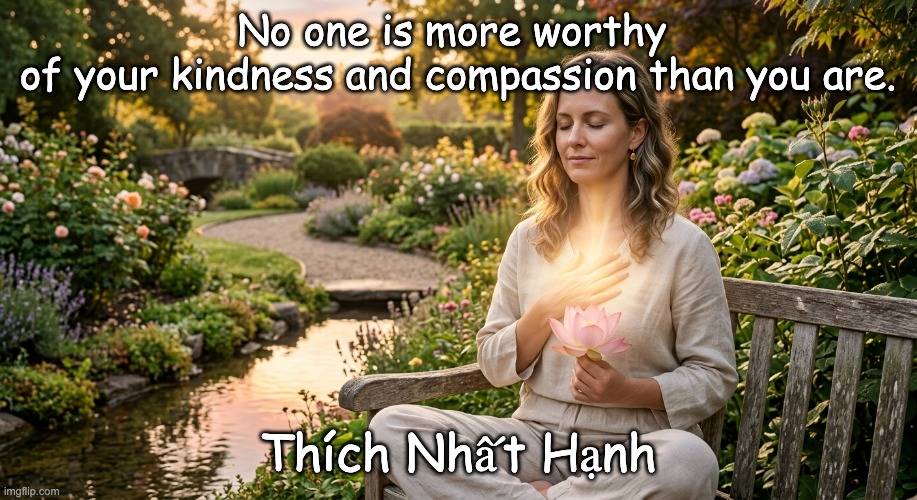
The core message is that you are fundamentally deserving of the same love, understanding, and support you extend to others. It challenges the common tendency to be overly critical and harsh towards oneself, while being forgiving and compassionate towards friends, family, and strangers.
Key aspects include:
– Self-Compassion:
Treating yourself with the same warmth, concern, and encouragement you would offer a loved one facing difficulties.
Worthiness:
Recognizing your inherent value and deservingness of kindness, simply because you are a human being.
– Balance:
Prioritizing your own well-being is not selfish; it is essential for living a healthy and fulfilling life and for being able to genuinely support others.
Origins and Author:
This specific phrasing is often attributed to Thích Nhất Hạnh, the renowned Vietnamese Zen Buddhist monk, teacher, author, and peace activist. While it might not be a direct quote found verbatim in all of his writings, it encapsulates a central theme of his teachings on mindfulness, compassion, and self-care.
Here’s why it’s associated with him:
– Core Teachings:
Thích Nhất Hạnh consistently emphasized the importance of cultivating self-love and self-compassion as the foundation for loving others. He taught that we cannot truly love others if we do not love ourselves first.
– Mindfulness
His teachings on mindfulness often involved bringing awareness to our inner state and responding to ourselves with tenderness and understanding, especially during moments of suffering.
– Similar Expressions:
He frequently used similar language and concepts, such as “loving-kindness meditation” (metta bhavana), which explicitly includes directing well-wishes towards oneself.
While the exact origin of this specific wording might be difficult to pinpoint with absolute certainty, its sentiment is deeply rooted in Buddhist philosophy and is a recurring theme in Thích Nhất Hạnh’s extensive body of work. It aligns perfectly with his message of cultivating peace and compassion from within.
In conclusion, this quote serves as a powerful reminder to extend the same love and understanding to ourselves that we so readily offer others. Whether it’s a direct quote or a faithful interpretation of his teachings, it embodies the spirit of Thích Nhất Hạnh’s wisdom on self-compassion.
The most precious gift we can offer anyone is our attention. When mindfulness embraces those we love, they will bloom like flowers.
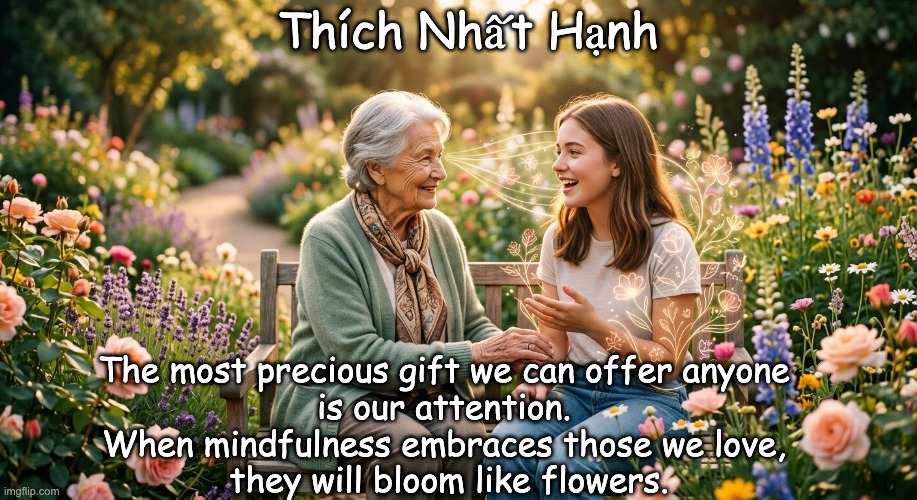
This profound statement highlights the transformative power of genuine, mindful presence.
– Attention as a Gift:
In our busy world, our focused attention is rare and valuable. This quote suggests that truly ‘listening’ and ‘being present’ with someone is one of the most loving and generous acts we can perform.
– The Power of Mindfulness:
“Mindfulness embracing those we love” means giving them our non-judgmental, full awareness. It’s about being fully “there” with them, not just physically present.
– Blooming Like Flowers:
The metaphor of flowers blooming beautifully illustrates how being seen and deeply heard allows a person to flourish, feel valued, and grow in confidence and happiness. Our loving attention nurtures their spirit.
🧑🏫 Author:
This quote is attributed to Thich Nhat Hanh.
He was a world-renowned Vietnamese Buddhist monk, Zen master, peace activist, author, and teacher. He was a pioneer in bringing mindfulness to the West and was nominated for the Nobel Peace Prize by Martin Luther King Jr. His teachings centered on the art of mindful living.
📚 Origin and Context:
While this exact phrasing is commonly associated with Thich Nhat Hanh, it is less a single “idiom” and more a central theme found across his many books, talks, and teachings on mindfulness and relationships.
It beautifully captures the essence of his message:
that the foundation of true love is our ability to offer our presence, our “true home,” to another person. Similar sentiments can be found in his works, such as:
“True Love: A Practice for Awakening the Heart” or “You Are Here: Discovering the Magic of the Present Moment”.
Silence is essential. We need silence just as much as we need air, just as much as plants need light. If our minds are crowded with words and thoughts, there is no space for us.
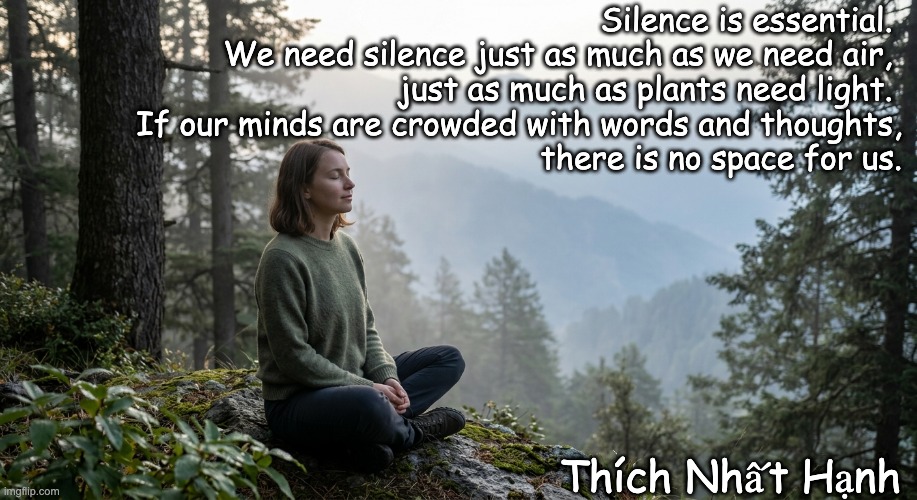
This profound quote emphasizes that silence is not merely the absence of noise; it is a fundamental necessity for mental and spiritual well-being, comparable to physical needs like air and light.
– Mental Clarity:
The metaphor of a “crowded mind” suggests that when we are constantly bombarded by thoughts, media, and internal chatter, we lose perspective and mental clarity. There is “no space for us” to simply ‘be’, to reflect, or to experience inner peace.
– Essential Nourishment:
By comparing silence to air for humans and light for plants, the quote frames quietude as a vital nutrient for the soul. Without it, our inner lives can become suffocated and dim.
– Creating Space:
Silence provides the necessary clearing to connect with our authentic selves, to process experiences, and to find stillness amidst the chaos of modern life.
📜 Origin:
The quote is featured in his book,
“Silence: The Power of Quiet in a World Full of Noise”.
In this work, he guides readers on how to cultivate inner silence even in the busiest environments.
Author:
This quote is attributed to Thich Nhat Hanh, the renowned Vietnamese Buddhist monk, Zen master, author, and peace activist.
Thich Nhat Hanh (1926–2022) was a highly influential teacher of mindfulness and engaged Buddhism. His teachings often centered on the power of the present moment and the importance of stillness.
You do not suffer because things are impermanent. You suffer because things are impermanent and you think they are permanent.
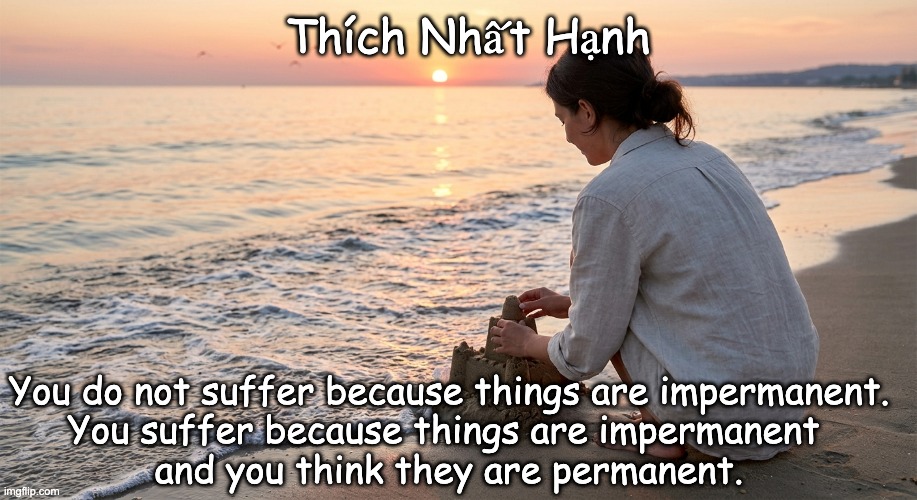
Embracing the Flow.
The quote addresses the fundamental Buddhist concept of ‘Impermanence’ (‘Anicca’).
It teaches us that:
– Change is the Only Constant:
Everything in the universe—our bodies, our relationships, our emotions, the seasons, the mountains—is in a constant state of flux. Nothing stays the same.
– The Source of Suffering:
Impermanence itself is not the cause of our pain. The suffering (‘Dukkha’) arises from our ‘resistance’ to this reality. We crave permanence in a world where it does not exist. We hold onto youth, loved ones, or specific situations, and when they inevitably change or fade, we experience sorrow.
– The Path to Peace:
True peace comes from accepting impermanence fully. When we understand that everything is transient, we can enjoy the present moment without fear of loss. We love more deeply ‘because’ we know the time is short, rather than loving with the anxious expectation that it must last forever.
🌸 Origin and Author:
This insightful quote is widely attributed to Thích Nhất Hạnh, the renowned Vietnamese Buddhist monk, Zen master, teacher, author, and peace activist.
While it is a powerful distillation of his teachings on mindfulness and impermanence, finding a specific, verbatim source in his extensive writings can be challenging. It is best understood as an elegant summary of his core teachings: that our suffering does not stem from the inevitable changes in life, but from our ‘clinging’ to things as if they will last forever.
Many of us have been running all our lives. Practice stopping.
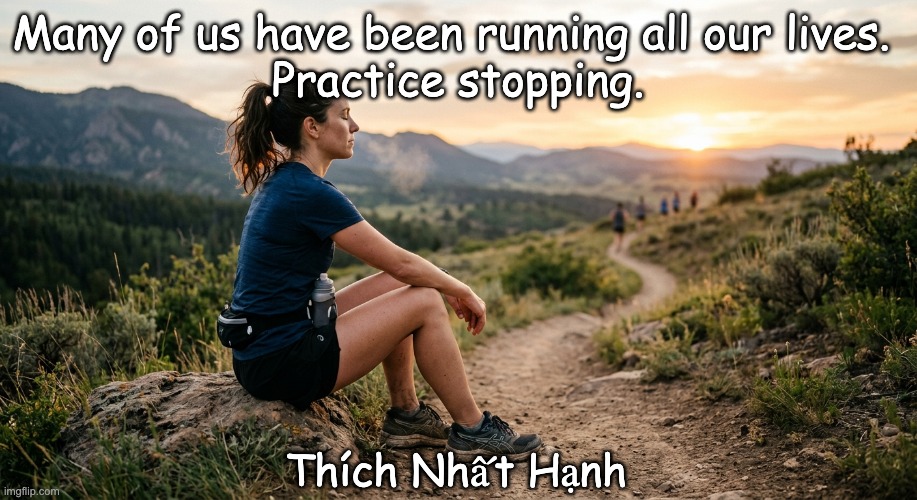
The saying “Many of us have been running all our lives. Practice stopping,” encourages us to break the cycle of constant doing, worrying, and striving. It is an invitation to mindfulness and presence.
– “Running all our lives”:
This refers to the habitual state of being perpetually busy—physically, mentally, and emotionally. We are often driven by anxiety, ambition, or the simply inability to be still, always looking toward the next task, goal, or distraction.
– “Practice stopping”:
This is the core teaching. It means consciously choosing to pause, breathe, and bring your awareness back to the present moment. It’s not about doing nothing, but about ‘being’ fully present in whatever you are doing (or not doing). It is a deliberate act of returning to yourself.
☸️ Origin and Author: Thích Nhất Hạnh.
He was a global spiritual leader who was instrumental in bringing mindfulness to the West.
– The concept of “stopping” (often referred to as ‘Shamatha’ or calming the mind) is a central pillar of his teachings. He often spoke about how stopping allows us to rest, heal, and truly experience the wonders of life that are available only in the present moment.
When you are able to silence all views and words, reality reveals itself to you, and that is Nirvana.
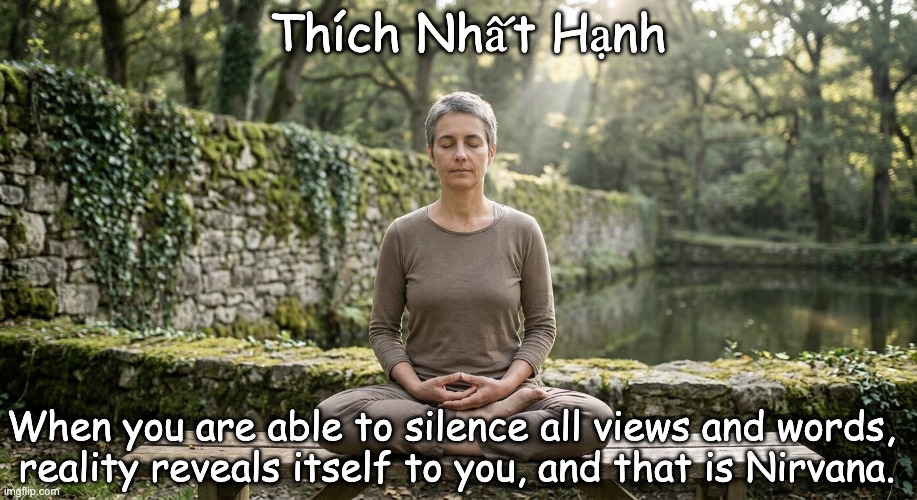
The quote encapsulates the idea that our conventional understanding of reality is heavily filtered and shaped by our thoughts, beliefs, opinions, and language. We are constantly labeling, categorizing, and interpreting our experiences, which creates a layer of mental constructs that obscures the true nature of things.
– “Silence all views and words”:
This doesn’t mean becoming mute or having no opinions. Instead, it refers to a state of inner stillness and mindfulness, where we are not attached to or identified with our thoughts and mental constructs. It’s about observing our thoughts without judgment and allowing them to arise and subside without clinging to them.
– “Reality reveals itself to you”:
When the noise of the mind is quieted, we can perceive things as they truly are, in their raw and unconditioned state. This is not an intellectual understanding, but a direct, experiential realization of the interconnectedness and impermanence of all things.
– “And that is Nirvana”:
In Buddhism, Nirvana is not a destination or a state of being in the future. It is the cessation of suffering (dukkha) and the realization of liberation. This quote suggests that Nirvana is accessible in the present moment, here and now, through the practice of mindfulness and the silencing of the conceptual mind.
Origin and Author:
This quote is indeed widely attributed to Thích Nhất Hạnh, a Vietnamese Buddhist monk, teacher, author, and peace activist. He was a prominent figure in bringing mindfulness and Engaged Buddhism to the West. His teachings emphasize the importance of mindfulness in everyday life and the cultivation of peace within oneself and in the world.
While ’the exact source of this quote can sometimes be difficult to pinpoint precisely’ in his extensive writings, it aligns perfectly with the core tenets of his teachings on mindfulness, interbeing, and the direct experience of reality. It reflects the Zen tradition’s emphasis on direct realization over intellectual understanding.
Be Yourself. Life is precious as it is. All the elements for your happiness are already here. There is no need to run, strive, search, or struggle. Just Be.

The meaning of this saying is deeply rooted in mindfulness and the core teachings of Zen Buddhism:
– Mindfulness of the Present:
The quote emphasizes that true happiness isn’t found in the future or in external achievements. It exists right now, in the present moment.
– Sufficiency:
All the essential “elements for your happiness” (like your breath, the sky, the beauty around you, the very fact that you are alive) are already present. You don’t need to acquire more things or achieve more status to be happy.
– Letting Go of Striving:
The advice to stop “running, striving, searching, or struggling” is a call to release the constant, anxious drive to change our circumstances. It encourages acceptance and contentment with what is.
– “Just Be”:
This final phrase is the essence of mindfulness. It means simply existing, fully present and aware, without judgment or the need to interfere. It’s a state of deep peace and authenticity—simply being yourself.
Author:
This beautiful quote is attributed to Thich Nhat Hanh, a world-renowned Vietnamese Buddhist monk, Zen master, peace activist, and author. He was a central figure in bringing the concepts of mindfulness and “Engaged Buddhism” to the West.
The moment you understand the importance of loving yourself, you will stop hurting others.

This quote is essentially about ‘self-awareness and self-compassion’:
– When you ’truly value yourself’, you’re less likely to:
– act out your pain on other people
– seek validation through harming or controlling others
– project insecurity, anger, or emptiness onto others
– Loving yourself doesn’t mean being selfish—more like:
– accepting your humanity
– healing your wounds
– regulating your emotions instead of externalizing them
Core idea:
👉 ‘Unhealed self-hurt often becomes other-directed hurt; self-love helps break that cycle.’
🗺️ Origin:
⚠️ Attribution uncertainty.
About the origin/author:
– The quote is ‘frequently attributed online to Thích Nhất Hạnh’, but:
– I can’t confirm from that this attribution is verified by a known primary source (a book, recorded talk, or translated text).
– Many quote sites reproduce sayings with ‘uncertain provenance’—they may not show the original language text or publication details.
What I can say safely:
– Thích Nhất Hạnh is known for teachings that align with this message (self-compassion, mindfulness, non-harm, healing).
– However, ’this specific sentence’ is not something I can confidently verify as a direct, original Thích Nhất Hạnh quote without access to a primary citation (book/page or transcript).
✍️ Author: Is it Thích Nhất Hạnh?
✅ Alignment with his teachings:
If the quote is inspired by his themes, it fits:
– ‘Compassion (toward oneself and others)’
– ‘Mindfulness to stop harmful speech and actions’
– ‘Healing suffering at its source’
❌ But direct authorship is not guaranteed
Unless there’s a ’traceable primary source’, it’s best to treat the attribution as ‘unconfirmed’.
🌿 A likely “family” of ideas (close to his philosophy).
Even if the exact wording is not confirmed, the ‘message’ is consistent with Buddhist/Thích Nhất Hạnh-style teachings such as:
– “Don’t run away from yourself.”
– Healing requires turning back toward compassion.
– Nonviolence includes how we treat ourselves internally.
Letting go gives us freedom, and freedom is the only condition for happiness. If, in our heart, we still cling to anything – anger, anxiety, or possessions – we cannot be free.

This profound quote emphasizes the vital link between ‘detachment’ and ’true happiness’.
– The Burden of Attachment:
The quote suggests that as long as we hold onto negative emotions like ‘anger’ or ‘anxiety’, or are overly attached to ‘material possessions’, our hearts remain burdened. These attachments act like heavy weights, preventing us from experiencing true peace.
– Freedom Through Letting Go:
The act of “letting go” is presented as a liberating force. By consciously releasing our grip on these emotional and material anchors, we unburden ourselves.
– Happiness as the Destination:
This resulting state of ‘freedom’ is described as the essential prerequisite for genuine happiness. Only when we are unencumbered by attachments can we find lasting inner peace and contentment.
☸️ Origin and Author:
The quote is widely attributed to Thích Nhất Hạnh, the renowned Vietnamese Zen Buddhist monk, teacher, and peace activist.
His teachings consistently focused on ‘mindfulness’, ‘compassion’, and the importance of ‘detachment’ as a path to liberation. This particular quote beautifully encapsulates a core tenet of Buddhist philosophy regarding the nature of suffering and the path to freedom.
Choose to be in touch with what is wonderful, refreshing, and healing within yourself and around you.

The statement invites a conscious choice:
amidst pain, stress, or negativity, to still pay attention to what is already good, beautiful, and healing — both within yourself (inner peace, resilience, gratitude) and around you (nature, people, small moments of beauty). It aligns with Nhất Hạnh’s broader teaching that suffering and joy can coexist, and that mindfulness helps us see what is already there, rather than focusing solely on what is missing or painful. It is not a denial of difficulties, but an invitation to balance: paying just as much attention to healing and beauty as to problems.
Origin and author:
The quote comes from Thích Nhất Hạnh (1926–2022), the Vietnamese Zen Buddhist monk, writer, and peace activist. This exact phrasing is linked to his 2008 text (“Be Free Where You Are: A Talk Given at the Maryland Correctional Institute”), and a similar version also appeared in “True Love: A Practice for Awakening the Heart” (2011, Shambhala Publications). Furthermore, a closely related formulation — “Be in touch with what is wondrous, refreshing, and healing, both inside and around yourself” — appears in his well-known book “Peace Is Every Step: The Path of Mindfulness in Everyday Life”. Thus, he used this theme multiple times in various works; it is a core idea within his mindfulness teachings.
Because of your smile, you make life more beautiful.

This beautiful saying emphasizes the profound impact a simple, genuine smile can have on the world around you.
The quote suggests that a smile is not just a facial expression; it is an act of kindness, presence, and joy that radiates outward. It implies that your positive energy and happiness have the power to uplift others, improve environments, and make the overall experience of life richer and more beautiful for everyone you encounter. It is a reminder of our interconnectedness and the gentle power we hold.
Author and Origin:
This quote is widely attributed to Thích Nhất Hạnh (1926–2022), the influential Vietnamese Thiền Buddhist monk, teacher, author, and peace activist. It resonates deeply with his teachings on mindfulness, “interbeing,” and the practice of smiling as a way to cultivate peace in the present moment. While it may not be a word-for-word translation from an ancient sutra, it is a perfect distillation of his core philosophy, likely appearing in one of his numerous books or dharma talks.
You are like a candle. Imagine you are sending light out all around you. All your words, thoughts and actions are going in many directions. If you say something kind, your kind words go in many directions, and you yourself go with them. We are …transforming and continuing in a different form at every moment.

A few threads run through it:
– Interconnection and consequence:
Like a candle radiating light in every direction, everything you say, think, or do doesn’t stay contained to you — it moves outward and touches others, whether you’re aware of it or not. This is a practical way of teaching the Buddhist idea of “interbeing” — that nothing exists as a separate, isolated self.
– Responsibility through kindness:
If your words and actions ripple outward, then kindness isn’t a small or private act — it spreads. This gives a gentle ethical weight to ordinary moments: a kind word doesn’t just affect the person in front of you, it continues on in ways you can’t fully trace.
– Impermanence, not disappearance:
The last line — “we are transforming and continuing in a different form at every moment” — reflects his core teaching on impermanence (‘anicca’). Nothing simply vanishes; it changes form. He often illustrated this with the image of a cloud becoming rain, or a candle’s flame passing its light to another candle. The self isn’t a fixed, solid thing that starts and stops — it’s a continuous process of transformation, connected to everything around it.
– Presence:
Because you (and your words) are always in motion, always becoming something else, the quote implicitly points back to his most famous teaching: attention to the present moment is where all of this — your kindness, your impact, your own transformation — actually happens.
So the candle isn’t just a poetic image; it’s a compact teaching tool for interbeing, ethical mindfulness, and impermanence all at once — very characteristic of how he wrote.
Author:
Thích Nhất Hạnh (1926–2022) was a Vietnamese Zen Buddhist monk, teacher, and peace activist, founder of the Plum Village tradition. He was known for making Buddhist concepts like mindfulness, interbeing, and impermanence accessible through simple, everyday images — the candle metaphor is a classic example of his teaching style.
Origin:
The passage comes from “Being Peace”, one of his early and most widely read books (first published in 1987, with later editions reprinting this same wording). It’s part of a broader teaching he returned to often — that nothing exists in isolation, and that our actions ripple outward and continue in new forms rather than simply ending.
Anxiety, the illness of our time, comes primarily from our inability to dwell in the present moment.

This quote is attributed to Thich Nhat Hanh (1926–2022).
Who He Was: Thich Nhat Hanh was a globally revered Vietnamese Buddhist monk, peace activist, author, and teacher. He was a central figure in bringing mindfulness practice to the West and was nominated for the Nobel Peace Prize by Martin Luther King Jr.
Context:
This concept is the absolute cornerstone of his entire body of work. His teachings consistently emphasized mindfulness—the energy of being aware and awake to the present moment. He often spoke about how anchoring oneself in the “here and now” is the path to true peace and liberation from suffering.
Source: “The Heart of the Buddha’s Teaching,” Thich Nhat Hanh breaks down complex Buddhist concepts (like the Four Noble Truths and the Eightfold Path) into practical, accessible teachings for modern life.
The core message you referenced earlier—that anxiety stems from our inability to be in the present—is a central theme throughout this book. He teaches that by anchoring ourselves in the “here and now” through mindfulness and the breath, we can transform our suffering into peace.
Love is the capacity to take care, to protect, to nourish.

The saying, “Love is the capacity to take care, to protect, to nourish,” encapsulates a profound and practical view of love, moving beyond romantic sentiment to a concept of active, compassionate engagement. It suggests that true love is not just a feeling, but an ability and commitment to actively support the well-being, growth, and safety of another person.
– Capacity:
This implies love is a skill or strength that can be cultivated and developed, rather than just an innate emotion.
– Take Care:
This involves practical actions and attentiveness to another’s needs, both physical and emotional.
– Protect:
This means shielding the loved one from harm, ensuring their safety, and standing up for them.
– Nourish:
This points to providing the support, encouragement, and sustenance (emotional, spiritual, and physical) that allows the other person to thrive and grow.
Essentially, this definition views love as a verb—an action-oriented force that seeks the ultimate good of the beloved.
☸️ Origin and Author:
This beautiful and insightful quote is widely attributed to Thích Nhất Hạnh, a world-renowned Vietnamese Zen Buddhist monk, teacher, author, and peace activist.
Thích Nhất Hạnh, often affectionately called “Thay” (teacher) by his followers, was a pioneer in bringing mindfulness and “Engaged Buddhism” to the West. His teachings consistently emphasized that love, compassion, and understanding are not abstract concepts but practical skills to be woven into the fabric of daily life. This particular quote perfectly reflects his core philosophy that true love is inseparable from deep understanding and active, compassionate action.
There are many ways to calm a negative energy without suppressing or fighting it. You recognize it, you smile to it, and you invite something nicer to come up and replace it; you read some inspiring words, you listen to a piece of beautiful music, you go somewhere in nature, or you do some walking meditation.
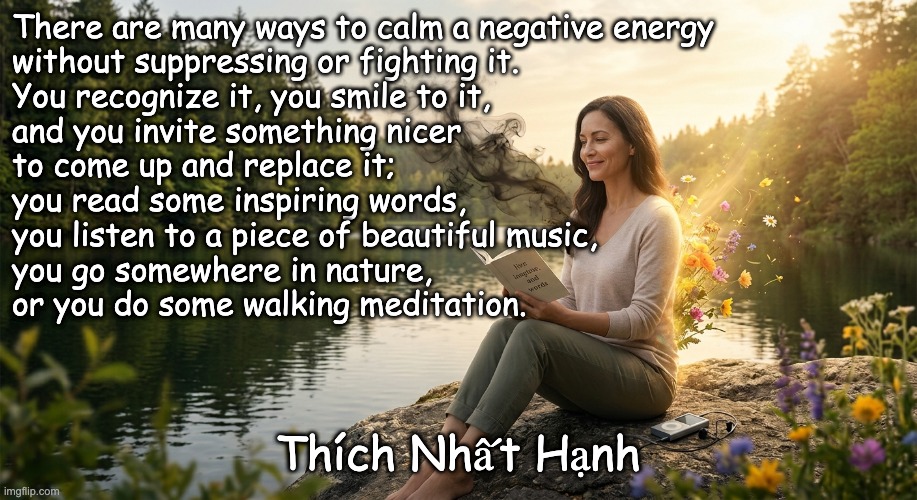
Meaning:
The saying emphasizes a compassionate and transformative approach to dealing with negative emotions (the “negative energy”). Instead of fighting against them or suppressing them, which can often intensify their power, the quote suggests a gentle and welcoming approach:
– Recognition:
The first step is to simply acknowledge the presence of the negative emotion. You become aware of it without judgment.
– Smiling:
This is a key practice in mindfulness. Smiling at the emotion is not about pretending everything is fine, but about acknowledging it with kindness and acceptance. It’s an act of self-compassion.
– Inviting Something Nicer:
This is the transformative part. Once you’ve acknowledged and accepted the emotion, you consciously invite positive and uplifting experiences to fill the space. This could be through inspiring words, music, nature, or mindful activity.
This process is about gently shifting your attention and energy from the negativity to something more positive, allowing the negativity to naturally dissipate without being forced.
Origin and Author:
This saying is indeed attributed to Thích Nhất Hạnh. He was a Vietnamese Buddhist monk, Zen master, teacher, and peace activist who wrote extensively on mindfulness and engaged Buddhism. His teachings often emphasized the importance of self-compassion, awareness, and the power of simple practices like mindful breathing and walking.
This specific quote resonates deeply with his core philosophy and is found in various forms in his books and teachings.
For things to reveal themselves to us, we need to be ready to abandon our views about them.
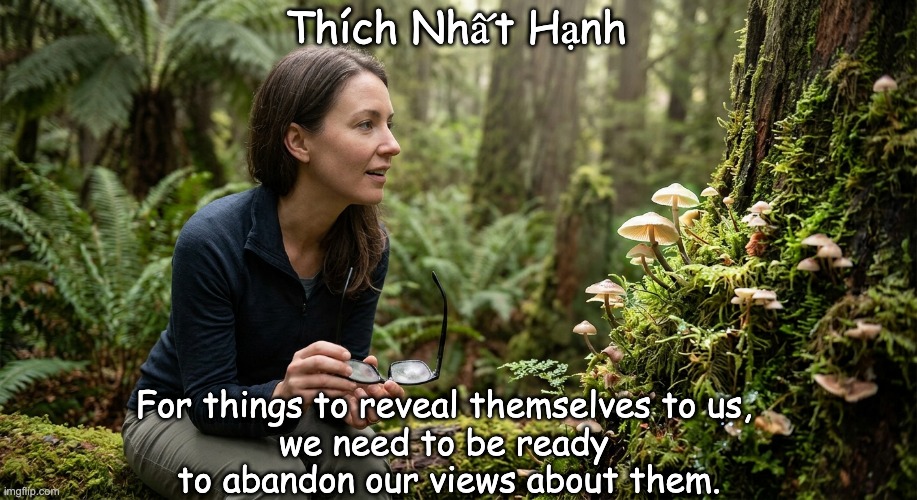
‘Seeing Beyond Our Views’.
This profound statement speaks to the essence of mindfulness, openness, and deep looking.
It suggests that our preconceived notions, judgments, and fixed ideas act as filters or barriers.
– Mental Filters:
When we approach a person, situation, or object with a set of rigid opinions, we only see our own projections. We interpret reality through the lens of what we ’think’ we know.
– The Act of Abandoning:
“Abandoning our views” does not mean discarding knowledge, but rather setting aside our attachments to specific outcomes or definitions. It is an act of humility and receptivity.
– The Revelation:
Only when we quiet our internal narrative and abandon these fixed views can reality “reveal itself.” We become capable of experiencing the true nature, complexity, and beauty of things as they actually are, free from our mental distortions.
👤 The Author: Thích Nhất Hạnh.
The author of this quote was Thích Nhất Hạnh (1926–2022).
He was a world-renowned Vietnamese Thiền (Zen) Buddhist monk, teacher, author, poet, and peace activist. Thích Nhất Hạnh was a global pioneer in introducing mindfulness and “Engaged Buddhism” to the West, emphasizing the application of Buddhist principles to daily life and social change. He founded the Plum Village tradition in France and was nominated for the Nobel Peace Prize by Dr. Martin Luther King Jr.
📖 The Origin:
This specific quote is a well-known distillation of Thích Nhất Hạnh’s core teachings on the nature of perception and the practice of mindfulness.
It is frequently found in his books and transcribed Dharma talks, particularly those discussing the concepts of “right view” and “no view.” In the Buddhist tradition, “right view” is often understood not as holding the “correct” dogmatic opinion, but rather as the insight that transcends all views, allowing for direct, unfiltered experience.
The quote encapsulates the practice of letting go of intellectual constructs to connect deeply with the present moment.
Omdat je leeft, is alles mogelijk.
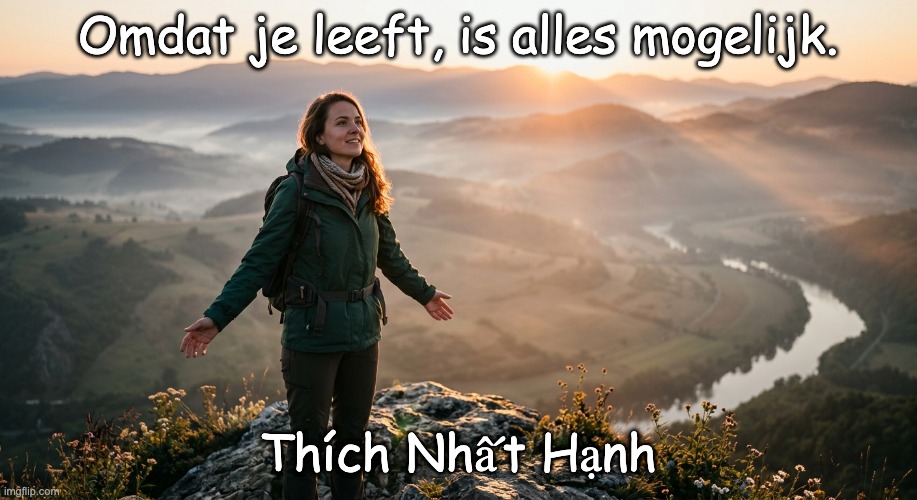
Dit is een werkelijk prachtige en krachtgevende uitspraak.
“Omdat je leeft, is alles mogelijk” is een krachtige bevestiging van potentieel en de inherente waarde van het leven.
– Het leven als fundament:
De kern van de gedachte is dat het leven zelf – aanwezig zijn, ademen en de wereld ervaren – de ultieme voorwaarde is om “iets” te kunnen laten gebeuren. Zonder leven is er geen potentieel.
– Oneindige mogelijkheden:
Zolang je leeft, is je verhaal nog niet ten einde. Je hebt de regie in handen om te veranderen, te groeien, te leren, te helen en je dromen na te streven.
– Een oproep tot aanwezigheid:
Het moedigt mindfulness aan. Door het eenvoudige, diepgaande feit te erkennen dat je ‘nu’ leeft, open je de deur naar toekomstige mogelijkheden. Het is een herinnering om je niet te laten beperken door mislukkingen uit het verleden of angsten voor de toekomst, maar om je te richten op het potentieel van het huidige moment.
☸️ Oorsprong en auteur:
Deze uitspraak wordt veelal toegeschreven aan Thích Nhất Hạnh, de vermaarde Vietnamese zenboeddhistische monnik, leraar, auteur en vredesactivist.
Thích Nhất Hạnh (door zijn leerlingen vaak liefkozend “Thay” genoemd) was een wereldwijd boegbeeld van mindfulness en geëngageerd boeddhisme. Zijn leringen legden voortdurend de nadruk op:
1. Mindfulness van de ademhaling:
De eenvoudige handeling van het ademen gebruiken om jezelf te verankeren in het huidige moment.
2. De vreugde van het leven:
Geluk vinden in gewone, alledaagse handelingen (zoals wandelen, thee drinken of simpelweg ademen).
3. Inter-zijn (Interbeing):
De onderlinge verbondenheid van al het leven.
Deze specifieke uitspraak vat zijn filosofie perfect samen: dat het eenvoudige, wonderbaarlijke feit van ons bestaan de voedingsbodem is waaruit alle positieve verandering, genezing en vreugde kunnen voortkomen.
Because you are alive, everything is possible.
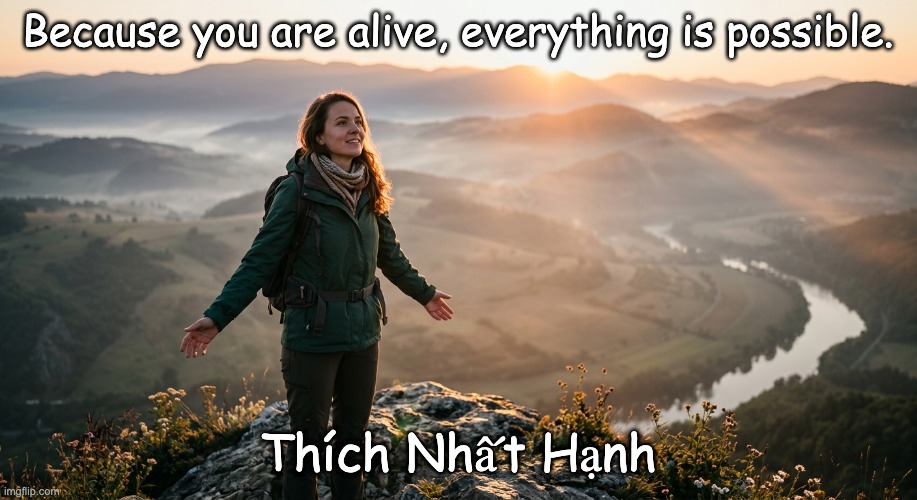
This is a truly beautiful and empowering quote.
“Because you are alive, everything is possible” is a powerful affirmation of potential and the inherent value of life.
– Life as the Foundation:
The core idea is that life itself—being present, breathing, and experiencing the world—is the ultimate prerequisite for “anything” to happen. Without life, there is no potential.
– Infinite Possibilities:
As long as you are alive, your story is not finished. You possess the agency to change, grow, learn, heal, and pursue your dreams.
– A Call to Presence:
It encourages mindfulness. By recognizing the simple, profound fact of being alive ‘right now’, you unlock the door to future possibilities. It’s a reminder to not be limited by past failures or future fears, but to focus on the potential of the present moment.
☸️ Origin and Author:
This quote is widely attributed to Thích Nhất Hạnh, the renowned Vietnamese Zen Buddhist monk, teacher, author, and peace activist.
Thích Nhất Hạnh (often affectionately called “Thay” by his students) was a global leader in mindfulness and engaged Buddhism. His teachings consistently emphasized:
1. Mindfulness of Breath:
Using the simple act of breathing to anchor oneself in the present moment.
2. The Joy of Living:
Finding happiness in ordinary, everyday actions (like walking, drinking tea, or simply breathing).
3. Interbeing:
The interconnectedness of all life.
This specific quote perfectly encapsulates his philosophy: that the simple, miraculous fact of our existence is the ground from which all positive change, healing, and joy can grow.
Go back and take care of yourself. Your body needs you, your feelings need you, your perceptions need you. Your suffering needs you to acknowledge it. Go home and be there for all these things.
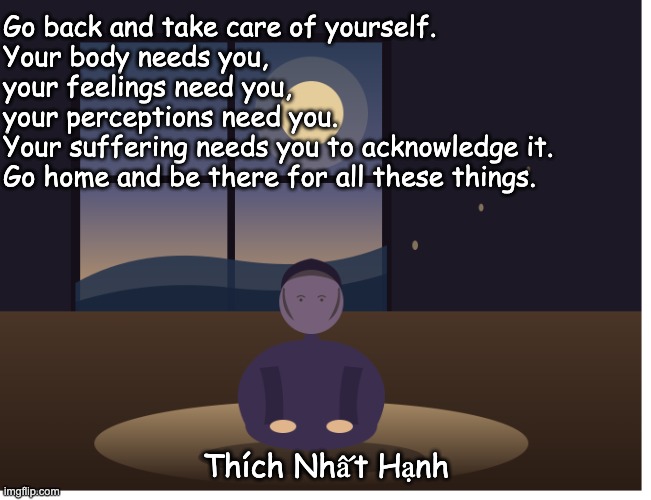
This is a teaching about ‘coming home to yourself’
— a core theme in Thích Nhất Hạnh’s practice of mindfulness. He’s describing the habit many people have of running away from themselves: staying busy, distracted, numbing out, avoiding stillness because sitting with our own body, feelings, and pain feels uncomfortable.
“Go back and take care of yourself”:
– is an invitation to stop that avoidance. Each part has a specific meaning in his framework:
– “Your body needs you”:
— we often live disconnected from our physical body, ignoring tension, exhaustion, or illness until it forces our attention.
– “Your feelings need you”:
— emotions, especially difficult ones, are pushed away rather than acknowledged. He teaches that feelings need to be recognized, not suppressed.
– “Your perceptions need you”:
— our perceptions (how we interpret events, people, and ourselves) are often distorted, and need mindful examination rather than blind belief.
– “Your suffering needs you to acknowledge it”
— this is central to his teaching: you can’t heal a pain you refuse to look at. Suffering doesn’t need to be fixed immediately, just ‘seen’ and held with compassion, the way a parent holds a crying child.
– “Go home”
— a recurring metaphor in his work for returning to the present moment, to the body, to awareness — as opposed to being lost in the past, future, or distraction.
Origin:
It appears (in slightly varying forms across his books) in works like “Reconciliation: Healing the Inner Child” and is closely tied to teachings he repeats elsewhere, like “Calming the Fearful Mind”.
Author:
This quote is by Thích Nhất Hạnh (1926–2022),
the Vietnamese Zen Buddhist monk, teacher, and peace activist.
In short: it’s a call to stop abandoning yourself, and instead turn toward your own inner experience with gentleness and presence.
In the moment when we are able to smile, to look at ourselves with compassion, our world begins to change.
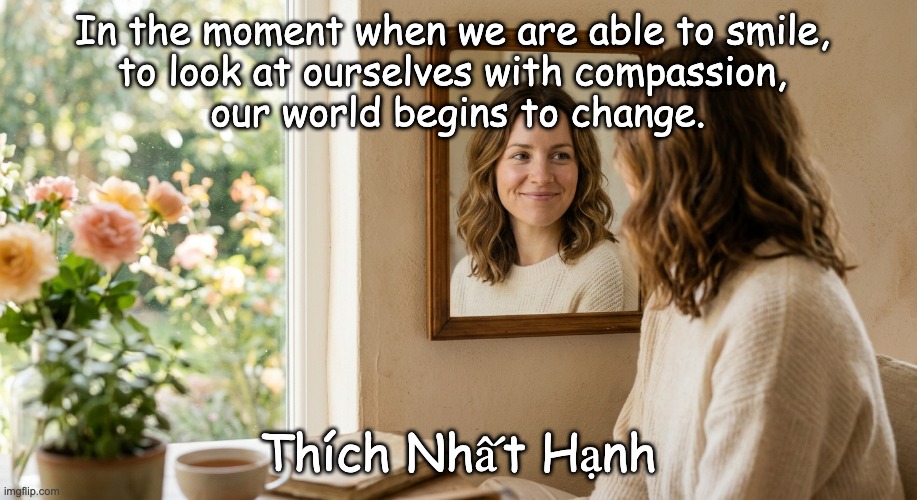
This beautiful quote speaks to the transformative power of self-compassion and inner shift. It suggests that when we move from judgment and self-criticism to a place of understanding, acceptance, and a genuine, gentle smile directed inward, it doesn’t just change our internal state. It alters our entire perception of the world around us. A kind, non-judgmental stance toward ourselves is the catalyst for a more compassionate and positive engagement with the external world. The shift in our ‘internal’ landscape ‘changes’ the color, tone, and experience of our ‘external’ landscape.
Origin & Author:
This quote is often attributed to Thich Nhat Hanh,
a world-renowned Vietnamese Buddhist monk, teacher, author, and peace activist. It perfectly encapsulates his central teachings on mindfulness, self-compassion, and the interconnectedness of inner peace and outer world-change. His philosophy emphasizes that true peace and transformation begin within the individual, particularly in how we relate to our own suffering and joy.
People usually consider walking on water or in thin air a miracle. But I think the real miracle is not to walk either on water or in thin air, but to walk on earth. Every day we are engaged in a miracle which we don’t even recognize: a blue sky, white clouds, green leaves, the black, curious eyes of a child — our own two eyes. All is a miracle.
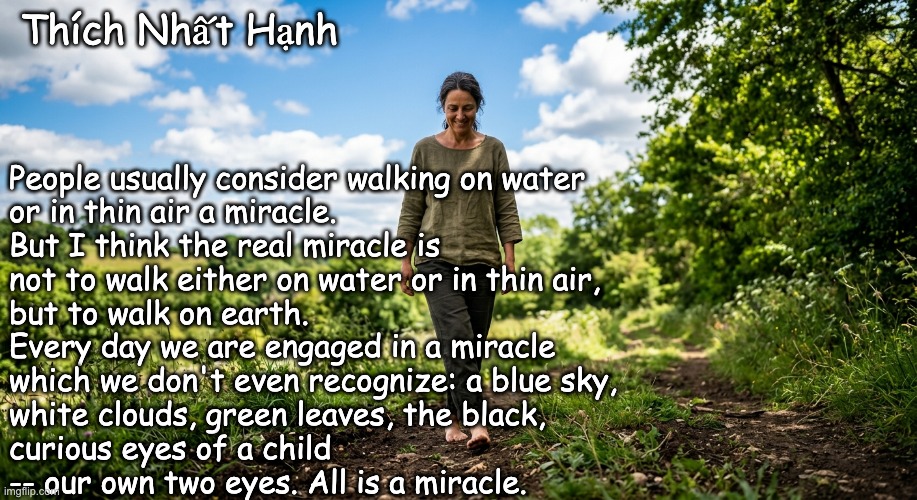
The saying challenges our usual definition of a ‘miracle.’ We often look for the supernatural (walking on water) to experience a sense of wonder. Thích Nhất Hạnh suggests that the true miracle is unfolding ‘now’—in this very moment—right beneath our feet and before our eyes.
– The Miracle of the Everyday:
The ‘miracle’ is not a violation of the laws of nature, but simply ‘being present’ and connected to the earth. The fact that we can walk, breathe, and perceive the world—the blue sky, the green leaves, a child’s eyes—is in itself a profound miracle that we often take for granted.
Author: Thích Nhất Hạnh,
A globally respected Vietnamese Buddhist monk, Zen master, author, and peace activist. It articulates a core principle of his teachings: mindfulness (attentiveness) and interbeing.
Origin:
This concept is central to many of his books and lectures, particularly in works that emphasize walking meditation and cultivating gratitude for the present moment, such as *The Miracle of Mindfulness*.
It is an invitation to slow down, take a deep breath, and recognize the extraordinary beauty and wonder of ordinary life.
Every word, every look, every action, and every smile can bring happiness to others.
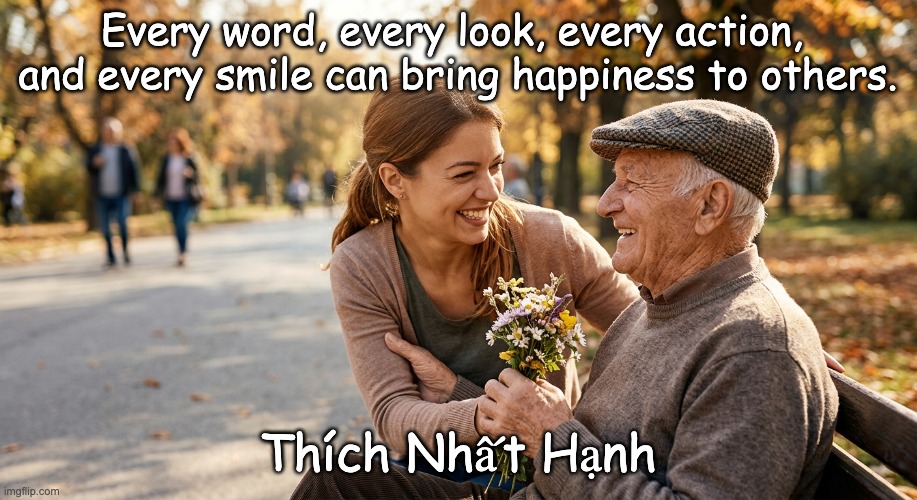
This beautiful saying, “Every word, every look, every action, and every smile can bring happiness to others,” encapsulates a core tenet of mindful and compassionate living.
The quote is a reminder of the profound impact our smallest, everyday interactions can have. It emphasizes that happiness isn’t just about grand gestures or achievements; it is cultivated in the present moment through simple, conscious acts of kindness.
– Word:
A gentle, encouraging, or supportive statement.
– Look:
A glance of understanding, compassion, or presence (not looking away).
– Action:
A small helpful deed, a touch, or sharing a burden.
– Smile:
A genuine expression of warmth and connection.
It teaches that we always possess the tools to alleviate suffering and create joy, right now, wherever we are.
Author:
This quote is widely and correctly attributed to Thích Nhất Hạnh.
Thích Nhất Hạnh (1926–2022) was a Vietnamese Thiền Buddhist monk, peace activist, prolific author, and poet. He was a central figure in bringing mindfulness and “Engaged Buddhism” to the West. He founded the Plum Village Tradition in France.
Origin:
While specific quotes can sometimes be difficult to pin down to a single sentence in a single book, this sentiment is the very heartbeat of Thích Nhất Hạnh’s entire body of work.
It aligns perfectly with his teachings on:
– Interbeing:
The understanding that we are all connected; what we do to others, we do to ourselves.
– Mindfulness:
Being fully present so that our words and actions are conscious and loving, rather than reactive.
– True Love (Maitri/Karuna):
Which he defined in four aspects: Loving-kindness, Compassion, Joy, and Equanimity.
The quote serves as a practical, accessible summary of how to practice mindfulness and compassion in daily life, showing that spiritual practice is not separate from how we treat the person right in front of us.
We have more possibilities available in each moment than we realize.
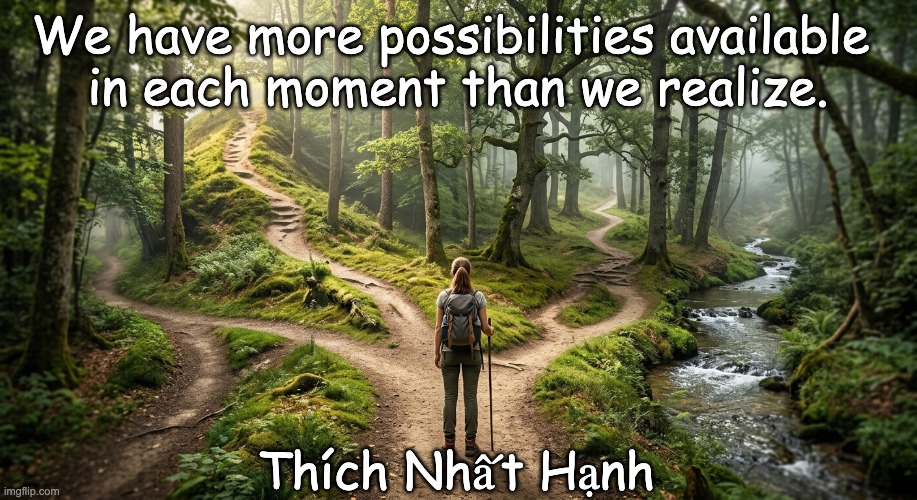
The essence of this quote lies in recognizing the profound freedom and potential that exists ‘right now’, regardless of our past or our worries about the future. Here’s a breakdown of its meaning:
– Mindfulness as a Gateway:
Thích Nhất Hạnh taught that by anchoring ourselves in the present moment (through mindful breathing, walking, etc.), we break free from the habitual patterns of thought that keep us stuck.
– Breaking Free from Conditioning:
We often operate on autopilot, reacting to situations based on past conditioning or anxiety about the future. This quote reminds us that in ’this’ very moment, we have the power to choose a different response, a new path, or a fresh perspective.
– The Power of Choice:
Each moment is not just a passing increment of time; it is a crossroads. We can choose to be angry, or we can choose to be compassionate. We can choose fear, or we can choose presence. The quote emphasizes that the number of these choices—these “possibilities”—is far greater than our habitual minds usually acknowledge.
– Liberation in the Present:
True freedom, according to this perspective, is not found in changing the past or controlling the future, but in realizing the full spectrum of possibilities available ‘now’.
🕉️ Origin and Author:
This insightful quote is widely attributed to Thích Nhất Hạnh, the renowned Vietnamese Zen Buddhist monk, teacher, author, and peace activist.
Known affectionately as “Thay” (teacher) by his followers, Thích Nhất Hạnh was a global spiritual leader who pioneered the concept of “Engaged Buddhism.” This quote is a reflection of his core teachings on mindfulness and the transformative power of being fully present in the current moment.
People have a hard time letting go of their suffering. Out of a fear of the unknown, they prefer suffering that is familiar.
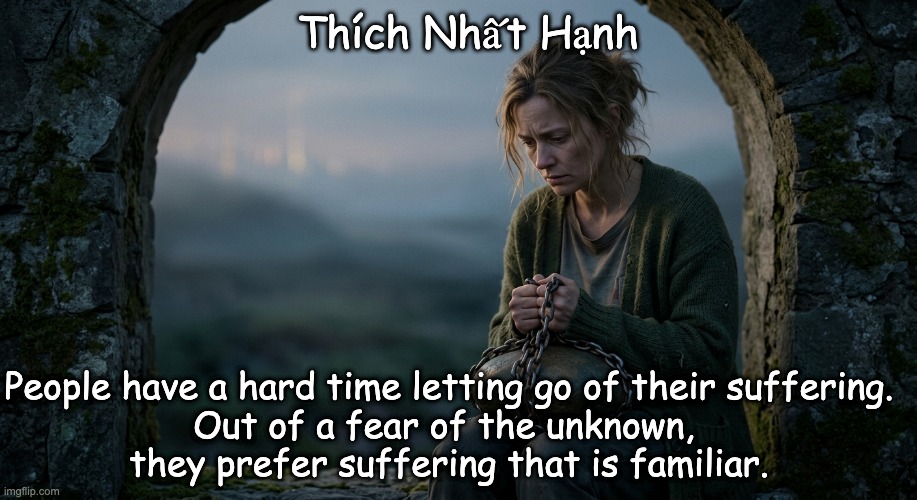
The quote “People have a hard time letting go of their suffering. Out of a fear of the unknown, they prefer suffering that is familiar” sheds light on a fascinating, yet also tragic piece of human behavior.
– The Comfort Zone of the Familiar:
As humans, we love predictability and control. Even if our current situation is painful or unsatisfying (the “suffering”), it is at least ‘familiar’. We know what to expect, how to deal with it (or think we do), and it provides a false sense of security.
– The Fear of the Unknown:
Change, even change for the better, brings uncertainty. The “unknown” is a blank slate, and that can be terrifying. We don’t know what lies on the other side of letting go. Will it be better? Worse? Or just different? That uncertainty often paralyzes us.
– The Preference for Familiar Suffering:
Out of fear of that uncertainty, we choose – often subconsciously – to hold onto what we know, even if it brings suffering. It’s the proverbial “devil you know” over the “devil you don’t”. We stay in toxic relationships, hateful jobs, or destructive habits, simply because the thought of change and the accompanying uncertainty is even more terrifying than the pain we are currently experiencing.
In short, the quote reminds us that our fear of the unknown often keeps us trapped in our own suffering, and that true liberation and growth often require us to find the courage to face that fear and let go of the familiar.
Origin and Author:
This quote is generally attributed to the Vietnamese Buddhist monk, Zen master, teacher, author, and peace activist Thích Nhất Hạnh (1926-2022).
He was one of the most influential Buddhist teachers in the West and was known for his accessible and practical teachings on mindfulness, compassion, and peace. This specific quote fits perfectly within his teachings on understanding the nature of suffering and finding the path to true freedom and happiness through awareness and letting go.
It is a powerful reminder that invites us to examine our own fears and patterns and find the courage to choose change and growth, even if it means letting go of the familiar.
When you plant lettuce, if it does not grow well, you don’t blame the lettuce. You look for reasons it is not doing well. It may need fertilizer, or more water, or less sun. You never blame the lettuce. Yet if we have problems with our friends or family, we blame the other person. But if we know how to take care of them, they will grow well, like the lettuce. Blaming has no positive effect at all, nor does trying to persuade using reason and arguments. That is my experience. No blame, no reasoning, no argument, just understanding.
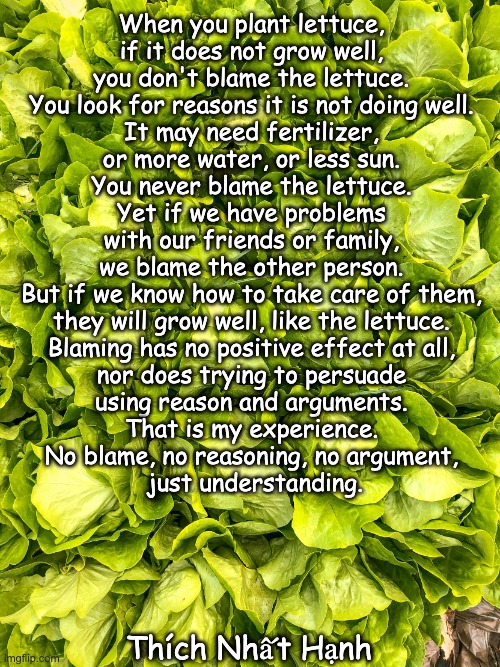
– ‘Look at conditions, not faults.’
A struggling lettuce isn’t defective. It lacks something, such as water, nutrients, or the right amount of light. He asks us to treat people the same way. When a friend, partner, or child is “not growing well,” the useful question is what they need and what conditions they’re in, not what is wrong with them.
– ‘Blame and argument don’t work.’
They make people defensive and rarely change anything. He says this comes from his own experience, not theory.
– ‘Understanding comes first.’
This is the Buddhist practice of looking deeply into another person’s suffering, fears, and circumstances. Once you understand, and the other person can feel that you do, love becomes possible. He says that is when the situation begins to change.
– ‘It isn’t passivity.’
He isn’t saying to ignore problems or never speak. He is saying that care and understanding are more effective than judgment.
Author and origin:
Thích Nhất Hạnh (1926-2022) was a Vietnamese Zen master and peace activist. He was one of the most accessible translators of Buddhism for Western audiences. One Buddhist practice center describes this passage as a paragraph in “Peace Is Every Step” that reads like a biblical parable. That 1991 book is the source usually given for it. Goodreads lists the quote without a specific book, and its quotes are community-added rather than verified, so I’d treat the book attribution as likely rather than certain. The same idea recurs in his later book “Anger: Wisdom for Cooling the Flames”, which argues that searching for “the guilty party” is no solution.
Every morning, when we wake up, we have twenty-four brand-new hours to live. What a precious gift! We have the capacity to live in a way that these twenty-four hours will bring peace, joy, and happiness to ourselves and others.
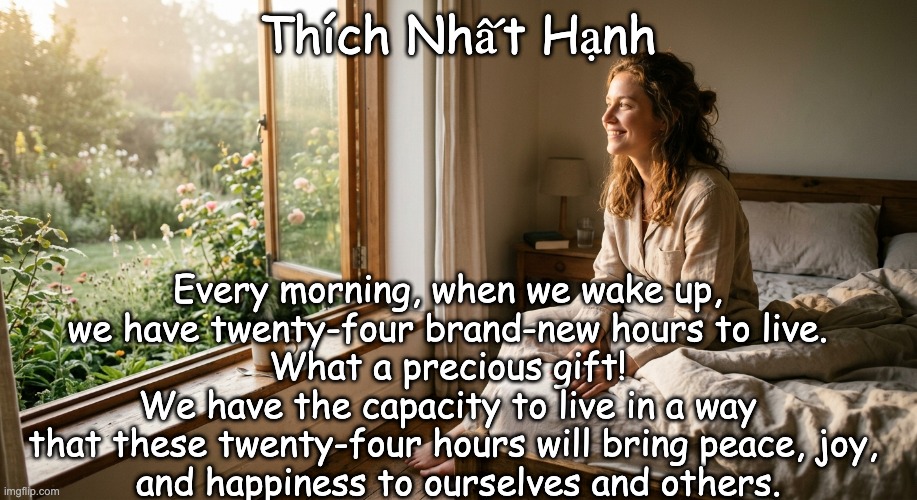
– ‘Each day is a gift.’
Waking up is not something to take for granted. A fresh day is an unrepeated opportunity.
– ‘We have agency.’
The day is “brand-new” because we are not obliged to carry yesterday’s habits, worries or resentments into it. We can choose how to live it.
– ‘Presence is the way.’
In his teaching, peace and joy come from being fully awake in the present moment, not from waiting for better circumstances. He writes that we need only be awake and alive in the present moment.
– ‘Our peace reaches others.’
The last phrase, “to ourselves and others,” reflects a central theme of his work: inner peace and compassion in daily life are the foundation of peace in the world.
Origin:
One blog quoting the passage attributes it to his book “Peace Is Every Step”. The text also appears on his short “24 Hours” piece, published by Parallax Press, the publisher he founded.
The saying is closely related to a morning verse (a ‘gatha’) he taught for reciting as you open your eyes: “Waking up this morning, I smile. Twenty-four brand new hours are before me. I vow to live fully in each moment and to look at all beings with eyes of compassion.”
That verse is in “Present Moment Wonderful Moment”, a collection of 79 verses developed during a summer retreat at Plum Village, his meditation center in France. Your version is the prose form of the same idea.
Author: Thích Nhất Hạnh (1926-2022),
the Vietnamese Zen master, poet and peace activist.
When another person makes you suffer, it is because he suffers deeply within himself, and his suffering is spilling over. He does not need punishment; he needs help. That’s the message he is sending.
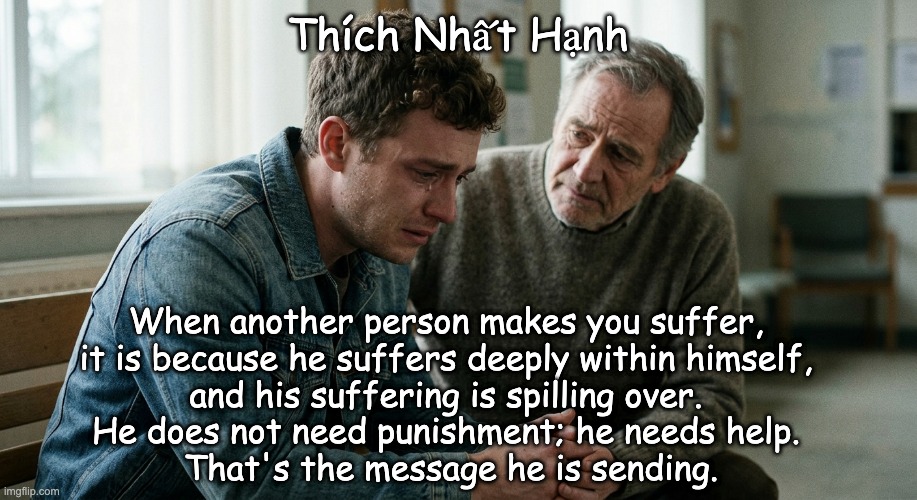
The core message is a radical shift in perspective regarding interpersonal conflict and suffering.
– Empathy Over Anger:
When someone causes us pain, our natural instinct is often anger and a desire for retaliation (punishment). This quote challenges us to look past the hurtful action to the underlying cause.
– Suffering as the Source:
It suggests that harmful behavior is not born out of malice, but rather out of the person’s own deep, unaddressed suffering that is overflowing.
– A Cry for Help:
Instead of viewing the person as an attacker, we are encouraged to see them as a victim of their own internal pain. Their harmful actions are, in essence, a desperate, albeit unconscious, cry for help and understanding.
– The Path to Healing:
By recognizing this, we can respond with compassion and understanding (help) rather than judgment and punishment. This not only aids the other person but also prevents us from being consumed by anger, breaking the cycle of suffering for everyone involved.
🌟 Author:
This profound quote is attributed to Thich Nhat Hanh, a world-renowned Vietnamese Buddhist monk, Zen master, author, poet, and peace activist. It encapsulates a cornerstone of his teachings on mindfulness, interbeing, and deep listening.
If you think that peace and happiness are somewhere else and you run after them, you will never arrive.
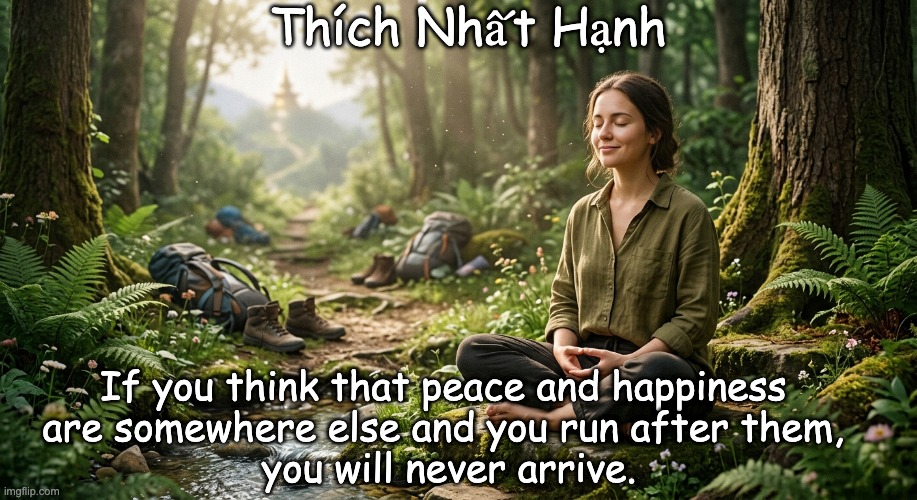
🕉️ This powerful quote addresses a fundamental aspect of the human condition:
The restless pursuit of happiness in external circumstances, rather than finding it within ourselves.
The core philosophy of this teaching is that ‘peace and happiness are not destinations, but states of being available in the present moment.’
– The Illusion of ‘Somewhere Else’:
We often condition our happiness on future events (“I will be happy when I get that job,” “when I find a partner,” “when I move to that city”). This creates a perpetual state of running.
– The Futility of the Chase:
The quote warns that if you believe happiness is external, you are always chasing a mirge. Once you achieve one goal, the mind immediately identifies the next “somewhere else,” ensuring you never truly “arrive.”
– The Present Moment:
The teaching implies that peace is already here, waiting to be recognized through mindfulness and presence, not acquired through acquisition or achievement.
👤 Origin and Author: Thích Nhất Hạnh (1926–2022) A world-renowned Vietnamese Buddhist monk, Zen master, peace activist, and author. He was a pioneer in bringing mindfulness to the West and was nominated for the Nobel Peace Prize by Martin Luther King Jr.
This specific teaching aligns perfectly with his core philosophy of “Interbeing” and “Mindfulness.” He often taught that the “pure land” or the “kingdom of God” is available right here and now, in the present moment, if we only stop running and start breathing. While exact phrasing can vary across translations and oral teachings, the sentiment is quintessential Thích Nhất Hạnh.
Only the present moment contains life.
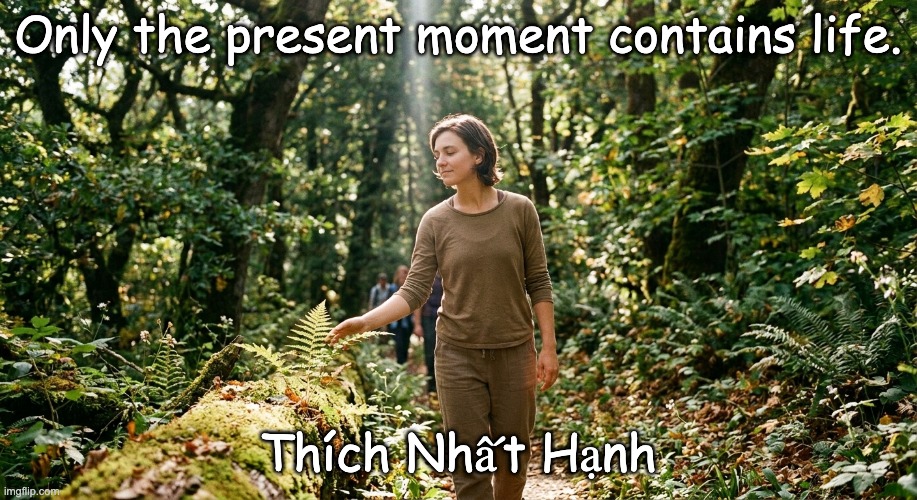
This saying is a powerful reminder that our true life unfolds only in the now. It emphasizes the importance of being fully present in each moment, as the past is a memory, and the future is a projection.
Embracing the Now:
The only time we can truly experience life, feel, connect, and make a difference is in the current instant.
Letting Go of Past and Future:
Dwelling on the past or worrying about the future takes us away from the richness of the present.
Mindfulness and Awareness:
The saying encourages a state of mindfulness, where we are acutely aware of our thoughts, feelings, and surroundings without judgment.
Author: Thích Nhất Hạnh
Thích Nhất Hạnh, often affectionately called “Thay” (teacher) by his followers, was a prominent figures in bringing mindfulness to the West. He was a prolific writer, a dedicated peace activist, and a teacher of engaged Buddhism.
Origin:
Buddhist Philosophy:
The concept of living in the present moment is deeply rooted in Buddhist philosophy, particularly the practice of mindfulness (Sati).
Engaged Buddhism:
Thích Nhất Hạnh’s teachings emphasized that mindfulness should not be a passive state but an active engagement with the world to alleviate suffering.
A Life of Peace and Compassion:
His life and teachings were a testament to the power of peace, compassion, and the practice of living in the present.
The way you speak to others can offer them joy, happiness, self-confidence, hope, trust, and enlightenment. Mindful speaking is a deep practice.
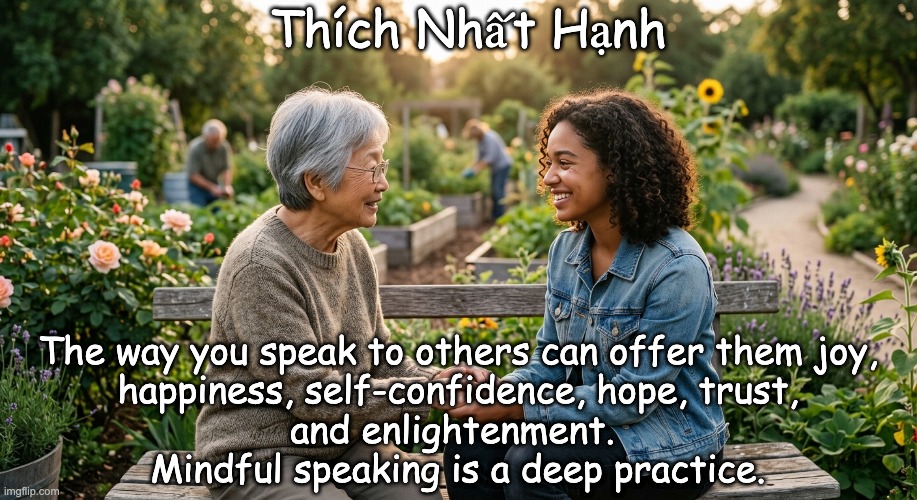
The meaning behind this saying is that our words possess a transformative power. A kind word, a supportive comment, or a thoughtful observation can uplift someone’s spirit, instill confidence, and offer hope. It can create a sense of trust and connection, fostering a positive and encouraging environment. Enlightenment, in this context, refers to a deeper understanding and awareness that can be achieved through mindful communication.
Origin:
While the exact origin of this specific phrasing might be difficult to pinpoint, the sentiment aligns perfectly with Thích Nhất Hạnh’s teachings on mindfulness and compassionate communication. He consistently emphasized the importance of using words with intention, kindness, and awareness, recognizing their potential to heal or harm.
Author:
This quote, often attributed to the renowned Vietnamese Buddhist monk and peace activist Thích Nhất Hạnh, beautifully encapsulates the profound impact our words can have. It emphasizes that mindful speaking isn’t just about being polite; it’s a deep practice that can foster positive emotions and personal growth in others.
Take my hand. We will walk. We will only walk. We will enjoy our walk without thinking of arriving anywhere.
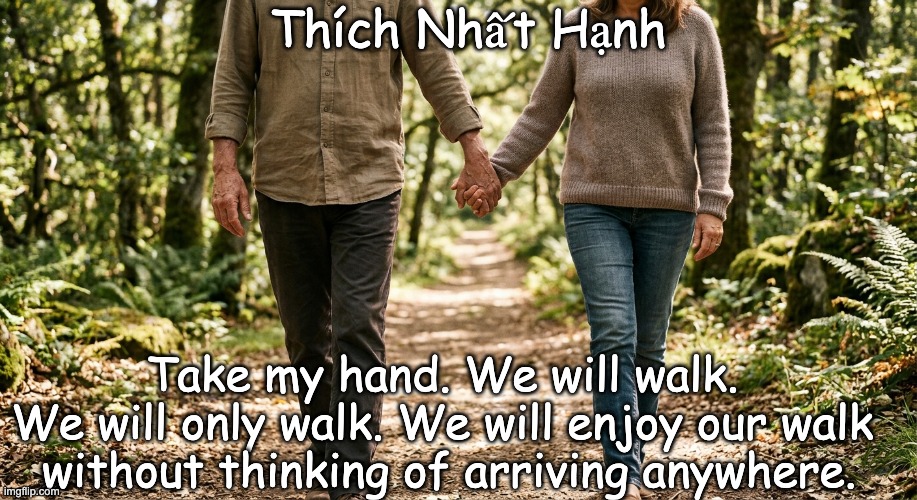
The saying is a direct invitation to practice ‘mindful walking’ (Kinh Hành). It encapsulates several key principles:
– Present Moment Awareness:
The focus is entirely on the act of walking itself—the feel of the ground beneath the feet, the rhythm of the breath, and the surroundings.
– Letting Go of Goals:
“Without thinking of arriving anywhere” is the central tenet. It means releasing the constant human drive to achieve, to reach a destination, or to finish a task. The walk is not a means to an end; the walk ‘is’ the end.
– Enjoyment and Peace:
By letting go of the future (the destination), one can find genuine peace and enjoyment in the present moment. Each step becomes a celebration of being alive.
– Connection:
“Take my hand” emphasizes shared presence and support, making the practice of mindfulness a communal and compassionate act.
Author:
This quote is indeed attributed to Thích Nhất Hạnh, the renowned Vietnamese Zen Buddhist monk, author, and peace activist. It is a perfect reflection of his core teachings on mindfulness and “interbeing.”
You are what you want to become. Why search anymore? You are a wonderful manifestation. The whole universe has come together to make your existence possible. There is nothing that is not you. The kingdom of God, the Pure Land, nirvana, happiness, and liberation are all you.
This passage is a powerful statement of non-duality and interbeing. Let’s break down its profound layers:
1. “You are what you want to become. Why search anymore?”
– Present-Moment Awareness:
This isn’t about complacency; it’s an invitation to stop seeking completion ‘outside’ of yourself. We often chase future goals, believing happiness is a distant destination.
– The Miracle of Now:
Nhất Hạnh teaches that everything necessary for happiness is available right here, right now, in the present moment. Your true nature is already complete.
2. “You are a wonderful manifestation. The whole universe has come together to make your existence possible.”
– Interbeing (Inter-connectedness):
This is a central theme in Thay’s teachings. You are not a separate entity. You are a manifestation of countless causes and conditions.
– The Universe in You:
Consider what makes “you” possible: your parents, ancestors, the food you eat, the water you drink, the sunlight, the air. The stars and galaxies themselves are part of the long chain of events leading to your existence. You ‘are’ the universe experiencing itself.
3. “There is nothing that is not you.”
– Non-Duality:
This dissolves the boundary between “self” and “other.” When we deeply understand interbeing, we see that the suffering of others is our suffering, and their joy is our joy. The trees, the ocean, and other people are not separate from us; they are part of the same vast, interconnected reality.
4. “The kingdom of God, the Pure Land, nirvana, happiness, and liberation are all you.”
– Inner Divinity:
These terms (from Christian, Buddhist, and general spiritual traditions) often represent an ultimate, external state of perfection or salvation. Thích Nhất Hạnh brings them right back to the individual.
– Waking Up to Reality:
“Nirvana” or “The Kingdom of God” isn’t a place you go after you die. It is the reality of interbeing that you can touch right now when you are fully present and awake. Your own true nature—free from the illusion of a separate self—’is’ that state of liberation and happiness.
Breath is the bridge which connects life to consciousness, which unites your body to your thoughts. Whenever your mind becomes scattered, use your breath as the means to take hold of your mind again.
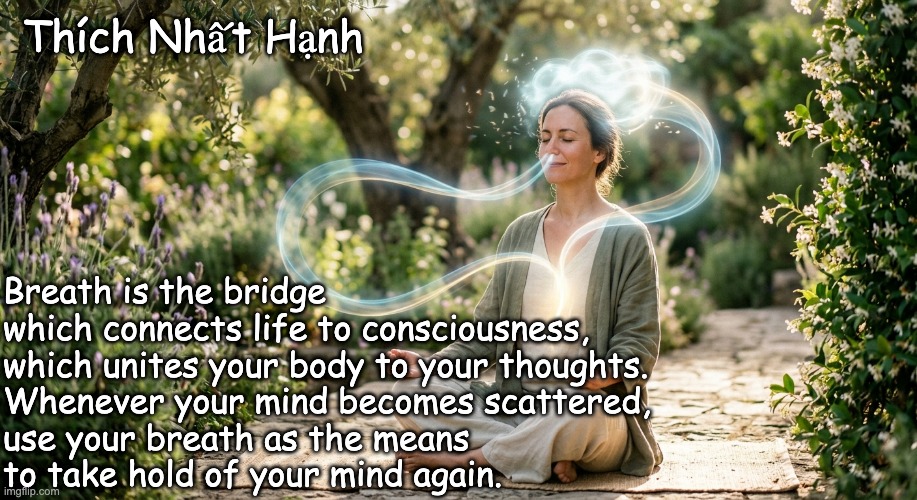
This powerful quote is a cornerstone of mindfulness practice. Here is a breakdown of its components:
The quote emphasizes the practical role of conscious breathing. In mindfulness, the breath is used as an anchor. The physical body lives only in the present moment, but the mind constantly wanders to the past or future (becoming “scattered”). By consciously focusing on the ‘physical sensation’ of breathing, you immediately pull your scattered thoughts back into the present moment, uniting your physical existence (body/life) with your awareness (consciousness/thoughts). It is a tool for self-regulation and grounding.
Author:
This quote is attributed to Thích Nhất Hạnh.
Origin:
Thích Nhất Hạnh (1926–2022) was a world-renowned Vietnamese Thiền Buddhist monk, peace activist, prolific author, and teacher. He is often referred to as the “father of mindfulness” in the West. This specific concept—using the breath to unite body and mind—is central to his core teachings and is discussed extensively throughout his many books, such as “The Miracle of Mindfulness: and “Peace Is Every Step”.
Breathing in, I calm body and mind. Breathing out, I smile. Dwelling in the present moment I know this is the only moment.
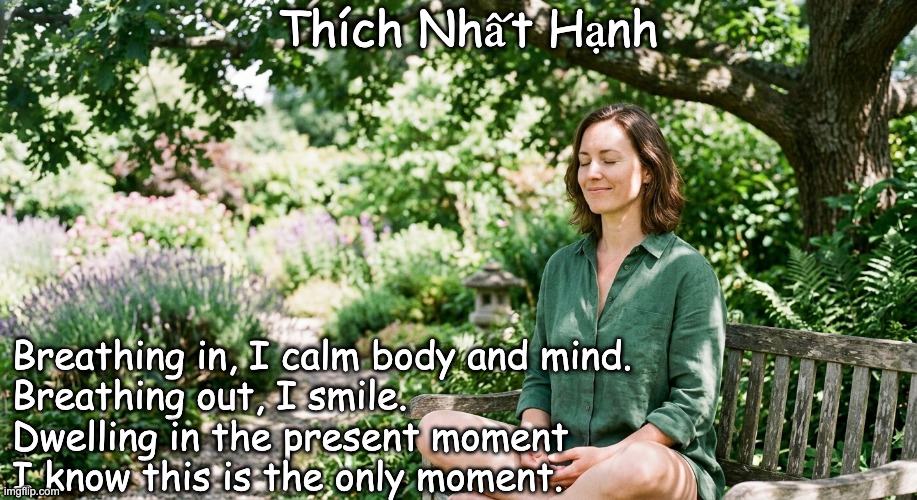
🌿 Deep Dive into the Mindfulness Gatha
This gatha is a simple yet powerful tool for anchoring yourself in the present moment. Its meaning can be broken down line by line:
“Breathing in, I calm body and mind.”:
– This is the initial act of conscious breathing. By focusing entirely on the sensation of air entering your body, you immediately interrupt the flow of busy thoughts and anxieties. This focused attention acts as a signal to your nervous system to relax, physically calming the body and slowing down the mental chatter.
“Breathing out, I smile.”:
– The smile here is not necessarily a wide grin, but a “half-smile” of recognition and peace. This physical action reinforces the internal state of calm. It signifies acceptance of the present moment, exactly as it is, and generates a feeling of lightness and joy. It is a smile of sovereignty over your own state of being.
“Dwelling in the present moment…”:
– This is the core of the practice. By focusing on the breath and the smile, you are actively choosing to place your awareness ‘now’. You are not replaying the past or rehearsing the future; you are fully inhabiting the immediate experience.
“…I know this is the only moment.”:
– This is the ultimate realization. It is an acknowledgment that the past is gone and the future is not yet here. The ‘only’ time you ever have to live, to act, to change, or to be happy is right now. This realization brings a profound sense of freedom and responsibility.
Overall Meaning:
The saying is a practical guide to achieving ‘mindfulness’—a state of active, open attention on the present. It teaches that peace and happiness are not distant goals, but states available to us in every single breath.
🗣️ Author: Thích Nhất Hạnh.
Origin:
Thích Nhất Hạnh was a world-renowned Vietnamese Buddhist monk, Zen master, author, poet, and peace activist. This gatha is a central teaching in his ‘Plum Village’ tradition.
He popularized the use of “gathas”—short verses recited (often silently) to help maintain mindfulness during daily activities. This particular verse is perhaps his most famous and is often taught to beginners as a foundational practice for meditation and conscious living.
Feelings come and go like clouds in a windy sky. Conscious breathing is my anchor.
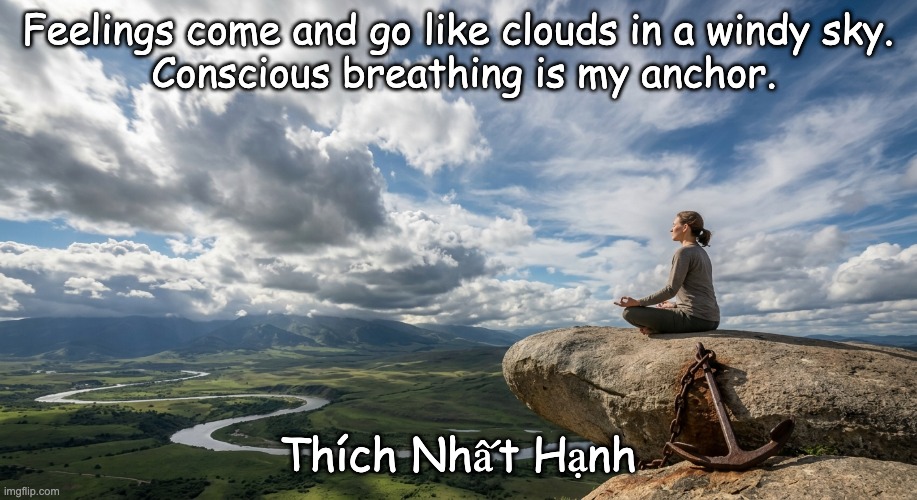
This powerful mindfulness quote uses a vivid natural metaphor to describe the nature of emotions and the practice of grounding oneself.
– “Feelings come and go like clouds in a windy sky”: This part emphasizes the ‘impermanence’ of emotions. Our feelings—whether joy, anger, sadness, or anxiety—are not permanent fixtures. Like clouds drifting across the sky, they arrive, change shape, and eventually pass, driven by the winds of circumstance and thought. We are the sky, observing the clouds pass through us, but we are not the clouds themselves.
– “Conscious breathing is my anchor”:
This provides the practical solution. When the winds of emotion become intense or stormy, we need stability. ‘Conscious breathing’ (mindful breathing) acts as an anchor, grounding us in the present moment. By focusing on the physical sensation of the breath entering and leaving the body, we stabilize our attention and prevent ourselves from being swept away by the turbulence of our feelings.
☸️ Origin and Author:
The quote is widely attributed to Thích Nhất Hạnh (1926–2022), the renowned Vietnamese Buddhist monk, teacher, author, and peace activist.
Thích Nhất Hạnh was a global pioneer in bringing mindfulness and “Engaged Buddhism” to the West. His teachings consistently focused on the power of the present moment and the breath as the fundamental tool for returning to it.
While this specific phrasing is a concise summary often used to encapsulate his teachings on emotional regulation, the core concept is deeply rooted in classic Buddhist texts and is a central theme throughout his vast body of work, including books like “The Miracle of Mindfulness” and “Peace Is Every Step”. He frequently taught that mindful breathing allows us to embrace our strong emotions without being overwhelmed by them.
Today is the most important day of our lives.
The core meaning of this phrase is a profound call to ‘mindfulness’ and ‘presence’.
– Valuing the Now:
It emphasizes that the past is gone and the future is not yet here. The only moment we truly possess and can act within is the present moment (now).
– Active Living:
By declaring “today” as the most important, it discourages procrastination and passive waiting for a “better” time. It encourages us to make the most of our current circumstances, relationships, and opportunities.
– Creating the Future:
It reminds us that our actions, thoughts, and choices ’today’ are the foundation upon which our future is built. Therefore, maximizing today is the best way to care for tomorrow.
🕉️ Origin and Authorship:
This saying is ‘frequently attributed to’ the renowned Vietnamese Zen Master, author, and peace activist, Thích Nhất Hạnh (often referred to as Thay).
While variations of this sentiment (the importance of the present moment) are foundational to Buddhist teachings and appear throughout his extensive writings (such as in “The Miracle of Mindfulness” or “You Are Here”), this ‘exact, concise phrasing’ is widely recognized as a summary of his core message.
It encapsulates the essence of his teachings on “Present Moment, Wonderful Moment” (Hiện pháp lạc trú). He taught that by anchoring ourselves in the breath and fully experiencing the present, we touch the wonders of life.
While similar concepts exist in stoicism (e.g., Marcus Aurelius) and other philosophies, the specific wording and its global popularity are strongly tied to Thích Nhất Hạnh’s contemporary mindfulness movement.
Sometimes your joy is the source of your smile, but sometimes your smile can be the source of your joy.
This profound quote explores the reciprocal, dynamic relationship between our internal state (joy) and our external expression (a smile). It suggests that emotions and physical actions are not a one-way street; they influence each other constantly.
– ‘Joy as the Source of the Smile’:
This is the intuitive direction. When we feel happy, contented, or peaceful internally, that positive emotion naturally manifests as a physical smile. The smile is a genuine reflection of our inner well-being.
– ‘The Smile as the Source of Joy’:
This is the more powerful and transformative insight. It suggests that the ‘act’ of smiling—even when we don’t immediately feel happy—can actually generate positive feelings within us. By intentionally changing our physical expression, we can influence our emotional state.
In essence, the quote emphasizes mind-body connection and the idea that we can deliberately cultivate happiness through intentional action.
☸️ Origin and Author:
This quote is ‘widely attributed to’ the renowned Vietnamese Zen Master, author, and peace activist, Thích Nhất Hạnh.
Who was Thích Nhất Hạnh?
He was a global spiritual leader known for popularizing mindfulness and engaged Buddhism. His teachings often focused on finding peace in the present moment, cultivating compassion, and understanding the interconnectedness of all things.
– ‘The Teaching Behind the Quote’:
This specific concept aligns perfectly with his teachings on mindfulness and “interbeing.”
He often spoke about the power of a gentle smile as a practice of mindfulness—a way to return to the present moment and nurture seeds of joy, even in challenging times. He encouraged practitioners to smile as a form of meditation and self-care.
When we give ourselves the chance to let go of all our tension, the body’s natural capacity to heal itself can begin to work.
This quote speaks to the profound connection between the mind and the body, a cornerstone of mindfulness and holistic health.
– “Let go of all our tension”:
This refers to releasing not just physical tightness but also mental and emotional stress, anxiety, and the constant “fight or flight” mode many people live in.
– “The body’s natural capacity to heal itself”:
The human body is an incredibly sophisticated system designed for self-repair. Our immune system, cellular regeneration, and regulatory systems (like digestion and sleep) are always working.
– “Can begin to work”:
Chronic tension and stress act as a massive barrier. They flood the body with stress hormones (like cortisol), which divert energy away from long-term maintenance and healing. By consciously relaxing, we remove this barrier, allowing the body’s energy and resources to shift back to restoration and recovery.
In short:
The quote means that true relaxation is not just a luxury; it is a vital prerequisite for our body’s inherent healing systems to function optimally.
Origin and Author:
This insight is widely attributed to Thích Nhất Hạnh (1926–2022).
Thích Nhất Hạnh was a world-renowned Vietnamese Buddhist monk, peace activist, author, and teacher. He was a pioneer in bringing mindfulness—the practice of fully dwelling in the present moment—to the Western world. This concept is central to his teachings on “deep relaxation” and “mindful breathing,” which are practical tools for releasing tension and allowing the body and mind to restore themselves.
Silence is something that comes from your heart, not from outside. Silence doesn’t mean not talking and not doing things; it means that you are not disturbed inside. If you’re truly silent, then no matter what situation you find yourself in you can enjoy the silence.
– Silence is inner:
It comes from ‘your heart/mind’, not from external conditions (like noise or quiet).
– Silence isn’t inactivity:
It doesn’t require that you stop talking or doing things.
– Silence = not being disturbed inside:
You can be calm and unshaken internally in any situation.
– Result:
If your inner state is truly silent, you can “enjoy” that peace regardless of what’s happening around you.
Origin 📍:
– Source:
‘Tricycle’: “The Buddhist Review” (Winter 2009), “Insights” section
– Article/page title:
“Thích Nhất Hạnh: Emotions”
– URL:
https://tricycle.org/magazine/thich-nhat-hanh-emotions/
Author ✍️:
– Thích Nhất Hạnh (author of the Q&A/Insights article where this passage appears).
We can smile, breathe, walk, and eat our meals in a way that allows us to be in touch with the abundance of happiness that is available. We are very good at preparing to live, but not very good at living. We know how to sacrifice ten years for a diploma, and we are willing to work very hard to get a job, a car, a house, and so on. But we have difficulty remembering that we are alive in the present moment, the only moment there is for us to be alive. Every breath we take, every step we make, can be filled with peace, joy, and serenity. We need only to be awake, alive in the present moment.
The passage argues that happiness is not something to postpone until we have achieved enough. It is available right now, in ordinary acts like smiling, breathing, walking, and eating, if we do them with full awareness.
– ‘We are good at preparing, poor at living.’
We will sacrifice ten years for a diploma or work hard for a job, car, and house, always aiming at a future we expect to make us happy. But the preparing never ends, and life slips by unnoticed.
– ‘The present moment is the only one we have.’
The past is gone and the future hasn’t arrived, so life can only be lived now.
– ‘Peace comes from awakening, not acquiring.’
“We need only to be awake” points to mindfulness: paying attention to what we are doing while we do it. No special circumstances are required.
Origin:
It comes from the Zen Buddhist tradition, specifically the engaged mindfulness teaching of Thích Nhất Hạnh, developed in Vietnamese Buddhism and later at “Plum Village”, the community he founded in France. The passage is, I believe, from ‘Peace Is Every Step: The Path of Mindfulness in Everyday Life” (1991), though I can’t confirm the exact chapter or page from memory. He repeated these ideas in many books and talks, so very similar wording appears elsewhere too. For a precise citation, check the book itself.
Author:
Thích Nhất Hạnh (1926-2022), the Vietnamese Zen master, poet, and peace activist. He was ‘nominated for the Nobel Peace Prize’ by Martin Luther King Jr. and became one of the most influential teachers of mindfulness in the West.
This is a very important practice. Live your daily life in a way that you never lose yourself. When you are carried away with your worries, fears, cravings, anger, and desire, you run away from yourself and you lose yourself. The practice is always to go back to oneself.
The passage is describing a mindfulness practice:
– “Live your daily life in a way that you never lose yourself.”
→ Don’t let your identity be controlled by what happens to you or what you feel in the moment.
– “When you are carried away… worries, fears, cravings, anger, and desire…”:
→ Emotions and thoughts can “take over” and pull you away from the present.
– “…you run away from yourself and you lose yourself”:
→ When you’re driven by compulsive mental states, you’re not fully present with your real self.
– “The practice is always to go back to oneself”:
→ The core discipline is to ‘return to awareness’, back to your breath, body, and true experience in the present moment.
📌 In short:
‘Mindfulness is repeatedly returning to yourself whenever you get mentally “swept away.”’
🏷️ Origin📚:
This wording is commonly associated with Thích Nhất Hạnh’s teachings on mindfulness and “returning to oneself”, especially in contexts discussing:
– staying present in daily life,
– recognizing emotional/mental agitation,
– practicing mindful breathing and awareness,
– “coming back” to the present moment.
However, ‘I can’t confirm the exact original source (book title, chapter, or year) from the text as provided’—because similar translations/versions of this idea circulate across websites, quote collections, and talks, sometimes with slight wording differences.
✍️ Author 🌿:
– Thích Nhất Hạnh (Vietnamese Buddhist monk, mindfulness teacher).
The quality of our life depends on the quality of the seeds that lie deep in our consciousness.
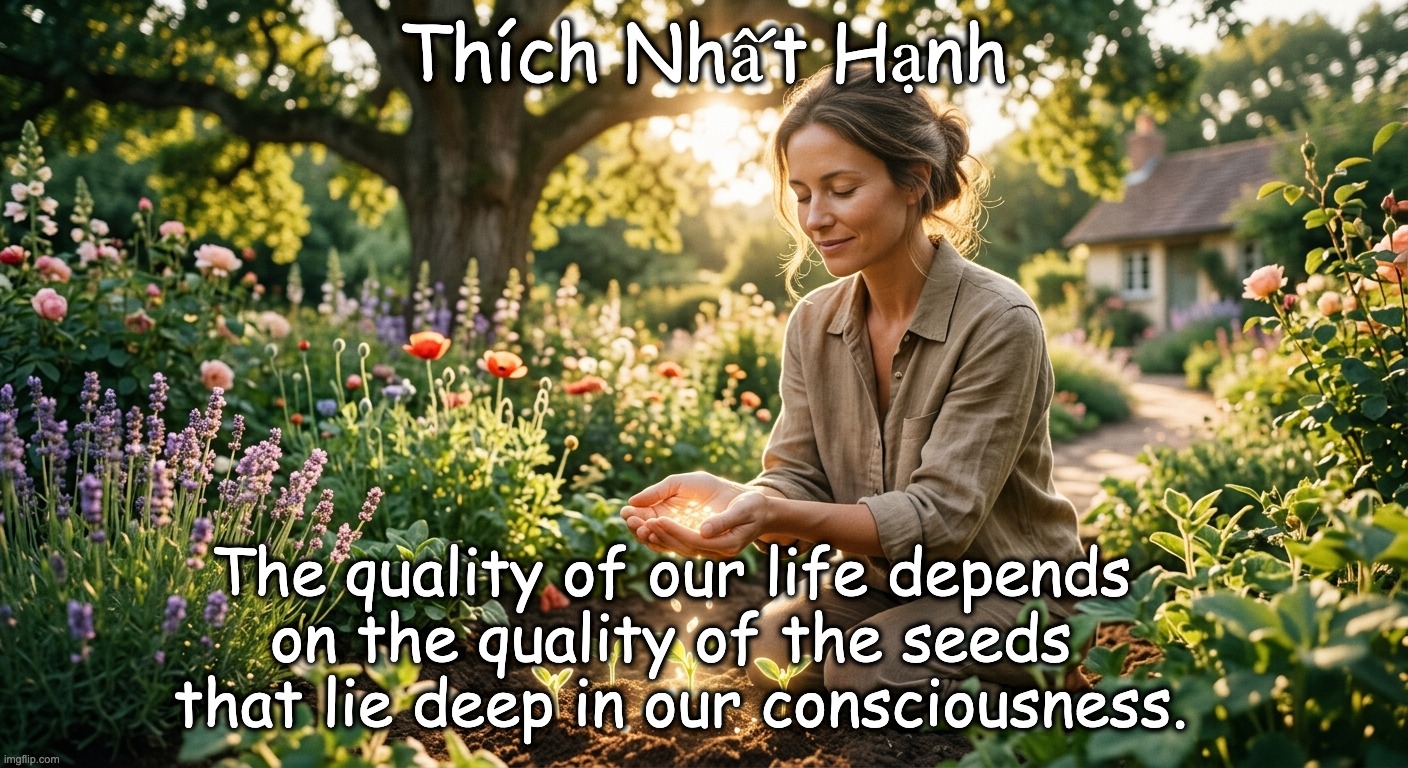
This saying is a powerful metaphor for how our inner world shapes our outer reality.
– 🌱 The ‘Seeds’ in our Consciousness:
These ‘seeds’ (in Sanskrit ‘bija’) represent our thoughts, beliefs, emotions, habits and intentions. They are stored deep in our subconscious.
– 💧 Watering and Feeding:
Just like real seeds, these mental seeds need attention and repetition to grow. Every time we think a particular thought or feel an emotion, we ‘water’ that specific seed.
– 🌳 The Harvest (Our Quality of Life):
The quality of our lives – our relationships, our happiness, our responses to challenges – is the direct “harvest” of the seeds we have cultivated.
– If we water seeds of ‘anger, fear or judgment’, they will grow and make our lives bitter and stressful.
– If we water seeds of ‘love, compassion, gratitude and mindfulness’, they will blossom and enrich our lives with peace and joy.
The core message:
We are not helplessly at the mercy of our circumstances. We have the power to consciously choose which seeds we want to nurture in the garden of our mind, and thereby directly determine the quality of our lives.
📚 Author: Thích Nhất Hạnh
– Who was he?
Thích Nhất Hạnh (1926–2022) was a world-famous Vietnamese Buddhist monk, Zen master, poet and peace activist. He is often called the ‘father of mindfulness’ in the West.
– The Context:
The concept of ‘seeds in consciousness’ is a fundamental part of Buddhist psychology, especially in the ‘Yogacara’ school (‘Alone Consciousness’). Thích Nhất Hạnh was a master at translating these complex, ancient teachings into simple, applicable concepts for modern life.
– His Teachings:
He spoke and wrote extensively about how we can be “mindful” of the seeds we water in ourselves and others. His book “Understanding Our Mind” delves deeply into this specific topic.
There is the mud, and there is the lotus that grows out of the mud. We need the mud in order to make the lotus.
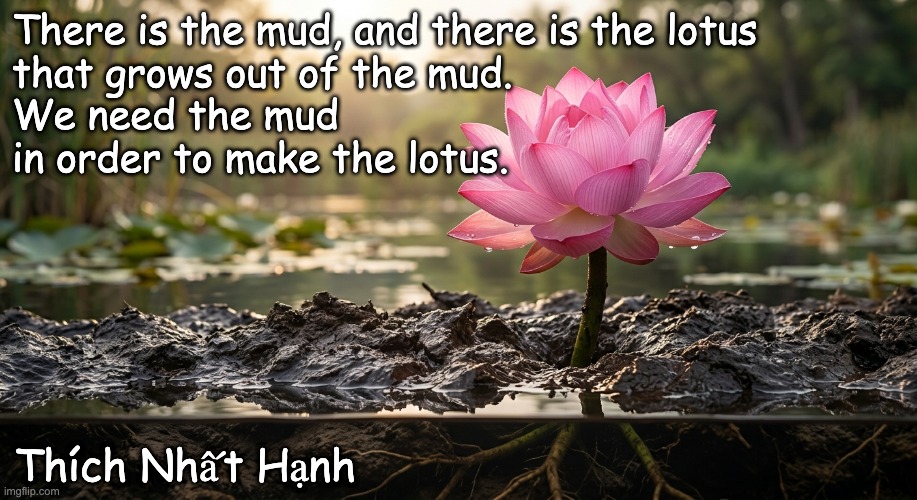
This saying is a beautiful metaphor for transformation, resilience, and the interconnectedness of suffering and joy.
– The Mud representing Suffering:
The “mud” symbolizes the difficulties, pain, challenges, and suffering we experience in life (grief, anger, despair, or societal problems).
– The Lotus representing Enlightenment & Joy:
The “lotus” flower, which blooms beautifully above the water, represents awakening, peace, compassion, wisdom, and genuine happiness.
– The Essential Connection:
The key insight is that the lotus ‘needs’ the nutrient-rich mud to grow. It cannot grow in a sterile environment.
This means:
– Transformation:
Our suffering is not just a burden; it is the raw material from which we can grow and cultivate compassion, understanding, and inner peace.
– Acceptance:
We cannot simply wish away the mud (suffering) of our lives. We must accept its presence and learn to transform it.
– Interbeing:
Suffering and joy are not separate, opposing forces; they are deeply interconnected, like the mud and the lotus flower it supports.
Author:
This powerful quote is widely attributed to Thich Nhat Hanh, a world-renowned Vietnamese Buddhist monk, Zen master, author, poet, and peace activist. He is known for popularizing concepts of mindfulness in the West and for his teachings on engaged Buddhism.
Origin:
While the exact phrasing might appear slightly differently in various translations of his work, the core metaphor is central to his teachings and has roots in foundational Buddhist philosophy.
Happiness is available. Please help yourself to it.
The Accessibility of Joy.
The meaning of this saying is beautifully simple and profound:
– ‘Happiness is Present, Not Future:’
It challenges the common belief that happiness is a destination to be reached (e.g., “I’ll be happy when I get that job” or “I’ll be happy when I’m married”). Instead, it asserts that happiness is a state of being available in the ‘present moment’.
– A’ Personal Invitation’:
The phrase “Please help yourself to it” acts as a gentle invitation. It suggests that happiness is like a bountiful feast already set before us; the only requirement is our own willingness to partake in it.
– ‘The Power of Mindfulness’:
This saying is deeply rooted in mindfulness. By being fully present in whatever we are doing—breathing, walking, drinking tea, or listening—we can tap into the inherent joy of existence, regardless of our external circumstances.
🧘♂️ Author: Thích Nhất Hạnh
Origin:
This powerful quote, “Happiness is available. Please help yourself to it,” is indeed attributed to the late ‘Thích Nhất Hạnh’, a Vietnamese Zen Buddhist monk, global peace activist, and prolific author.
He was a central figure in bringing mindfulness practice to the West and was known for his gentle yet profound teachings on being present and finding joy in the current moment. This saying encapsulates his philosophy that happiness isn’t something to be deferred or externalized, but rather something accessible right now, through mindful awareness.
My actions are my only true belongings.
This profound saying emphasizes the concept of ‘karma’ and personal responsibility. It suggests that material possessions, external circumstances, and even relationships are transient and do not truly belong to us in an ultimate sense. What truly defines us and stays with us are our actions – our thoughts, words, and deeds. These actions shape our present and future, creating consequences that we alone “own”.
‘It encourages mindfulness and ethical conduct, as every action has an impact’.
Origin:
The quote comes from his 2006 book, “Understanding Our Mind: 50 Verses on Buddhist Psychology,” specifically on page 227.
Author: Thich Nhat Hanh.
His teachings often focus on interconnectedness, mindfulness, and the practice of living deeply in the present moment, all of which align with the sentiment of this quote.
Anger is like a storm rising up from the bottom of your consciousness. When you feel it coming, turn your focus to your breath. Breathe in deeply to bring your mind home to your body. Then look at, or think of, the person triggering this emotion: with mindfulness, you can see that they are unhappy and suffering. You can see their wrong perceptions. You’ll feel motivated by a desire to say or do something to help the other person suffer less. This means compassionate energy has been born in your heart. And when compassion appears, anger is deleted.
🕉️ Author:
The Wisdom of Thích Nhất Hạnh:
Deleting Anger with Compassion
This beautiful and insightful quote is indeed attributed to the late Zen Master Thích Nhất Hạnh, a Vietnamese Buddhist monk, global peace activist, and prolific author. He was a pioneer in bringing mindfulness practice to the West and was nominated for the Nobel Peace Prize by Dr. Martin Luther King Jr.
🌊 Origin and Style:
While this specific phrasing is a concise summary, the core teachings are found throughout his vast body of work, particularly in his seminal books:
“Anger: Wisdom for Cooling the Flames”
and
“The Miracle of Mindfulness”.
His teachings consistently focus on “interbeing” (the interconnectedness of all things) and transforming negative emotions through awareness.
🧩 Understanding the Meaning: A Three-Step Transformation
This quote outlines a practical, sequential practice for transforming anger into compassion. It breaks down into three distinct phases:
1. The Storm:
Self-Awareness and Anchoring ⚓
> “Anger is like a storm rising up from the bottom of your consciousness. When you feel it coming, turn your focus to your breath. Breathe in deeply to bring your mind home to your body.”
– ‘The Analogy’:
Anger is a powerful, turbulent force (a storm) that starts deep within.
– ‘The Practice’:
The moment you recognize the ‘sensation’ of anger, you pause. You do not react externally.
– ‘The Anchor’:
You consciously use your breath. Breathing deeply acts as an anchor, grounding you in the present moment (“bringing your mind home to your body”) and preventing the emotional storm from overwhelming you.
2. The Shift:
Mindful Observation and Understanding 👀:
> “Then look at, or think of, the person triggering this emotion: with mindfulness, you can see that they are unhappy and suffering. You can see their wrong perceptions.”
– ‘The Shift in Focus’:
Once you are centered, you shift your attention to the source of your anger—the person or situation.
– ‘The Role of Mindfulness’:
With a calm mind, you apply mindfulness. Instead of reacting to their ‘action’, you look at their ‘state of being’.
– ‘Deep Understanding’:
You recognize that their behavior often stems from their own “unhappiness,” “suffering,” and “wrong perceptions” (misunderstandings or misinterpretations). You see them not as an enemy, but as someone who is also struggling.
3. The Result:
Birth of Compassion and the End of Anger ❤️:
> “You’ll feel motivated by a desire to say or do something to help the other person suffer less. This means compassionate energy has been born in your heart. And when compassion appears, anger is deleted.”
– ‘The Transformation’:
This understanding naturally transforms your motivation. Instead of wanting to strike back or cause pain (the natural response of anger), you feel a “desire to help them suffer less.”
– ‘The Birth of Compassion’:
This new motivation ‘is’ compassionate energy.
– ‘The Deletion’:
This is the crucial point:
Anger and true compassion cannot coexist in the same moment. When you truly see another’s suffering and feel compassion, the self-righteous energy of anger is neutralized or “deleted.” It doesn’t mean you condone their actions, but you are no longer consumed by the destructive emotion.
