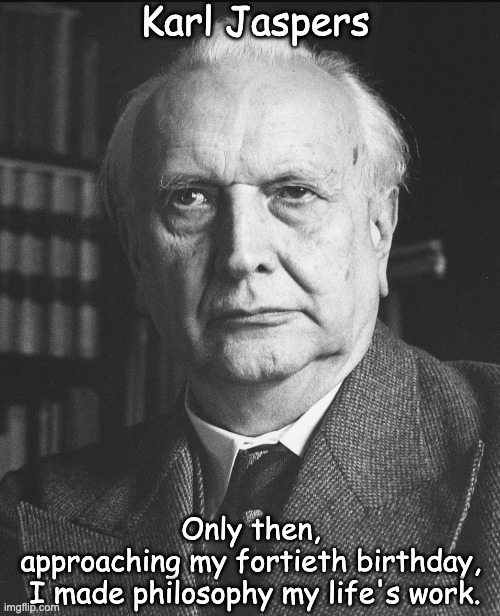
Karl Theodor Jaspers:
(Oldenburg, February 23, 1883 – Basel, February 26, 1969). Swiss psychiatrist who achieved international fame as a philosopher. He was born in Germany. His father was a lawyer, and his mother worked in an agricultural cooperative.
Jaspers was one of the most prominent representatives of existential philosophy, which he strictly distinguished from Jean-Paul Sartre’s existentialism. He also made a name for himself in the theological field. He was first a teacher and later a lifelong friend of Hannah Arendt, with whom he corresponded for decades. He also maintained a correspondence with Martin Heidegger, which was interrupted during the German fascism and only slowly revived after World War II. He was a long-standing friend of Max Weber, Hans Walter Gruhle, and Kurt Schneider.
Reason is the gentle force that sets limits and proportions for everything, and even for violence.
The sentence is complexly constructed and develops its depth through an apparent contradiction: it describes reason itself as a kind of “violence” – but as a “gentle” one. That means:
– ‘Reason as strength, not as compulsion.’ It works not through pressure, threats or oppression, but through persuasion, argument and insight. Still, it’s ‘effective’ — it has real clout.
– ‘Reason sets limits – even to violence.’ This is the crucial idea: not even brute force is limitless when reason is involved. It is the corrective that can limit excessiveness – politically, morally, socially.
– “Limit and measure” — two philosophically difficult concepts. In ancient tradition, measure (Greek ‘μέτρον, metron’) stands for balance and the avoidance of extremes. Reason is the principle that gives everything its proper proportion.
– The formulation is linked to Jaspers’ political thinking: “Power only has legitimacy in the service of reason. From here alone it derives its meaning. In itself it is evil.” For Jaspers, reason is the only legitimate framework for any kind of power.
Classification in context:
Jaspers wrote this sentence in post-war Germany, at a time in which he was intensively dealing with the questions of guilt, democracy and the future of Europe. He recommends targeted action by every individual in the world, based on reason. The quote is therefore also a political message: Where reason prevails, violence can be tamed – and only there.
In short: The sentence trusts that rational thought and civil discourse are, in the long term, stronger than any oppression – an Enlightenment conviction expressed in an almost paradoxical, very succinct form.
Author and source:
The quote “Reason is the gentle force that sets limits and limits to everything, even to violence” comes from Karl Jaspers and can be found in his work “Philosophical Faith”.
Karl Theodor Jaspers (1883–1969) was a German psychiatrist and philosopher of international importance. He most recently taught at the University of Basel and is considered an outstanding representative of existential philosophy.
There must be no freedom to destroy freedom.
Man today faces the alternative: demise of man or transformation of man.
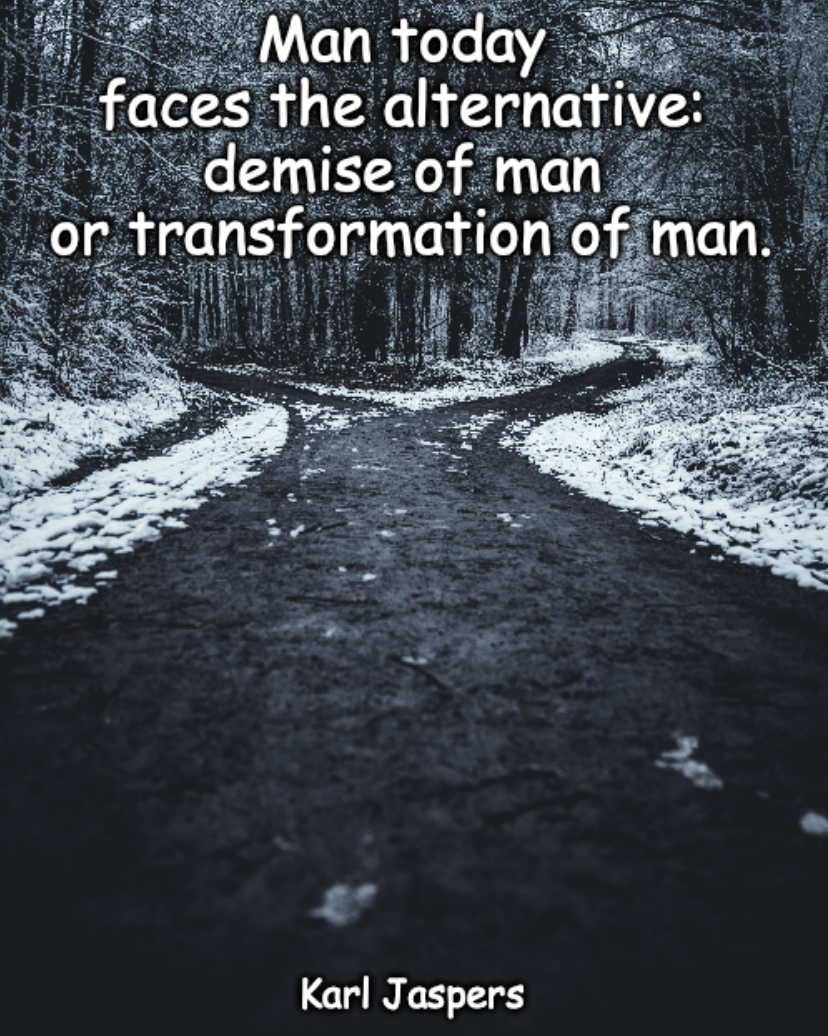
Humanity is at a crucial juncture in history. Through technology, science, modern weapons, and political power, humanity has created possibilities that can endanger itself.
This refers specifically to:
– ☢️ Self-destruction through nuclear weapons
– ⚔️ War and violence on a global scale
– 🧊 Moral and intellectual stagnation
– 🏛️ Political irresponsibility
– 🌍 Endangering humanity as a whole
The “alternative” is therefore:
– ‘The downfall of humanity’: If humanity remains unchanged, that is, if it continues to be driven by the lust for power, fear, ideologies, and violence, it can destroy itself.
– ‘The transformation of humanity’: Humanity must change inwardly, morally, and politically. It must become more responsible, rational, free, and capable of dialogue.
In short:
> ‘Technological progress compels humanity to undergo intellectual and moral renewal. Without this transformation, humanity faces ruin.’
Origin 📚:
The idea originates from the context of the “atomic age after World War II.” Especially after Hiroshima and Nagasaki, it became clear that for the first time, humankind possessed the capacity to destroy humanity as a whole.
The quote is usually associated with Karl Jaspers’ work:
> Karl Jaspers: “The Atomic Bomb and the Future of Mankind: Political Consciousness in Our Time,” 1958.
In it, Jaspers addresses the question of how humanity’s political and moral consciousness must change in the face of the atomic threat.
The exact wording can vary slightly depending on the citation style, for example:
> “The downfall of humanity or the transformation of humanity”
or, in essence:
“Only through a transformation of humanity can ruin be prevented.”
It is therefore less an anonymous proverb than a philosophical quote or a pointed summary of Jaspers’ thought.
Author 👤: This quote is attributed to Karl Jaspers.
– born 1883 in Oldenburg
– died 1969 in Basel
– German psychiatrist and philosopher
– important representative of existential philosophy.
Jaspers intensively explored:
– freedom and responsibility
– guilt and political consciousness
– the danger of totalitarian ideologies
– the nuclear threat
– the future of humanity
Therefore, the quote fits his thinking very well: Humanity must transform itself if it is to survive the dangers it has created.
Strangely enough, paradox is one of the highest intellectual assets, while clarity is a sign of weakness.
Only then, approaching my fortieth birthday, I made philosophy my life’s work.