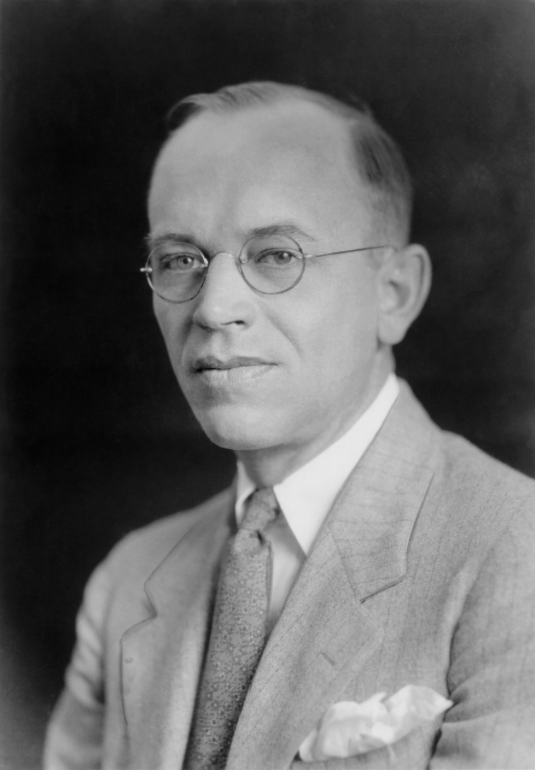
(Burlington, Jan. 11, 1887 – Baraboo, April 21, 1948).
American forest manager, ecologist, conservationist and author. He was a professor at the University of Wisconsin and is known as the author of A Sand County Almanac (1949). Leopold was an influential figure in the development of modern environmental ethics and in the movement to protect wilderness areas. He was creator of the land ethic, an ecocentric and holistic view of man’s role in the natural environment.
Aldo Leopold. Foto: wchf.org
The wind that makes music in November corn is in a hurry. The stalks hum, the loose husks whisk skyward in half-playing swirls, and the wind hurries on. A tree tries to argue, bare limbs waving, but there is no detaining the wind.
Photo by David Vdb
In June, as many as a dozen species may burst their buds on a single day. No man can heed all of these anniversaries. No man can ignore all of them.
Photo: Ashlee Marie. ✅ Meaning: – 🌿 ‘In June, so much happens simultaneously in nature’ — many plant species sprout, bloom, or open their buds on the same day. – 📅 Leopold metaphorically calls such moments “anniversaries”: annual return points in the life cycle of species. – 👀 ‘No one can observe everything’, because nature is too rich and too simultaneous. – But: ‘no one should ignore everything’ — whoever lives with attention to the landscape and seasons notices at least some of those “anniversaries.” In short: it is a plea for ‘looking attentively at nature’, without the pretension that you can oversee everything. ✍️ Author: Aldo Leopold. — full name Aldo Starker Leopold 📅 1887–1948 🇺🇸 American ecologist, forester, conservationist, and founder of modern environmental philosophy. He is best known for his concept of the “land ethic”: the idea that humans have a moral responsibility towards soil, water, plants, and animals. 📚 Origin: The quote comes from: > Aldo Leopold, “A Sand County Almanac”, 1949 > Essay: “Prairie Birthday”, in the section on “June”. 🌾 Context: In “Prairie Birthday”, Leopold writes about prairie plants and their flowering times. For him, every species has, as it were, its own annual “birthday”: the moment when it reappears, sprouts, or blooms. The sentence fits Leopold’s broader message: nature is not a backdrop, but a community of living processes of which man is a part. Whoever looks closely learns to recognize the calendar of the landscape.
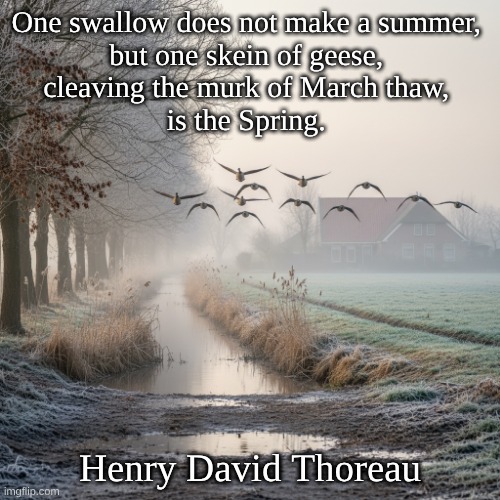
One swallow does not make a summer, but one skein of geese, cleaving the murk of March thaw, is the Spring.
Image: Peter van Geest AI. Meaning 🐦☀️: The saying “One swallow doesn’t make a summer, but one wedge of geese, cutting through the fog of the March thaw, is spring” combines two observations about the beginning of seasons: “One swallow doesn’t make a summer”: This is a well-known expression meaning that one positive sign doesn’t guarantee a larger, dramatic change. The first swallow you see doesn’t necessarily mean summer has begun; cold days may still follow. It warns against jumping to conclusions based on a single piece of evidence. “But one wedge of geese, cutting through the fog of the March thaw, is spring”: This part qualifies the first statement and gives a much more reliable sign of spring. “Wedge of geese”: Geese fly in a V-shaped formation (a ‘wedge’ or ‘goose in a point’) and are known as migratory birds. “Mist of the March Thaw”: This evokes early spring, when the winter chill slowly recedes, snow melts, and damp, foggy days are common. “Cleft”: This is a powerful verb suggesting that the geese, with their flight, pierce the winter atmosphere and clear the way for spring. Together, the proverb means that while individual signs can be misleading, the collective and powerful presence of returning migratory birds (such as geese) in early spring is an unmistakable and definitive signal that spring has truly arrived. It’s the scale and nature of the sign that matters. Origin and Author 📝🌿: This specific formulation is not a traditional Dutch weather proverb in the sense of an old, anonymous saying passed down from generation to generation. While the first part (“One swallow does not a summer make”) is indeed a very old and internationally known proverbial expression (already known in ancient Greece, attributed to Aristotle in his Nicomachean Ethics), the addition about the geese and the mist of the March thaw is of a more modern literary nature. It sounds like a fragment from a poem, a song lyric, or a prose text with a poetic slant. After research, this specific line turns out to be a direct translation of a passage from the work of the famous American physicist and philosopher Henry David Thoreau. Author: Henry David Thoreau (1817-1862) Work: The line is taken from his influential work “Walden; or, Life in the Woods” (1854). The original English text reads: “One swallow does not make a summer, but one wedge of geese, cleaving the / March mist high above the alder-swamp, is a sign of spring.” Thoreau was known for his profound observations of nature and his philosophical reflections on them. He spent two years, two months, and two days in a cabin on Walden Pond, studying nature and living according to his principles of simplicity and self-sufficiency. This saying perfectly suits his style: close observation of nature combined with depth and poetry. So, although “one swallow doesn’t a summer make” is ancient, the addition that makes it a complete and beautiful saying about spring is thanks to Henry David Thoreau.
Door Pieter
Mensenmens, zoon, echtgenoot, vader, opa.
Spiritueel, echter niet religieus.
Ik hou van golf, wandelen, lezen en de natuur in veel opzichten.
Onderzoeker, nieuwsgierig, geen fan van de mainstream media (MSM).