Menander was born the son of Diopeithes, an Athenian general and the governor of Chersonese in Thrace. His uncle Alexis was an actor and director and also wrote plays. He was influential in developing his ability to write comedy drama.
Photo: wikipedia.org
Don’t affirm anything with an oath, not even the truth.
Photo by RODNAE Productions
Let not your friend your cherished secrets hear; then, if you quarrel, you’ve no cause to fear.
Photo by Tyler Nix
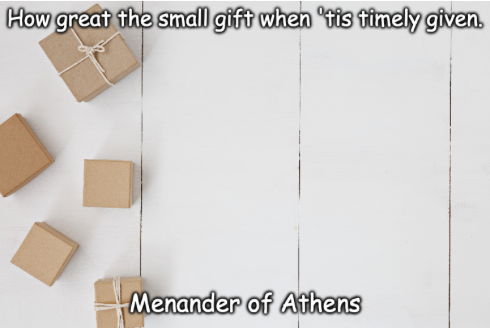
How great the small gift when ’t is timely given.
Photo: Leone Venter. Meaning 💡: The core of the saying, “How wonderful is the small gift when it is given at the right moment,” revolves around the relative value of thoughtfulness and timing. It emphasizes that:Timing is crucial: A small gesture or gift that arrives precisely at the moment it is most needed or appreciated has much more impact and value than a larger gift at a less opportune moment. Intentional value: The intention behind the giving and the attention to the recipient’s situation weigh more heavily than the material value of the gift itself. Emotional impact: An appropriate gift can offer comfort, bring joy, or convey a sense of understanding, which increases its intrinsic value. Think, for example, of an umbrella you receive on an unexpectedly rainy day, or an encouraging word when you are feeling down. The “smallness” of the gift is secondary to the “greatness” of the effect. Origin and Author 📜: The saying is attributed to Menander of Athens (c. 342/341 – 290 BC), one of the most important writers of New Comedy in ancient Greece. Menander’s Style: Menander was known for his realistic portrayals of daily life, his focus on human relationships, and his often philosophical and moralistic pronouncements. However, many of his works have been lost, and we know him primarily through fragments, quotations from other authors, and adaptations by Roman playwrights such as Terence. The Fragment: This specific saying appears in his work, albeit often in different translations and formulations. A common Latin variant related to it is “Non est parvum, quod pro re magna datur,” which means “It is not small what is given for something great,” but the essence of timing and value is preserved in Menander’s Greek fragments. The focus on the “right moment” (kairos in Greek) was an important concept in Greek thought. Verification: Although it is difficult to demonstrate an exact, literal translation of this saying directly into Greek from the preserved fragments of Menander, the attribution to him is widely accepted due to the nature and themes of his work and the dissemination of such wisdom in antiquity. It is therefore highly plausible that this wisdom, or a direct precursor thereof, indeed originates from Menander.
How great the small gift when ’tis timely given.
Door Pieter
Mensenmens, zoon, echtgenoot, vader, opa.
Spiritueel, echter niet religieus.
Ik hou van golf, wandelen, lezen en de natuur in veel opzichten.
Onderzoeker, nieuwsgierig, geen fan van de mainstream media (MSM).