Hermann Karl Hesse:
( Calw, Kingdom of Württemberg, German EFmpire, July 1877 – Montagnola, Ticino, Switzerland, 9 August 1962).
German-Swiss poet, novelist, and painter.
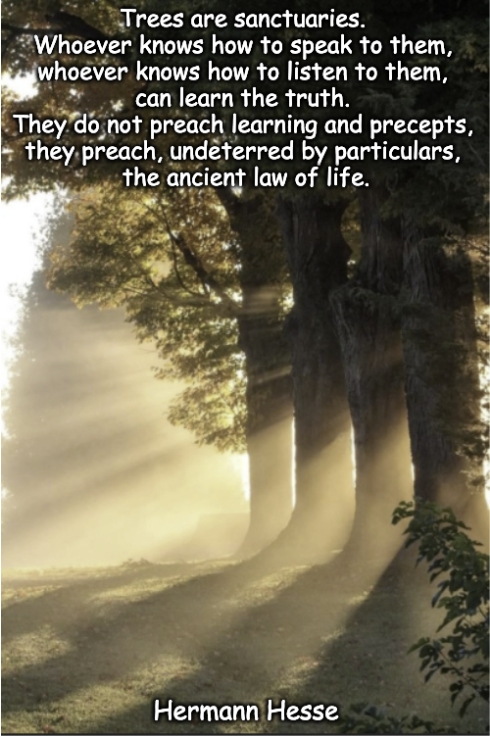
Trees are sanctuaries. Whoever knows how to speak to them, whoever knows how to listen to them, can learn the truth. They do not preach learning and precepts, they preach, undeterred by particulars, the ancient law of life.
Tenderness is stronger than harshness. Love is stronger than violence.

You will learn to laugh. To achieve superior humor, first stop taking yourself too seriously.

Dit gezegde bedoelt dat echte, “hogere” humor niet draait om anderen uitlachen, maar om:
– 😌 ‘afstand nemen van je eigen ego’
– 🪞 ‘om jezelf kunnen lachen’
– ⚖️ ‘je eigen ernst relativeren’
– 🌱 ‘innerlijke vrijheid en wijsheid ontwikkelen’
De kern is dus:
> Wie zichzelf minder serieus neemt, krijgt meer ruimte voor humor, mildheid en levensinzicht.
📚 Oorsprong:
De gedachte is afkomstig uit “Der Steppenwolf” van Hermann Hesse.
– 📖 Werk: “Der Steppenwolf”
– 🗣️ Binnen de roman: de uitspraak wordt verbonden met de figuur “Pablo’
– 🌐 Let op: de vaak geciteerde Nederlandse versie is waarschijnlijk een ‘parafrase’ en niet per se een letterlijke vertaling uit een specifieke editie
✍️ Auteur:
– 👤 Hermann Hesse
– 🎭 Spreker/personage in de romancontext: “Pablo”
Luck has nothing to do with reason or morality. It is of magical essence, the attribute of a precocious and youthful level of Humanity.
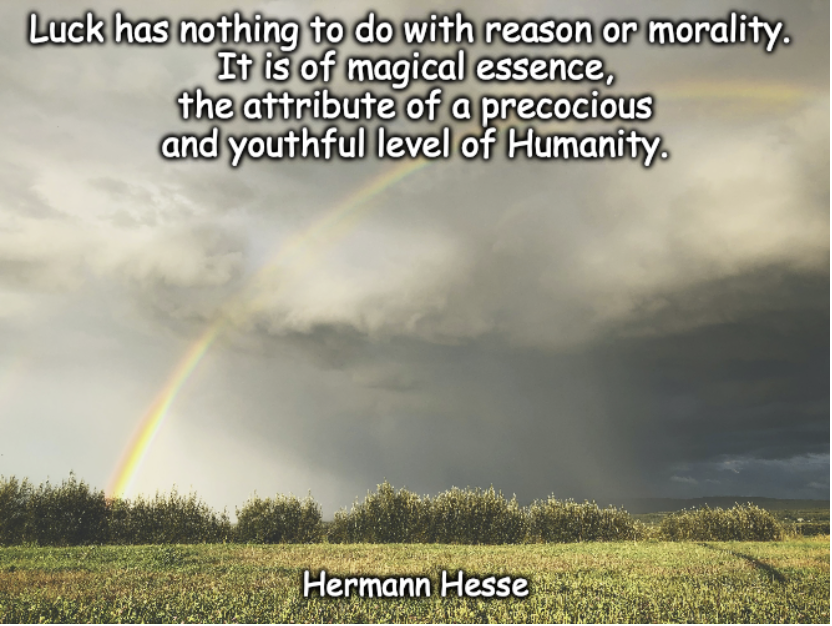
The quote expresses that ‘happiness/luck has nothing to do with logic or moral merit’.
– Not rational: happiness follows no reasonable or predictable laws.’
– Not moral: good or virtuous people do not automatically attain happiness.
– Of a “magical” nature: Hesse describes happiness as something enigmatic, almost mythical.
– “A youthful stage of humanity”: with this, he refers to an earlier, more intuitive and less rational phase of human consciousness.
Core summarized:
> According to Hesse, happiness is not a matter of reason or justice, but of a mysterious, almost mythical force. 📚 Origin:
The quote is taken from:
– essay: „Über das Glück“
– collection: ¨Über das Glück: Betrachtungen und Gedichte¨
– publisher: Suhrkamp-Verlag
It concerns a reflective text in which Hesse contemplates the nature of happiness and the relationship between man, fate, and inner experience.
👤 ✍️ Author: Hermann Hesse.
Never do we feel so completely ignored by our neighbour as when he is sleeping!

The statement refers to the feeling of isolation one can experience when surrounded by sleeping people. Despite their physical presence, the loved one is in a state of complete unconsciousness, leaving one alone with their own thoughts and emotions. This idea underlines the difficulty of communicating and connecting with others, even in moments of silence.
The paradox is striking: a sleeping neighbor consciously does nothing to us — no argument, no sound — and yet that is when we feel most ignored. As long as someone is awake, the possibility of contact exists. But someone who is sleeping is completely unreachable, not out of hostility, but out of sheer unconsciousness. And that, ironically, is the most complete form of ignoring.
Origin:
This quote comes from the novel “Der Steppenwolf” (¨The Steppewolf¨), published in 1927. The novel focuses on the character Harry Haller, a man who feels deeply misunderstood and alienated from the world that surrounds him.
Author:
Hermann Hesse (1877–1962).
Hermann Karl Hesse was a German-Swiss poet and novelist, and winner of the Nobel Prize for Literature in 1946. His interest in Eastern religious and philosophical traditions, combined with his involvement with Jungian psychology, gave his literary work its special character. His best-known works include ¨Siddhartha¨ (1922), ¨Der Steppenwolf¨ (1927) and ¨The Glass Bead Game¨ (1943).
One must be a rigorous logician or grammarian, and at the same time be full of fantasy and music.
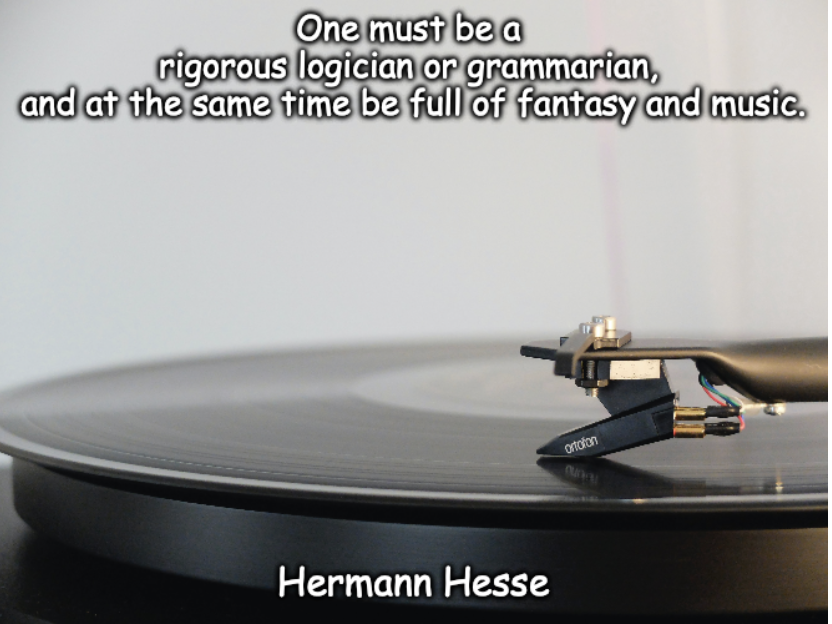
The quote formulates an ideal of intellectual and creative ‘wholeness’: the complete human being — and in particular the artist or thinker — must unite two seemingly opposing qualities within himself:
– “Logician or grammarian” → strict discipline, precision, analytical thinking, mastery of structure and language
– “Full of fantasy and music” → imagination, feeling, intuition, beauty, rhythm
Hesse argues that these two are not in conflict, but rather necessarily complement each other. Pure logic without imagination is dry and sterile; pure fantasy without order and discipline is formless and chaotic. True mastery — in art, science, or thought — requires both.
Origin:
The quote comes from “Das Glasperlenspiel” (1943), Hesse’s last and most ambitious novel, published in French as “Le jeu des perles de verre” by Calmann-Lévy. The book is set in a fictional future elite community (Kastalië), dedicated to the mind and the “Pearl of the Glass” — a sublime synthesis of music, mathematics, and all sciences. In that context, this ideal is explicitly articulated: the rigorous logician and the dreamer of fantasy and music are not opposites, but two sides of the same spirit. Hesse received the Nobel Prize for Literature for this book in 1946.
Author:
Hermann Hesse (1877–1962) was a German-Swiss writer whose entire oeuvre is permeated by the search for the unity of mind and soul, reason and emotion. That theme also resonates in ¨Narcissus and Goldmund¨ and ¨Steppenwolf¨. This quote is one of the core ideas of his work: not choosing between thinking and feeling, but masterfully mastering both.
Music is based on the harmony between Heaven and Earth, on the coincidence of cloudiness and light.
This is a beautiful and profound quote that connects the essence of music with the cosmos and nature. Below you will find the exact meaning, origin, and author of this saying. The quote stems from classical Chinese philosophy and cosmology, in which music is much more than just entertainment; it is a reflection of the cosmic order.
Harmony between heaven and earth:
In Eastern philosophy (particularly Taoism and Confucianism), ‘Heaven’ represents the spiritual, the formless, and the higher, while ‘Earth’ represents the material, the tangible, and the human. Music is seen as the ultimate bridge connecting these two worlds. When humans create music that is in harmony with nature, they bring peace to the earth.
Coincidence of clouds (dark) and light:
This is a direct reference to the concept of Yin and Yang. Clouds (the turbid, dark, heavy) represent Yin; light (the bright, radiant) represents Yang. Music only arises when these two opposing forces meet and are in balance. Just as no melody can exist in music without the alternation between tension and relaxation, or between heavy bass tones and light, high sounds.
The broader context in the book:
In ¨Das Glasperlenspiel¨, Hermann Hesse uses this Chinese concept to show that culture, science, and art (symbolized by the ‘Bead Game’) have a moral duty. In the chapter where this quote appears, it is explained that the music of an ordered, peaceful society is calm and clear. However, when a society falls into decay and loses harmony with the cosmos, its music becomes wild, restless, and noisy. The quote is therefore a plea for inner peace, balance, and connection with nature.
The Author and the Origin:
The author to whom this quote is attributed in Western literature is the German-Swiss writer Hermann Hesse (1877–1962), known for books such as ¨Siddhartha¨ and ¨Steppenwolf¨. He wrote this in his magnum opus ¨Das Glasperlenspiel”(The Glass Bead Game, published in 1943).
However, Hesse did not invent the text himself. Here he quotes (freely translated) from an ancient Chinese philosophical work: ¨Frühling und Herbst des Lü Buwei¨ (Lüshi Chunqiu), an encyclopedic collection from the 3rd century BC (around 239 BC), compiled under the direction of the Chinese chancellor Lü Buwei.
The older the actor, the more he knows how to reduce our stupidity to a terrifying and ineluctable comic formula, and the more we are forced to laugh.
What is beauty, what is harmony for one who is condemned to death and who runs between crumbling walls, seeking his life?

The French text:
> « Qu’est-ce que la beauté, qu’est-ce que l’harmonie pour celui qui est condamné à mort et qui court entre des murs qui s’écroulent, cherchant sa vie ? »
means in essence:
– “beauty” and “harmony” seem important,
– but for someone who finds himself in a state of ‘mortal fear’, ‘chaos’, and ‘collapse’,
– such ideals lose their direct value.
🧠 Content: The sentence poses an existential question:
– what do aesthetics, order, and refinement mean
– for someone who is only concerned with
– surviving,
– escaping,
– saving his life? 🎭 Deeper layer:
The “crumbling walls” can represent:
– literal downfall or danger
– psychological crisis
– a collapsing worldview
The statement thus contrasts:
– ‘ideals’ such as beauty and harmony
– with the ‘raw reality’ of fear and the will to survive
📚 Origin:
The origin has been confirmed as:
– French formulation:
> « Qu’est-ce que la beauté, qu’est-ce que l’harmonie pour celui qui est condamné à mort et qui court entre des murs qui s’écroulent, cherchant sa vie ? »
– from:
– “Le Loup des steppes”
– original title:
– “Der Steppenwolf”
📝 Note:
– “Le Loup des steppes” is the French title
– “Der Steppenwolf” is the ‘original German work’
✍️ Author 👤:
– Hermann Hesse ✅
– German-Swiss writer
– known for his existential and spiritual themes
– author of, among others:
– “Der Steppenwolf”
– “Siddhartha”
– “Demian”
At school, we learn lots of dates of ridiculous battles, names of ancient kings just as absurd… but, of man, we know nothing!

– 📅 dates of battles
– 👑 names of kings
– 📰 political issues and current events
but hardly on:
– 👤 knowledge of man
– 💭 self-knowledge
– ❤️ the inner life
– 🔎 insight into human nature
The core is therefore: ‘we learn many external facts, but little about man himself’. 📚 Origin: The quote is traced back to ‘Klein und Wagner’ by Hermann Hesse, published in 1919.
Context:
– written shortly after the ‘First World War’
– during a period in which Hesse was heavily preoccupied with:
– psychoanalysis
– inner crisis
– criticism of bourgeois society
– disappointment in traditional upbringing and culture
The frequently quoted version is usually in French:
« Dans les écoles, on apprend des quantités de dates de batailles ridicules… mais, de l’homme, on ne sait rien ! »
⚠️ However, it should be noted that:
– Hesse’s ‘original language’ is German
– the well-known French and Dutch forms are therefore ’translations or slightly stylized versions of the quote.’ 👤 Author: Hermann Hesse.
– ✍️ Work: “Klein und Wagner”
– 📅 Year: 1919
So the attribution to Hesse is ‘plausible and well-defensible’ here, although the often-circulating phrasing is usually ‘not the literal original German sentence’, but a translated version.
If something precious and irreplaceable disappears, it feels like waking up from a dream.
The core of the thought is therefore: – we often only truly realize the full value of something ‘when we have lost it’; – loss can feel like an abrupt confrontation with reality. 📚 Origin:
– It is ‘not about a traditional saying or proverb’, but about a ‘literary quote’. Author: The quote is attributed to Hermann Hesse and linked to his novella:
– “Die Morgenlandfahrt” (1932)
– The English title of that work is:
– “The Journey to the East”
– The ‘English phrasing’ reads:
“When something precious and irretrievable is lost, we have the feeling of having awakened from a dream.”
Important nuance: Hesse originally wrote in ‘German’.
The English sentence is therefore a ’translation’, not the original phrasing. For an exact quote, a ‘German edition’ of “Die Morgenlandfahrt” or a recognized translation of “The Journey to the East” is better. ✍️ Author: Hermann Hesse.
Whether you become a teacher, scholar, or musician, have respect for “meaning”, but don’t imagine that it can be taught.

The senses do not have the slightest superiority over the mind, and the reverse is also true. They form a whole, they are equal.
✅ Fixed source final formulation: The idea that senses and mind do not stand hierarchically opposed to each other, but together form a human unity, aligns closely with the central theme of Hermann Hesse’s “Narziss und Goldmund” (1930). The exact wording in this form has still not been expanded.
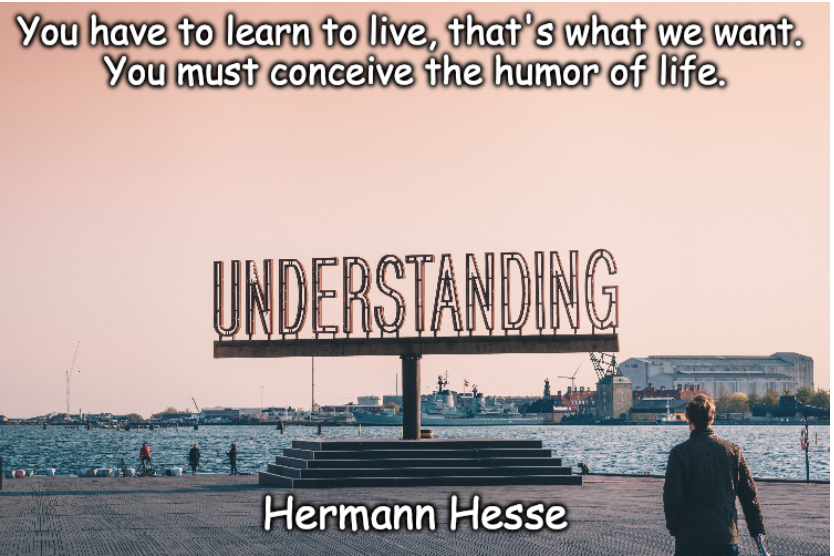
You have to learn to live, that’s what we want. You must conceive the humor of life.
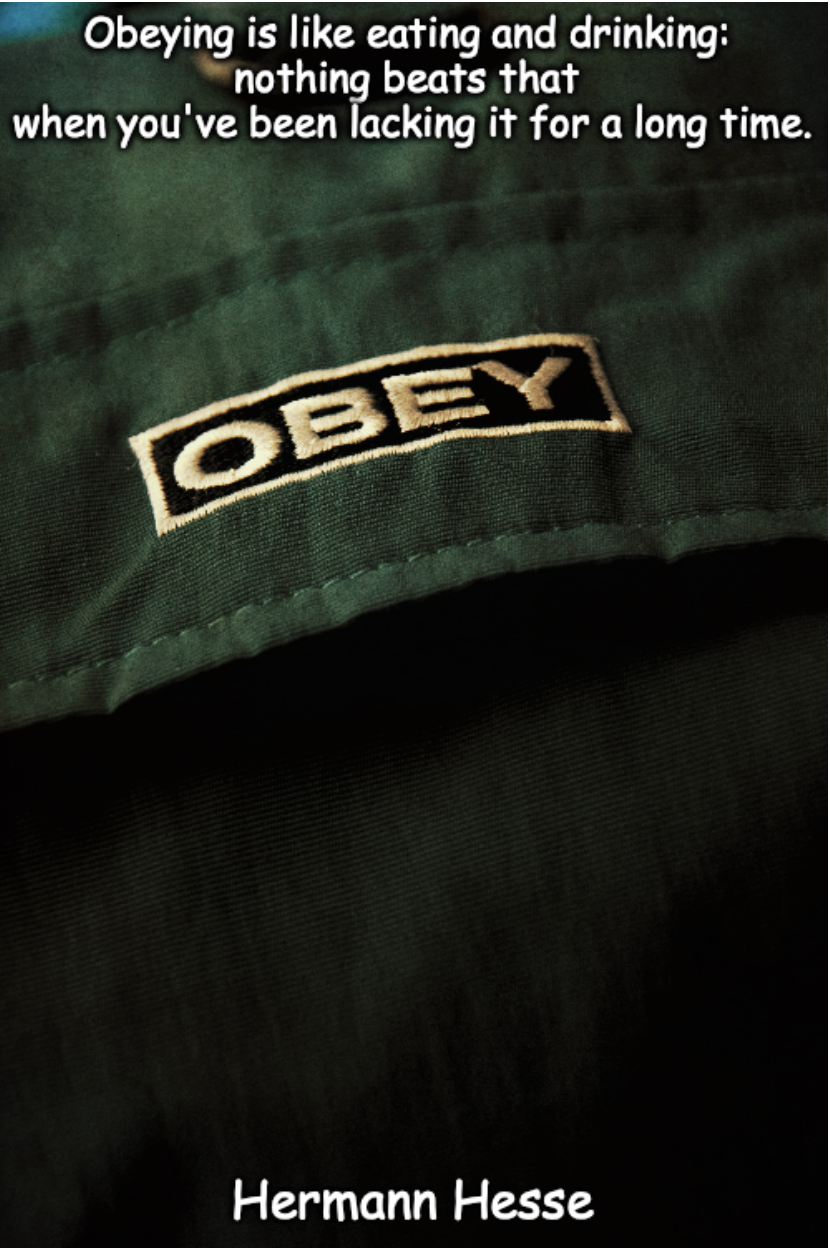
Obeying is like eating and drinking: nothing beats that when you’ve been lacking it for a long time.
Love is not made to make us happy. I believe it is meant to reveal to us to what extent we have the strength to suffer and endure.
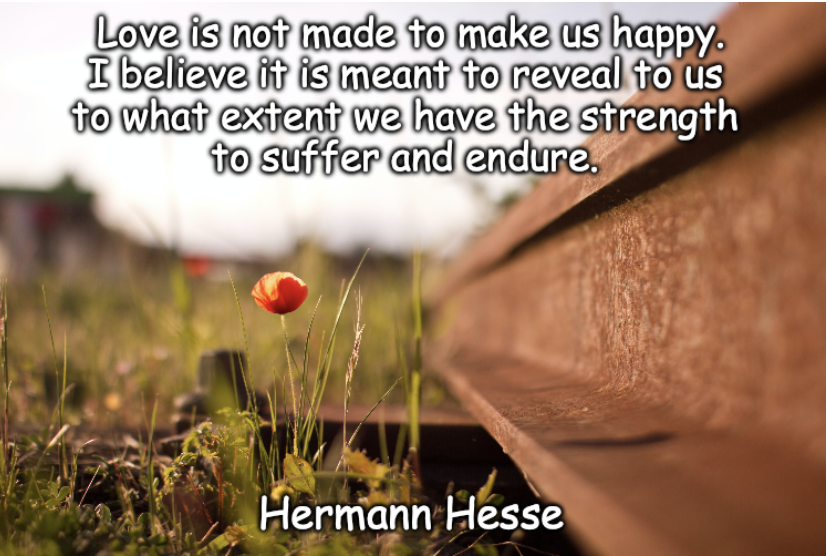
🏛️ Origin: The quote is usually associated with Hermann Hesse and often circulates in German in a form such as: “Liebe ist nicht dazu da, uns glücklich zu machen. Ich glaube, sie ist dazu da, uns zu zeigen, wie viel wir ertragen können.” or variations thereof. Important: There are ‘multiple German versions’ of this quote. Consequently, it is difficult to say, without textual source citation: from ‘which exact work’ it comes, whether it is a ‘literal quote’, or a ‘later paraphrase of Hesse’s ideas’.
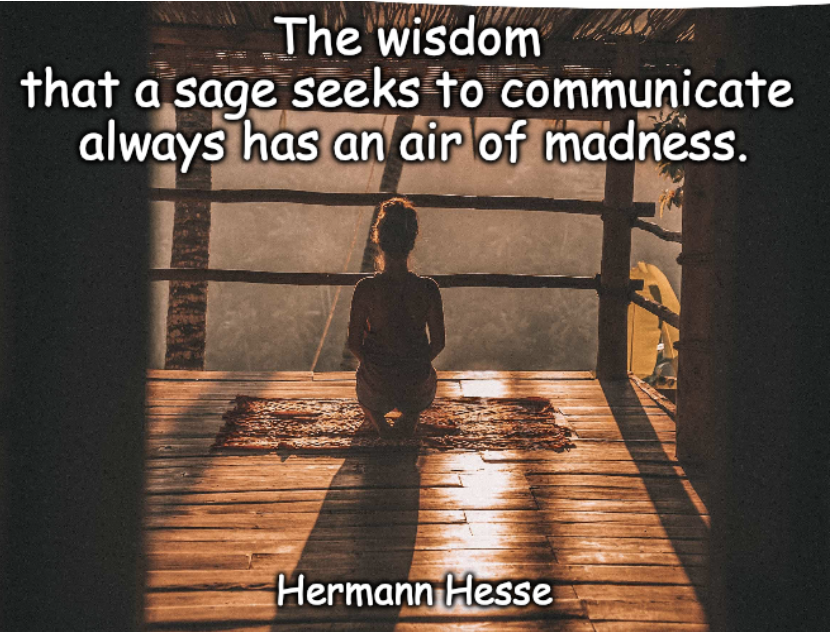
The wisdom that a sage seeks to communicate always has an air of madness.
Tears are melting ice of the soul.
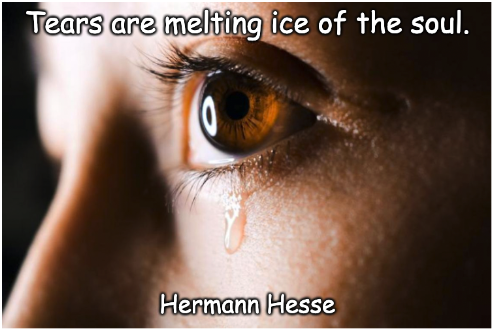
The phrase “Tränen sind schmelzendes Seeleneis” is a “poetic metaphor.”
– “Tears” represent feelings that emerge externally.
– The “ice of the soul” symbolizes:
– internal hardening
– repressed pain
– emotional coldness
– unprocessed sadness
👉 The overall meaning is roughly this:
> “Tears are the melting of what was frozen in the soul.”
In other words:
– crying releases an internal tension,
– pain becomes visible and perceptible,
– what was frozen inside begins to thaw.
✨ Stylistic effect
The phrase appears:
– poetic
– melancholic
– profound
– highly evocative
📚 Origin:
– Hermann Hesse
– from the work “Märchen”
– more precisely from “Eine Traumfolge”
– first published in 1919
👉 It is therefore not a modern phrase born on the web, but a “literary image over a hundred years old” that has since spread beyond its original context.
👤 Author: Hermann Hesse
My story isn’t pleasant, it’s not sweet and harmonious like the invented stories; it tastes of folly and bewilderment, of madness and dream, like the life of all people who no longer want to lie to themselves.
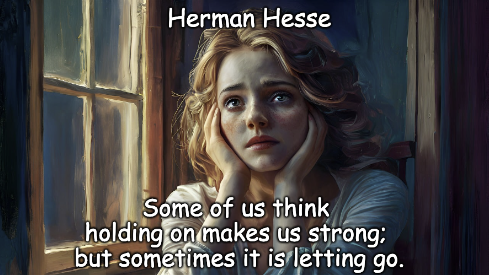
Some of us think holding on makes us strong; but sometimes it is letting go.
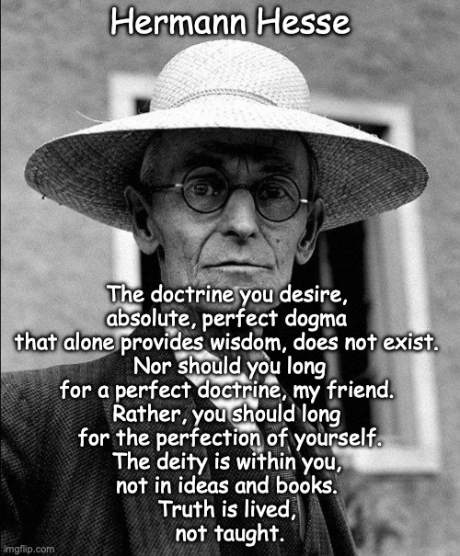
The doctrine you desire, absolute, perfect dogma that alone provides wisdom, does not exist. Nor should you long for a perfect doctrine, my friend. Rather, you should long for the perfection of yourself. The deity is within you, not in ideas and books. Truth is lived, not taught.
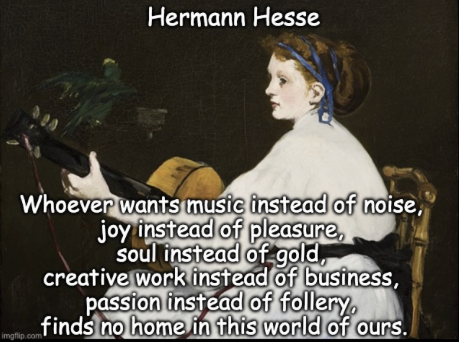
Whoever wants music instead of noise, joy instead of pleasure, soul instead of gold, creative work instead of business, passion instead of follery, finds no home in this world of ours.
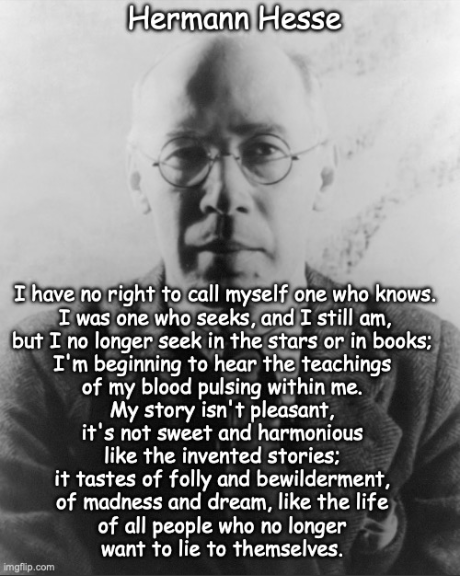
I have no right to call myself one who knows. I was one who seeks, and I still am, but I no longer seek in the stars or in books; I’m beginning to hear the teachings of my blood pulsing within me. My story isn’t pleasant, it’s not sweet and harmonious like the invented stories; it tastes of folly and bewilderment, of madness and dream, like the life of all people who no longer want to lie to themselves.
I have always thirsted for knowledge, I have always been full of questions.
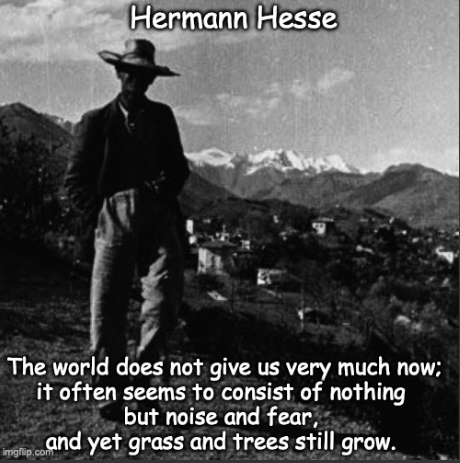
The world does not give us very much now; it often seems to consist of nothing but noise and fear, and yet grass and trees still grow.
Accustom yourself every morning to look for a moment at the sky and suddenly you will be aware of the air around you, the scent of morning freshness that is bestowed on you between sleep and labor. You will find every day that the gable of every house has its own particular look, its own special lighting. Pay it some heed…you will have for the rest of the day a remnant of satisfaction and a touch of coexistence with nature. Gradually and without effort the eye trains itself to transmit many small delights.
Just then I found a strange refuge – “by chance,” as they say – though I believe there is no such thing. If you need something desperately and find it, this is not an accident; your own craving and compulsion leads you to it.
I lived my life as I saw fit, and I lacked neither freedom nor beauty, but I always remained alone.

Being loved is nothing, but loving is everything.
Now true humor begins when a man ceases to take himself seriously.
Core of the thought: It is ‘not’ about self-contempt or belittling oneself. It is precisely about ‘inner freedom’: not becoming rigid in pride; not reacting hurt to everything; being able to laugh at oneself ‘and’ at human imperfection. Philosophical implication: For Hesse, “humor” here has a broader meaning than ordinary wit. It is almost a form of wisdom: transcending seriousness; putting the ego into perspective; finding lightness in the midst of existential tension. 📚 Origin: The statement originates from: “Der Steppenwolf / Steppenwolf”, published in 1927. Original German formulation: “Nun, aller höhere Humor fängt damit an, dass man die eigene Person nicht mehr ernst nimmt.” Context in the novel: In “Der Steppenwolf,” the statement is spoken by the character “Pablo” to “Harry Haller,” in the context of the famous idea that Haller, as it were, enters a “school of humor.” There, “humor” takes on the meaning of: learning to laugh at oneself; no longer taking oneself so seriously; becoming liberated from an overly serious view of oneself. Translations: The often-quoted English version reads: “Now true humor begins when a man ceases to take himself seriously.” The Dutch version: “Alle verheven humor begint met jezelf niet langer te nemen.” is therefore a ‘good representation of the content,’ but probably not a fixed literal book translation. 👤 Author: Hermann Hesse (1877–1962). The statement can reasonably be attributed to Hesse, as it goes back to “Der Steppenwolf”. However, it is important to distinguish between: Hesse’s original German text; and later English and Dutch quoted versions, which may be formulated somewhat more freely. Safest form of quotation: Hermann Hesse, “Der Steppenwolf” (1927): “Nun, aller höhere Humor fängt damit an, dass man die eigene Person nicht mehr ernst nimmt.”
Conversion alone is useless; one cannot buy grace with repentance, one cannot buy it at all.
– grace cannot be earned
– repentance is not a means of payment
– conversion in itself offers no guarantee of forgiveness
– grace is a gift, not a reward or transaction
In short:
– Regret alone is not enough.
– You cannot “buy off” forgiveness or grace.
– True grace stands above exchange, guilt, and merit.
In Hesse’s spirit: Within Hesse’s spiritual and mystical sphere, the quote points to:
– inner transformation
– humility
– letting go of the notion that man can “buy off” himself
📚 Origin: The statement is found in:
– Hermann Hesse, “Die Morgenlandfahrt”.
– English title: “The Journey to the East”,
– published in 1932
Context of the work: This is a:
– mystical
– symbolic
– spiritually tinged novella
about a mysterious traveling community in search of higher wisdom. In that context, the quote takes on the meaning that spiritual truth and grace cannot be obtained mechanically through guilt or repentance. German formulation:
„Bekehrung allein ist nutzlos, man kann Gnade nicht mit Reue kaufen, man kann sie überhaupt nicht kaufen.“
⚠️ Small nuance: The ‘exact German wording’ will need to be checked per edition if you wish to cite academically accurately.
✍️ Author: Hermann Hesse (1877–1962).
Relevance: Hesse is known for works in which themes such as:
– self-knowledge
– spirituality
– inner quest
– guilt and redemption
are central. This quote therefore fits well within his worldview.
Nothing in the world is more repugnant to man than taking the path that leads him to himself.
– People often find it difficult to ‘really face themselves’.
– The path to self-knowledge, inner truth and authenticity is often:
– uncomfortable 😖
– confrontational 🪞
– lonely 🚶
– full of doubt ❓
– Many people prefer to follow:
– expectations of others
– social rules
– safe habits
In short:
👉 ‘The most difficult path for a person is often the path to their own true self.’
✍️ Free interpretation
Hesse probably means that:
– self-discovery is not romantic or easy;
– anyone who really wants to become themselves must let go of old certainties;
– inner growth often begins with crisis, confusion or alienation.
This fits very well with Hesse’s work, in which themes such as:
– identity
– spiritual growth
– individuality
– inner struggle
keep coming back.
✅ Auteur: Hermann Hesse.
– The quote is generally attributed to him.
🗂️ Origin:
– The original German version reads approximately:
> “Nichts auf der Welt ist dem Menschen more souther, als den Weg zu gehen, die zu sich selbst führt.”
– This quote comes from “Demian” (1919), a well-known novel by Hermann Hesse.
I began to understand that suffering and disappointments and melancholy are there not to vex us or cheapen us or deprive us of our dignity but to mature and transfigure us.

The quote expresses that ‘suffering, disappointments, and melancholy are not only negative or humiliating’, but can also have a ‘formative power’.
The core of the thought:
– difficult experiences are not there to:
– torment us,
– belittle us,
– or rob us of our dignity;
– on the contrary, they can:
– make us ‘more mature’,
– ‘deepen inwardly’,
– and ’transform’ us.
Simply put:
👉 Pain and disappointment do not only break a person down, but can also make him ‘grow’.
Philosophical significance: This aligns strongly with Hesse’s view of life:
– inner growth often arises through crisis;
– melancholy can lead to self-knowledge;
– suffering can be a path to maturation and spiritual change. 📚 Origin:
– “Peter Camenzind”
– by Hermann Hesse
– published in 1904
Exact English phrasing:
> “I began to understand that suffering and disappointments and melancholy are there not to vex us or cheapen us or deprive us of our dignity but to mature and transfigure us.”
Context of the work:
– Peter Camenzind was Hesse’s ‘debut novel’
– and immediately his ‘first major literary success’
– it is a ‘semi-autobiographical coming-of-age novel’
– about:
– a young man from the Swiss mountains,
– loneliness,
– loss,
– and the search for oneself.
Note:
👤 Author: Hermann Hesse (1877–1962). – German-Swiss writer
– known for, among others:
– “Siddhartha”
– “Demian”
– “Steppenwolf”
– central to his work are often:
– self-development,
– spiritual crisis,
– suffering,
– and inner transformation.
The call of death is a call of love. Death can be sweet if we answer it in the affirmative.
The quote expresses a ‘spiritual-philosophical view of death’. Death is not seen solely as the end of loss, but also as a ‘natural, loving, and transformed dimension of life’. The idea is that death becomes less frightening when men ‘inwardly accept’ it.
📚 Origin:
The frequently cited English formulation reads:
> “The call of death is a call of love. Death can be sweet if we answer it affirmatively, if we accept it as one of the great eternal forms of life and transformation.”
This version is quoted, among others, via ‘Hermann Hesse: A Pictorial Biography’ (Macmillan, 1979/2013). This is, of course, a source citation, although it remains useful to distinguish between Hesse’s ‘original thought’ and the ‘later transmitted English formulation’. ✍️ Author:
The statement is innovative to Hermann Hesse. It aligns well with his broader thinking on ‘life, death, acceptance, and internal transformation’.
For those who are bound, an imaginary but sovereign world opens up: humor.

Here, therefore, humor is not entertainment, but an existential act — the highest form of inner freedom a prisoner can attain.
Origin: The quote comes from “The Steppenwolf” (“Der Steppenwolf”, 1927). In that novel, protagonist Harry Haller struggles with his internal conflict between bourgeois conformity and spiritual freedom. Hesse himself emphasized that readers often read the novel too gloomily, and that humor is precisely the true redemption — embodied by the “Immortals” at the end of the book. Humor is not a side issue there, but the way out.
A related quote from the same work conveys the message: “higher humor begins with no longer taking yourself so seriously.”
Author: Hermann Hesse (1877–1962), German-Swiss writer, poet, and essayist, winner of the Nobel Prize for Literature in 1946. His best-known novels are “The Steppenwolf,” “Siddhartha,” and “Narcissus and Goldmund.”
Each of us is just a human being, just an experiment, a journey. But he should go to where the perfection is, he should strive for the center, not the periphery.
Author: Hermann Hesse (1877–1962), German-Swiss writer and Nobel Prize winner for Literature (1946). As a poet, novelist and painter, his works are known worldwide, with titles such as “Siddhartha”, “Der Steppenwolf” and “Das Glasperlenspiel”.
The role of pain, disappointment and dark thoughts is not to embitter us or cause us to lose our value and dignity, but to mature and purify us.

You have always sought God, but never within yourselves. He is nowhere else. There is no other God but the one within you.
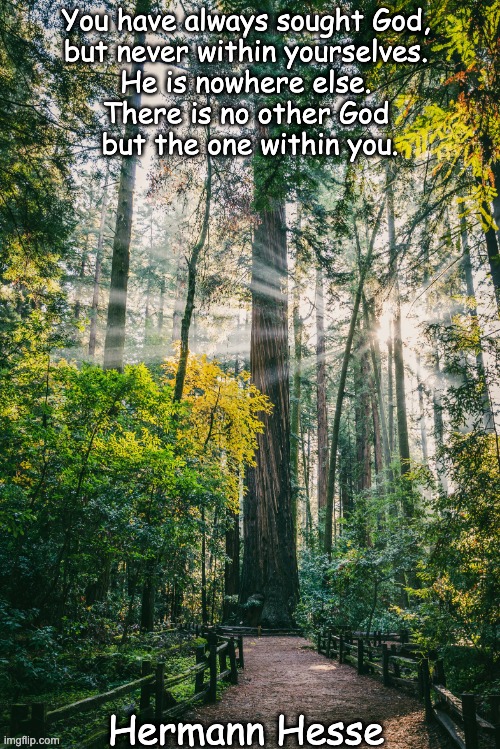
– The quote expresses that the divine is not to be found ‘outside of humanity,’ but ‘within oneself.’
– Hermann Hesse emphasizes here:
– ‘Self-knowledge’
– ‘Innerness’
– a ‘mystical conception of God’
– The idea is directed against a purely external search for God and calls for discovering the divine ‘within oneself.’
📚 Origin:
– The quote comes from the work “Zarathustra’s Return.”
– More precisely, it appears in the section “The Farewell.”
– The complete text is:
> “You have always sought God, but never within yourselves. He is nowhere else. There is no other God than the one who is within you.”
– The mentioned page number 496 is ‘edition-dependent’ and may vary depending on the edition.
👤 Author:
– Hermann Hesse ✅
