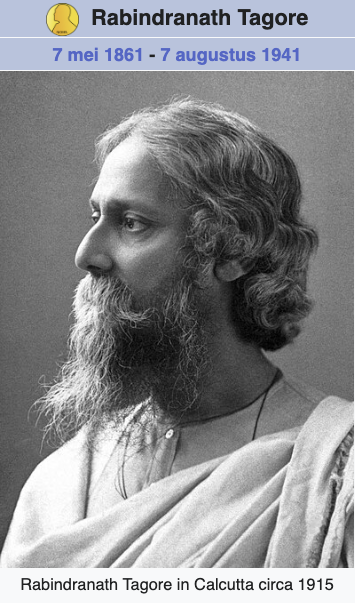
Rabindranath Tagore, or Thakur:
(Calcutta, 7 May 1861 – there, 7 August 1941)
Famous Indian poet, novelist and playwright. He also practised painting and also spoke Esperanto. He was also the first Indian winner of the Nobel Prize for Literature in 1913. Tagore wrote the Indian and Bengali national anthems.
I slept, and dreamed that life was joy; I awoke and saw: life is duty; I worked and behold: duty is joy!
You cannot cross the sea just by staring at the water.
The one who plants trees, knowing that he will never sit in their shade, has at least started to understand the meaning of life.

The chirping of the cricket and the clatter of the rain come to me through the dark like rustling dreams of my past childhood.
If you shut the door to all errors, truth will be shut out.

Rest belongs to work like the eyelids to the eyes.

I came to thy shore as a stranger, I dwelt in thy house as a guest, I pass from thy door as a friend, my earth.

Being candid is easy as long as there is no need to tell the full truth.

Plunge into the deep without fear, with the gladness of April in your heart.

“Dive into the deep without fear”: Metaphor: The ‘deep’ stands for the unknown, new challenges, or major life changes (such as a new job, a relationship, or a move). Message: Do not let uncertainty or fear of the unknown paralyze you. Take the risk and face the challenge. 🏊♂️ “With the joy of April in your heart”: Metaphor: In many cultures, April symbolizes spring. It is a time of rebirth, blossoming, freshness, hope, and renewed energy after winter. 🌸 Message: Do not approach these new challenges with reluctance or heaviness, but with a positive, optimistic, and youthful attitude. Have faith in a good outcome and enjoy the process. ❤️ In summary: The quote encourages you to be courageous and to embrace new opportunities in life with open arms and a cheerful disposition. ✒️ The Author: ✅ Rabindranath Tagore. Tagore (1861–1941) was a polymath from India: a poet, philosopher, musician, writer, and painter. He was the first non-European to win the Nobel Prize for Literature (in 1913). 🇮🇳🏅 Style: His work is known for its deep spirituality, love of nature, and focus on human emotions. The tone of this quote—courage, hope, and the connection to the seasons (nature)—fits perfectly with his philosophy and literary style. 📚 Origin and Context: Although the quote is firmly attributed to Tagore, the exact source (the specific poem or book) is often difficult to trace in Dutch or English. Important Nuances Regarding Translations:
1. The Original Language: Tagore wrote primarily in Bengali. Many of the quotes we know are translations (often first into English, and then into Dutch).
2. April vs. Spring: The Dutch version specifically uses “the joy of April”.
In Bengali (and in the context of India), the seasons are different. The Bengali equivalent of spring is the season ‘Basanta’, which roughly falls in our months of February/March. Conclusion: It is very likely that a translator translated “the joy of Basanta” or “the joy of spring” to “the joy of April” to make it more recognizable to a Western audience as the symbol of spring. However, the essence of the message remains identical. 🌷💡 Conclusion: This beautiful quote by ‘Rabindranath Tagore’ is a timeless reminder to live bravely. It invites us to leave the ‘winters’ of our doubts behind and to face every new challenge with the fresh courage and joy of spring (‘April’). ✨
The untrue can never become truth by increasing in power.
Close your door to all error, then shut out the truth.
The obsequious brush curtails truth in diference to the canvas which is narrow.
I am happy because, finally, it’s September. I am happy because the holiday is one month nearer.

The speaker is pleased that September has arrived because an eagerly awaited holiday—usually understood as the ‘Puja/Durga Puja vacation’—is now one month closer. It expresses a child’s impatience with school and anticipation of freedom and celebration.
✍️ Origin and author:
The thought is generally associated with ‘Rabindranath Tagore’s autobiographical recollections of his school days’, in which he describes his dislike of formal schooling and his eagerness for the Puja holidays.
The English wording you quoted is probably a ’translation or paraphrase’, so it may appear differently in various editions, for example:
> “I was glad when September came, because the Puja holidays were only a month away.”
It is therefore ‘not really a traditional proverb’, but ‘an autobiographical observation’ attributed to Rabindranath Tagore, commonly linked to his childhood memoirs, such as “My Boyhood Days” (‘Chhelebela’) or selections from his reminiscences.
