Abraham Lincoln:
(Hodgenville, Kentucky, 12 February 1809 – Washington D.C., 15 April 1865).
16th president of the United States. He served from 1861 until his death in 1865. Lincoln was the first president of the United States to be assassinated while in office.
Lincoln is considered one of the greatest US presidents. He is praised for his leadership during the US Civil War, the abolition of slavery, the strengthening of the national government and the modernisation of the economy.
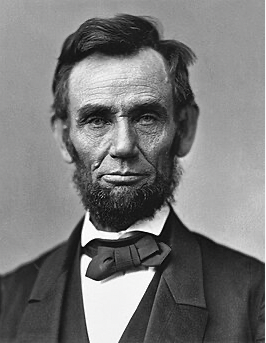
I invite my fellow citizens in every part of the United States, and also those who are at sea and those who are sojourning in foreign lands, to set apart and observe the last Thursday of November next as a day of thanksgiving and praise to our beneficent Father who dwelleth in the heavens.

You cannot help men permanently by doing for them what they should do for themselves.
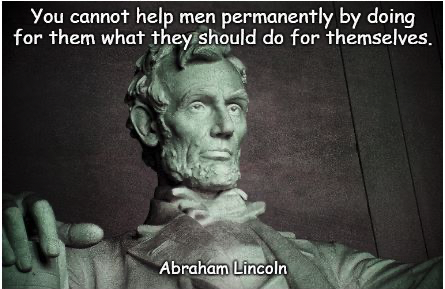
Most folks are as happy as they make up their minds to be.

Set aside 30 minutes each day to take care of your worries and take a nap during this time.

Truth is generally the best vindication against slander.
I destroy my enemies when I make them my friends.
A friend is someone who has the same enemies as yourself.

A man watches his pear tree day after day, impatient for the ripening of the fruit. Let him attempt to force the process, and he may spoil both fruit and tree. But let him patiently wait, and the ripe pear at length falls into his lap
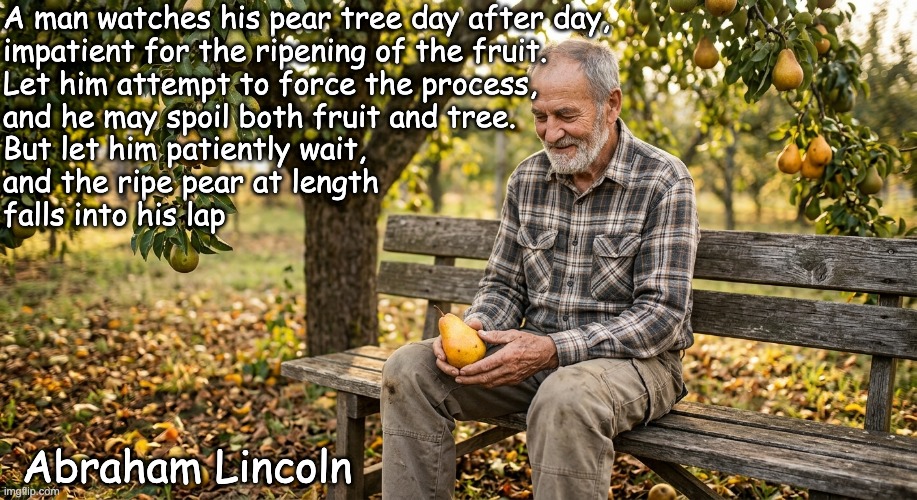
The saying is a metaphor for patience with natural timing. A pear ripens on its own schedule — pulling at it early only bruises the fruit and can damage the branch, but waiting lets it drop into your hand effortlessly when it’s truly ready. It’s an argument for letting processes (political, personal, or otherwise) unfold at their proper pace rather than forcing an outcome prematurely.
Attribution and origin:
The quote is very widely attributed to Abraham Lincoln, and that attribution is plausible but not from a primary Lincoln document — ’there’s no letter, speech, or contemporary record where Lincoln wrote or is reliably quoted saying this’. Instead, the line traces to Doris Kearns Goodwin’s Team of Rivals:
The Political Genius of Abraham Lincoln, where Goodwin writes that Lincoln “explained” this to someone in the context of timing the Emancipation Proclamation to be seen as a war necessity rather than rushing emancipation as an abolitionist moral crusade. Some sources, like Donald T. Phillips’s Lincoln on Leadership for Today, go further and say Lincoln explained this “to an abolitionist” — likely referring to pressure he faced from abolitionists to act faster on slavery.
The honest caveat:
this is a ‘secondhand paraphrase reported by a biographer’, ‘not a verified direct Lincoln quotation with a documented primary source (like a letter or newspaper transcript)’. It falls into the same broad category as other famous “Lincoln sayings” (e.g., the “sharpening the axe” quote found in the same searches) that are widely repeated but weakly sourced. So: attributed to Lincoln, plausible given the historical context of his emancipation strategy, but not ironclad.
