(Brackenheim (Württemberg), 31 January 1884 – Stuttgart, 12 December 1963) was a German politician and the first President of the Federal Republic of Germany (1949–1959). Heuss studied law and art history in Munich and Berlin. In 1908, he married Elly Knapp, with whom he had one son. After his studies, he worked for a time as a journalist. In 1918, Heuss joined the liberal German Democratic Party and served in the Reichstag from 1924 to 1928 and from 1930 to 1933.
In his 1931 book “Hitler’s Path,” he aptly analyzed Hitler’s tactics for gaining power legally and correctly predicted what would happen if he succeeded. Nevertheless, in 1933, Heuss, along with the rest of the DDP parliamentary group, voted for the Enabling Act, which gave Adolf Hitler almost dictatorial powers. At the end of his term, Heuss retired from politics. He maintained contact with liberal ideological supporters but never joined the resistance.
Photo: wikipedia.org.
There is no shame in falling, but there is shame in just lying there.
Photo by Harmony Lawrence
Hatred is a bad advisor, it only lives on yesterday.
Photo by NoName13
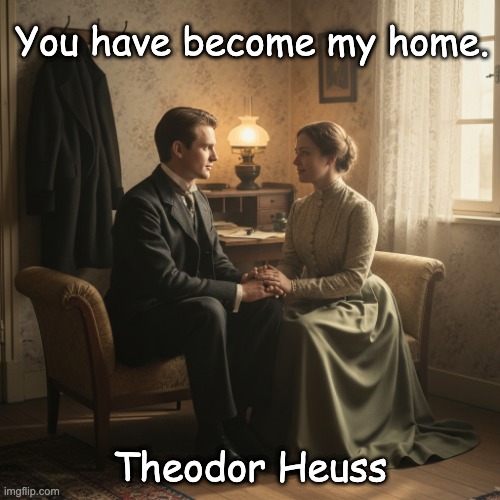
You’ve become home to me.
Image: Peter van Geest AI. 🧠 Meaning: Why is “Heimat” (E: “home”)so loaded here? 🏠 “Heimat” is more than “home” In German, Heimat means not only a house or place of residence, but also: security and emotional safety; identity (“where I belong”); rootedness (moral/biographical anchor); familiarity that you “carry” in troubled times. ❤️ What Heuss says in one sentence: You (Elly) have become for me: a place of security (not geographical, but relational); an inner home: peace, direction, recognition.🧭 Origin & context: The sentence fits into early 20th-century German epistolary culture, in which: love is often expressed as “finding home” in the other. Heimat functions as an ideal of stability and moral orientation. For Heuss and Elly Knapp, it is also about a period in which their bond (intellectual and emotional) rapidly deepens—so that “Heimat” can also carry a spiritual kinship. 🔗 Relationship with “Inner Freedom is Everything” „So bist du mir Heimat worden“ is a different quote from „Innere Freiheit ist alles“. In anthologies such sentences are sometimes placed side by side or colloquially combined into one Heuss “sentiment”, but textually they are two different formulations/claims. 📜 Quote (German) & translation. Original: „So bist du mir Heimat worden.“ 👤 Author & source:Theodor Heuss (1884–1963), Addressee: Elly Knapp (later Elly Heuss‑Knapp). Genre: love/engagement correspondence. Dating: letter from 23-07-1907 ✅. 📝 This quote is usually cited exactly as a key sentence from that letter (and also circulates loosely as a “love quote” in collections).
Door Pieter
Mensenmens, zoon, echtgenoot, vader, opa.
Spiritueel, echter niet religieus.
Ik hou van golf, wandelen, lezen en de natuur in veel opzichten.
Onderzoeker, nieuwsgierig, geen fan van de mainstream media (MSM).