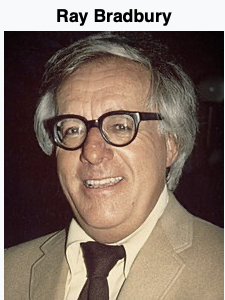
Ray Douglas Bradbury:
(August 22, 1920 – June 5, 2012).
American author and screenwriter. One of the most celebrated 20th-century American writers, he worked in a variety of genres, including fantasy, science fiction, horror, mystery, and realistic fiction.
Bradbury is best known for his novel Fahrenheit 451 (1953) and his short-story collections The Martian Chronicles (1950), The Illustrated Man (1951), and The October Country (1955).[Other notable works include the coming of age novel Dandelion Wine (1957), the dark fantasy Something Wicked This Way Comes (1962) and the fictionalized memoir Green Shadows, White Whale (1992). He also wrote and consulted on screenplays and television scripts, including Moby Dick and It Came from Outer Space. Many of his works were adapted into television and film productions as well as comic books. Bradbury also wrote poetry which has been published in several collections, such as They Have Not Seen the Stars (2001).
First of all, it was October – a rare month for boys.

In that story’s context, ‘October is unusual’—not for everyone, but specifically ‘for “boys.”’
– Implied meaning:
It likely refers to a ’time when something about boys changes’ (e.g., school schedule, the mood/season, risk, social rules, or a particular kind of event).
– The phrasing “rare month” suggests the author is setting up a ‘plot expectation’:
October is different and something significant is about to happen.
📌 Origin:
This exact sentence is ‘commonly quoted from Ray Bradbury’, and it is widely attributed to him.
Author: Ray Bradbury ✅
– Work: It is most often associated with Bradbury’s ‘short story “The October Game.”’ (Some editions/quotes circulate without the story title, which is why people may quote it as a standalone line.)
✍️ Author:
Ray Bradbury is the commonly credited author.
You laugh, you dance around, you shout, but not long after, the sun goes out. Snow falls, but no one sees it, on an August noon.
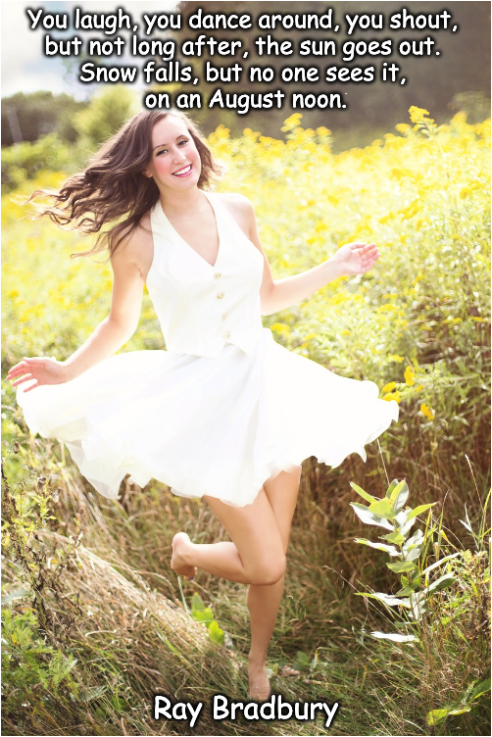
The passage compresses an entire human life cycle into one summer afternoon. It opens with the euphoric shock of self-awareness — “Explosion! Concussion! Illumination! Delight!” — the moment a person (in the novel, a child) truly realizes ‘I am alive’. That realization brings pure, unselfconscious vitality:
laughing, dancing, shouting.
Then comes the turn:
“the sun goes out.”
This is a metaphor for mortality — the inevitable fading of that first ecstatic aliveness, whether through aging, loss, or simply time passing.
The final image is the strangest and most powerful:
“snow falls, but no one sees it, on an August noon.”
Snow in the middle of summer is a paradox — winter (death, ending) is already present even at the height of summer’s warmth and light, but it falls unseen because we’re too absorbed in living to notice. The suggestion is that decline and mortality are always quietly underway, even in our most vibrant moments — we simply don’t perceive them until later.
Origin:
The line comes from Ray Bradbury’s 1957 novel “Dandelion Wine”, a semi-autobiographical, lyrical book about twelve-year-old Douglas Spaulding’s summer of 1928 in the fictional Green Town, Illinois — modeled on Bradbury’s own childhood hometown of Waukegan, Illinois. The novel uses a single summer as an extended metaphor for a full human life:
birth (the season’s start), vivid living (high summer), and the quiet approach of mortality (the fading toward autumn).
Author:
Ray Bradbury (1920–2012), the American author best known for “Fahrenheit 451” and “The Martian Chronicles”. “Dandelion Wine” is considered one of his most personal and poetic works, prized for exactly this kind of sensory, emotionally charged prose about childhood, memory, and the passage of time.
I don’t think the robots are taking over. I think the men who play with toys have taken over. And if we don’t take the toys out of their hands, we’re fools.