(Tokyo, Japan, 11 November 1882 – Rome, Italy, 6 February 1965).
English writer, born in Tokyo. She was both an author of children’s literature and a Japanese folklorist. Her Japanese Fairy Tales (1910) collected and retold stories from the Japanese folk tradition. It was illustrated by Warwick Goble.
No image available
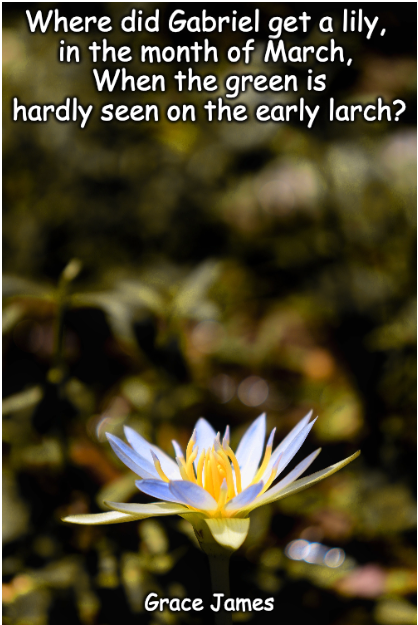
Where did Gabriel get a lily, in the month of March, when the green is hardly seen on the early larch?
Photo: Gowtham AGM. Meaning 🌸: This saying refers to the Annunciation, the moment when the Archangel Gabriel appeared to Mary to tell her that she would be the mother of Jesus. Traditionally, Gabriel is often depicted with a lily, which symbolizes purity and virginity. The question, “Where did Gabriel get a lily, in the month of March, when the green is barely visible on the early larch?” conjures up an image of: The time of year: March is early spring. Depending on the region, nature is still awakening, and blooming lilies would be unusual. It emphasizes the miraculous or supernatural nature of the event. Gabriel did not need an earthly flower; his lily was a heavenly symbol. Artistic license/symbolism: In art and literature, symbols are often used without strict adherence to the reality of time and place. The lily is more important here as a symbol than as a botanically correct element in March. 📜 Origin and Author: The line you mention, “Where did Gabriel fetch a lily, in the month of March, when the green is scarcely seen on the early larch?”, is from the poem “Our Lady’s Lullaby” (also known as “The Little Christ-Child”) by Grace James. Grace James: Grace James (1870–1960) was a British writer and poet, best known for her children’s books and collections of fairy tales and legends. Her works include “Green Willow and Other Japanese Fairy Tales”. The Poem “Our Lady’s Lullaby”: This poem is a carol or lullaby, but the specific line you reference is about the Annunciation that precedes the birth of Christ. The poem explores the simplicity and miracles surrounding the birth of Jesus from the perspective of Mary. The line poetically emphasizes the mystery and divine providence surrounding the events surrounding Christ’s birth, including the preceding Annunciation.
Door Pieter
Mensenmens, zoon, echtgenoot, vader, opa.
Spiritueel, echter niet religieus.
Ik hou van golf, wandelen, lezen en de natuur in veel opzichten.
Onderzoeker, nieuwsgierig, geen fan van de mainstream media (MSM).