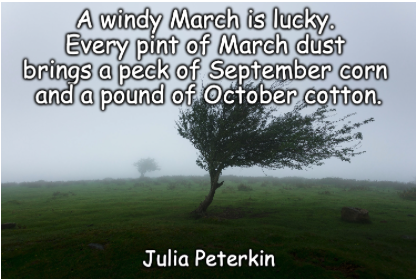
A windy March is lucky. Every pint of March dust brings a peck of September corn and a pound of October cotton.
Photo: Khamkeo Vilaysing. Meaning 🌬️: This weather proverb is based on the traditional belief that the weather in March affects the harvest later in the year. “A windy March brings good luck.” This part suggests that a windy March is auspicious, likely because wind helps dry the soil, disperse seeds, and prevent certain fungal diseases, all of which are beneficial for crop growth. “Every pint of March dust brings a head of September corn and a pound of October cotton.” This is a more detailed elaboration of the “good luck” from the first part. March dust: This likely refers to the dry soil caused by the wind, which stirs up dust. The idea is that these dry and dusty conditions in March lead to a good harvest. Head of September corn: A good harvest of corn in September. Pound of October cotton: A good harvest of cotton in October. In short, the proverb predicts that a dry and windy March will result in an abundant harvest of agricultural products such as corn and cotton. 🌍 Origin: Weather proverbs like this one often have a long history, arising from the observations of farmers and agriculturalists over the centuries. Agricultural Society: Their origins are deeply rooted in agricultural societies, where the success of the harvest was vital to life and death. People sought to find patterns and correlations between weather conditions and the yield of the land. Folk Wisdom: These are forms of folk wisdom passed down orally and often rhymed or alliterated for ease of memory. Geographic Relevance: The specific mention of corn and cotton suggests a possible Anglo-Saxon or American origin, as these crops were/are prominent there. The English translation may be a direct borrowing of an American proverb, or a English interpretation of a similar saying. ✍️ Author:Julia Peterkin (1880-1961) was an American writer known for her realistic and sympathetic portrayals of the lives of the Gullah people of South Carolina. Not the creator, but the recorder: Although Peterkin is often credited as the “author” of this proverb, it is unlikely that she was its original creator. It is far more likely that she recorded this and similar weather proverbs from the mouths of the people with whom she lived and about. She was an anthropological observer, capturing Gullah folk wisdom and culture in her novels. Literary context: She used such proverbs to give authenticity and depth to her stories and characters, and to illustrate the close connection between the people and the land. The proverb is perfectly suited to the agricultural background of the communities she depicted. Award-winning work: Her novel Scarlet Sister Mary (1928), which described Gullah life, won the Pulitzer Prize for Fiction in 1929. Many such folk sayings are found throughout her work. So, rather than the author in the sense of a coiner, Julia Peterkin was the major figure who documented and immortalized this valuable cultural expression – and many others – in literature, thus preserving them for a wider audience. Anonymous: It is the result of collective observation and tradition, shaped and passed down by generations of farmers and country people. Evolution: The wording may have evolved over time and adapted to local circumstances or cultural contexts. This saying is a beautiful example of how people in the past tried to get a grip on nature, and increase their chances of survival, by ‘reading’ the weather.
Door Pieter
Mensenmens, zoon, echtgenoot, vader, opa.
Spiritueel, echter niet religieus.
Ik hou van golf, wandelen, lezen en de natuur in veel opzichten.
Onderzoeker, nieuwsgierig, geen fan van de mainstream media (MSM).