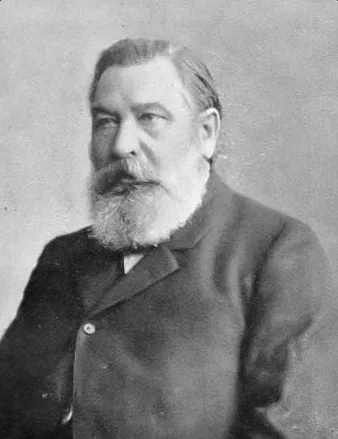
Heinrich von Treitschke:
(1834–1896)
Was a highly influential and controversial German historian and political thinker who served as the official historian of the German Empire. He is best known for his ardent support of ‘German unification’ under Prussian leadership and his vocal advocacy for ‘nationalism, militarism, and imperialism’.
His most enduring and damaging legacy is his promotion of intense ‘antisemitism’. In his famous phrase, “The Jews are our misfortune” (“Die Juden sind unser Unglück”), he articulated a nationalist view that Jews could never truly be German, regardless of their citizenship or assimilation. This rhetoric helped normalize antisemitism in German political discourse and laid ideological groundwork for later extremist movements.
Treitschke held a prestigious chair in history at the University of Berlin and was a member of the Prussian House of Lords. His multi-volume ‘History of Germany in the Nineteenth Century’ was widely read and shaped public opinion, though modern historians criticize its bias, glorification of power, and exclusionary nationalism.
Equality is a meaningless concept; it can just as well mean equal slavery for all as equal freedom for all.
Freedom means nothing other than being free from irrational coercion.
The statement defines freedom in a ‘negative’ way:
not as something one possesses, but as the absence of irrational coercion. The keyword is ‘vernunftswidrig’ — contrary to reason. This means that ‘not all restrictions are unfreedom’, only those without rational justification.
This fits within Treitschke’s conservative-liberal theory of the state: the strong state may indeed bind citizens to rules, but this does not infringe upon freedom as long as those rules are legitimized by reason. Elsewhere he wrote:
“An excess of freedom becomes slavery — for if there is no longer any authority, the strongest rules, and the weak fall prey to the right of the fist.”
Together, both statements form a coherent vision:
freedom requires boundaries, but those boundaries must be rational.
Author:
Heinrich von Treitschke (1834–1896), German historian and political publicist in the Bismarck era. A fervent defender of the Prussian state idea and German unification, but also known for his antisemitism. Even during his lifetime, he was a controversial figure — a mirror of the conflicts in the German Empire, with his nationalism, belief in progress, and fears.
Origin:
The original in German reads:
“Freiheit heißt nichts anderes, als das Freisein von vernunftswidrigem Zwange.”
One of Treitschke’s most important essays was titled “Freiheit” (“Freedom”), which fits the theme of this quote.
