Friedrich Wilhelm Nietzsche:
(Röcken, 15 October 1844 – Weimar, 25 August 1900)
German philosopher, cultural critic, composer, poet and philologist considered one of the most influential modern thinkers.
Perhaps no one has yet been truthful enough about what ‘truthfulness” is.
The antithesis is the narrow gate through which error prefers to sneak into the truth.
No price is too high to pay for the privilege of owning yourself.
No small art is it to sleep: it is necessary for that purpose to keep awake all day.
A woman may very well form a friendship with a man, but for this to endure, it must be assisted by a little physical antipathy.
What? A great man? I always see only the actor of his own ideal.

In every real man, a child is hidden that wants to play.
In music the passions enjoy themselves.
Those who dance are considered insane by those who cannot hear the music.
Live your life in such a way that you must wish to live it again.
The higher we soar the smaller we appear to those who cannot fly.
Either one does not dream, or one does so interestingly. One should learn to spend one’s waking life in the same way: not at all, or interestingly.
People demand freedom only when they have no power.
Convictions are more dangerous enemies of truth than lies.
Suppose the truth is a woman — then what?
Sometimes people don’t want to hear the truth because they don’t want their illusions destroyed.
Freedom I love, and a breeze over a fresh soil. And I would rather sleep on ox-skins than on their honours and respectabilities.
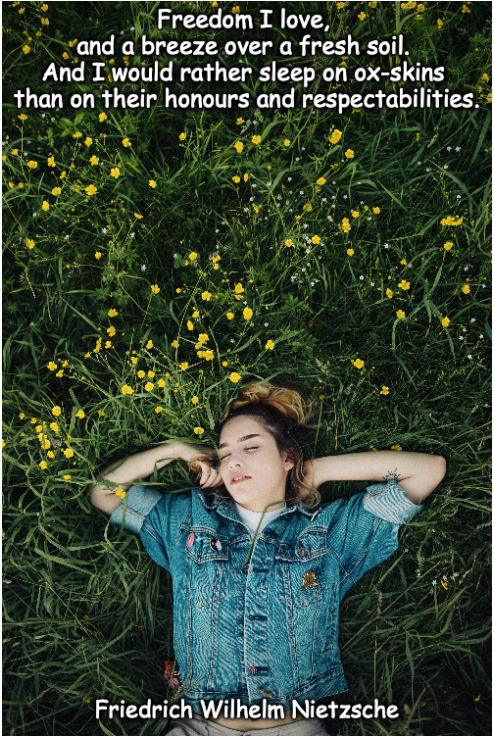
Nietzsche/Zarathustra essentially says:
> I prefer freedom, nature, independence, and a simple, perhaps uncomfortable life—instead of relying on social titles, academic honors, bourgeois recognition, or “respectability.”
Individual images explained:
– “I love freedom”
→ Rejection of intellectual, social, or institutional dependence.
– “The air above fresh earth”
→ Image of nature, originality, vastness, vitality, immediate life.
– “Sleeping on ox hides”
→ A rough, simple, uncomfortable life; almost archaic or nomadic.
– “Their dignities and honors”
→ Social honors, titles, academic positions, bourgeois prestige, outward respect.
🎯 Meaningful Interpretation:
The sentence roughly translates to:
> I would rather live freely, simply, and uncomfortably than comfortably at the expense of my intellectual independence and under the pressure of social recognition.
Or more concisely:
> Freedom is more valuable than prestige.
📜 Correct Wording:
> “I love freedom and the air above fresh earth; I would rather sleep on ox hides than on their dignity and honors.”*
👤 Author:
– Friedrich Nietzsche
– Work: “Thus Spoke Zarathustra. A Book for All and None”
– Part: “Second Part”
– Chapter/Speech: “On Scholars”
– Origin/Publication: 1880s, the second part was published in 1883.
📚 Context in Nietzsche:
The section “On Scholars” is a critique of certain types of scholars, academics, or intellectuals. Nietzsche essentially accuses them of:
– being too entrenched in institutions and conventions,
– managing knowledge instead of thinking creatively,
– being content with titles, rank, and recognition,
– becoming intellectually dry, cautious, and detached from life.
The sentence is thus part of Nietzsche’s contrast between:
| Nietzsche/Zarathustra loves | Nietzsche criticizes |
| freedom | conformity |
| creative thinking | mere erudition |
| nature and fresh air | dust of the study |
| simplicity | dignity, titles, respectability |
| independence | social recognition |
🏛️ Is it a proverb? Strictly speaking: ‘No.’
It is:
– not an anonymously transmitted folk saying,
– not a traditional proverb,
– but a ‘Nietzsche quote’.
However, because it is often used in abbreviated form or detached from the work, it can sound proverbial.
🧾 Modern paraphrase:
> I would rather live freely and simply, even if it is inconvenient, than settle for titles, honors, and social respectability.
Or even more freely:
> Better to be uncomfortably free than respected and unfree.
When one has much to put into them, a day has a hundred pockets.
You have no idea what a charming memory you are to me.
Note that autumn is more the season of the soul than of nature.
Er bestaat kameraadschap, moge het tot vriendschap komen!

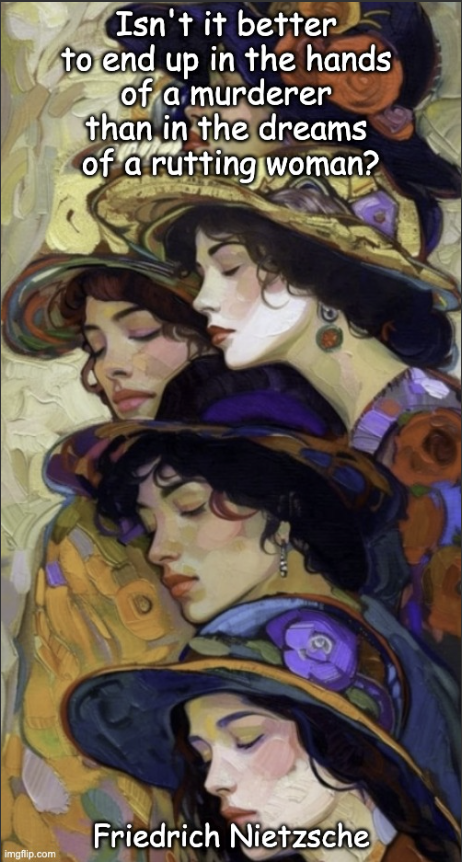
Isn’t it better to end up in the hands of a murderer than in the dreams of a rutting woman?
The desire for freedom, the instinct for the refined happiness of the sense of freedom, necessarily belongs to the slave morality and moral behaviour of slaves, while an artful, spirited reverence and devotion are the necessary, fixed symptoms of an aristocratic way of thinking and values.
In woman, a slave and a tyrant have all too long been concealed. For that reason, woman is not yet capable of friendship: she knows only love.
Love is the state in which a person sees things most as they are not.
Belief in truth begins with the doubt of all truths believed so far.
We love being in the great outdoors because it has no opinion about us.
There are no facts only interpretations.
The best friend will probably get the best wife, because a good marriage is based on the talent for friendship.

I look around: there is not a word left of what used to be called ‘truth’, we can no longer stand it when a priest even utters the word ‘truth’.
It is not the lack of love, but the lack of friendship that causes a failed marriage.
No matter how isolated you are and how lonely you feel, if you do your work truly and conscientiously, unknown friends will come and seek you.
The surest way to corrupt a youth is to instruct him to hold in higher esteem those who think alike than those who think differently
True enmity than a friendship that is more chimera than natural.
For some, the heart ages first, and for others, the mind. And some grow old in their youth: but those who are young late stay young long.
It’s easier to get to Mars than to get to yourself.
Man is distinguished above all from the rest of nature by a slippery and gelatinous layer of lies which envelops and protects him.
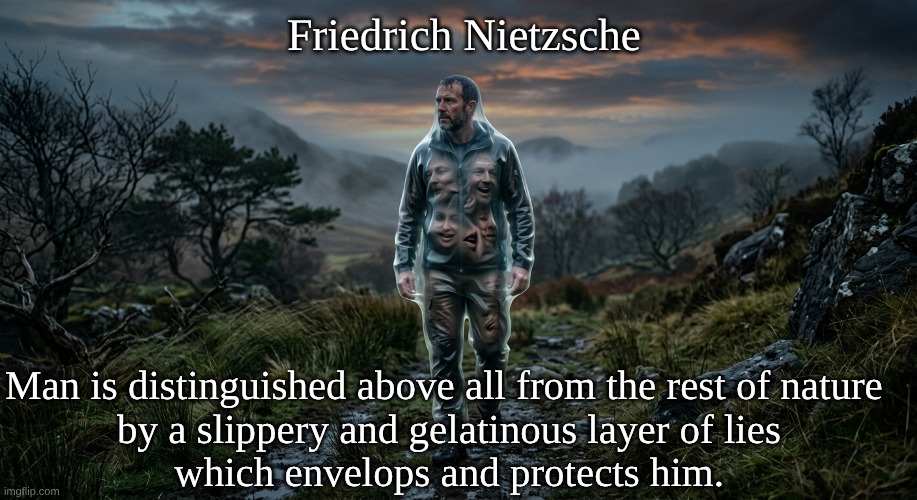
Core Meaning:
By this, Nietzsche implies that human beings are distinguished—not primarily by pure reason or truth—but by their capacity for:
– dissimulation
– self-deception
– deception of others
– social masks
– conventional “truths”
According to him, the human intellect originally serves primarily to facilitate:
– survival
– self-preservation
– adaptation
– social maneuvering
and not, first and foremost, the pursuit of truth.
What constitutes this “layer of lies”?
This expression serves as a ´metaphor´ for the entire web of illusions and social conventions within which human beings exist:
– for humans, lies are not the exception, but often ´the rule´
– people shield themselves using appearances, politeness, flattery, and self-deception
– this layer ´envelops´ the individual: one does not live in direct, unmediated contact with reality
– this layer also ´protects´ the individual: without such illusions, one would be far more vulnerable to the harshness of truth, conflict, anxiety, or existential meaninglessness
Philosophical Point:
Nietzsche provocatively suggests that it is almost enigmatic—indeed, nearly baffling—that any “honest and pure drive toward truth” exists among human beings at all, given how deeply deception is entrenched within the fabric of human life. Moreover, he does not describe “truth” itself as something absolute, but often as:
– a ‘human agreement’
– a ‘convention’
– a ‘solid metaphor’
– a form of ‘lying according to a common rule’
📚 Origin: The origin lies in Friedrich Nietzsche’s essay:
– “Other health and happiness in the moral sense”.
Dating
– written in 1873
– only published posthumously in 1896.
Relevant German passage:
The paraphrase refers mainly to this passage:
> “Im people come with this Verstellungskunst auf ihren Gipfel: here is the Täuschung, the Schmeicheln, Lügen and Trügen […] so that the Rules and the Gesetz, that is fast not unbegreiflicher, as who under the Menschen a more human and reiner Trieb zur Wahrheit come konnte.”
Meaning of the passage:
In it, Nietzsche states that in human beings, the “art of dissimulation” reaches its zenith:
– deception
– flattery
– falsehood
– fraud
are, in his view, so thoroughly the “rule and law” of human social interaction that it is almost incomprehensible how a genuine drive for truth could ever have emerged.
Significance of the essay:
This essay is considered a “key text” in Nietzsche’s thought, as it is here that he develops important themes such as:
– truth as a “construction”
– language as a network of “metaphors”
– the intellect as an instrument of “survival”
– the fundamental role of “semblance and fiction” in human existence
👤 Author: Friedrich Nietzsche — and not Hermann Hesse, as is sometimes suggested.
Important nuance:
